Beer, Sunflower Seeds & Golden Star Balm: Four Vietnamese Experimental Performances In New York
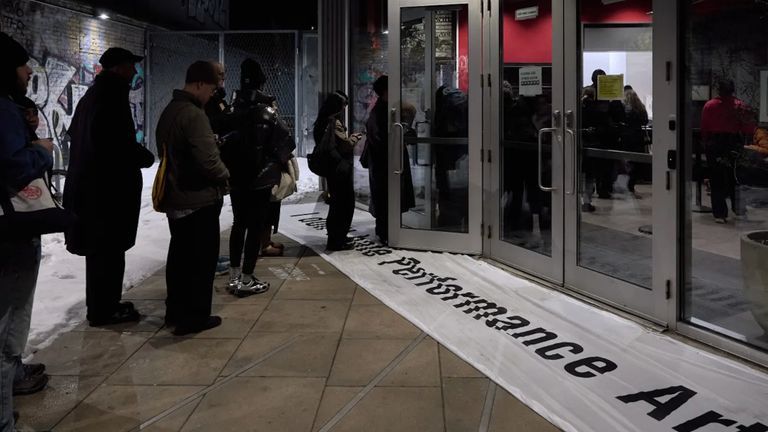
“I don’t hate performance art”, read the banner on the ground outside PSNY on the show night. | Photo by Queenie Si for Performance Space New York
In late January 2026, four Vietnamese performance artists arrived in New York City for a residency at Performance Space New York (PSNY): Nhi Lê, Lại Diệu Hà, Vũ Đức Toàn and Đoàn Thanh Toàn. The residency project was co-organized by performance artists Anh Vo, maura nguyễn donohue and curator Lumi Tan.
Titled We Exist, the residency was originally a project acknowledging the 50th anniversary to the end of the US war in Vietnam, then ended up recontextualizing the commemoration into the present through contemporary Vietnamese performance art scene. The artists-in-residence received the technical and curatorial support, and above all, the space and time to experiment in a New York venue known for embracing risks and the unknown; this public showcase was its fruition.
Beyond experimentation within unfamiliarity, all four performances carried the urge to embrace how the self is always incomprehensible and incomplete. Exploring an existential condition within a society constantly wrestling with a history that haunts, and a future that is always a step premature, the performances felt both universal and distinctively Vietnamese, and urgently contemporary. Coming from a fellow born-and-raised Vietnamese, this piece humbly aims to document and express appreciation to the artists who are constantly reshaping how we may perceive ourselves. The analysis that follows centers on the performances’ exploration of the opaque and fragmented self.
“I don’t hate performance art,” read the banner on the ground outside PSNY on the show night. It was a humble admittance outside one of the most important sites for avant-garde performance art in New York since the 70s. The banner, by Nhi Lê, was previously hung in Hanoi, outside Vietnam Art Collection in 2024. Its original intention of using ambivalence to provoke Hanoian passers-by to reconsider their relationship to performance art still held true in New York. Outside the doors to this long-time home for performances, the status of the craft felt precarious; the country got increasingly intolerant of any self-expressions deemed deviant, the art world growing more insular, and experimental arts more a luxury. The banner, simultaneously, felt reassuring and sympathetic to any questions that may arise from the show.
Through the hallway, encountering fellow Vietnamese in our small community and other New York-based artist friends, we entered the Keith Haring Theatre to find seatings around a white paper circle. In the first performance, Nhi’s Cải thảo thịt bằm (Napa cabbage minced meat), Nhi sat on her knees atop the circle, next to a pair of metal scissors and a glass bowl of water. Projected behind her, a poem about the namesake dish that read less like a recipe, and more a choreographic text about laying down.
The screen went dark. Nhi laid down flat. She started slitting through the paper with scissors, tracing the shape of her body. She then cut off the slit into a figure. The scissors sounded crisp. Once finished, she lifted it up. The cutout looked like it was peeling off from her shadow. She started tearing. She held the final piece of paper to her face, then with it she dove into the water. Face still submerged, she stripped off her top entirely into the bowl. As she slowly rose to her knees, music swelled. Her naked upper body fully bathed in the stage light. She raised her arm, her fingers ushering each musical tone into being. She looked up. The song ended, lights out. “Mộng này nhẹ tênh” - a gentle, feathery revelry, parting words floated in pitch-black darkness.
Nhi’s performance reminded me of Maya Deren’s Meshes of the Afternoon. At every near-identical recurrence of a main event, Deren’s character felt her sense of reality eroded, her self breaking down into imperfect copies. Nhi also severed herself, figuratively and literally. All at once, we encountered Nhi in her physical body, her shadow, her paper cutout, and the mold on the floor in its shape. Time was utilized by both Deren and Nhi Lê less linearly, and more a tool for interior depth. Almost like a glitch, or a recurring dream, each moment in Nhi's performance seemed multiplied, inhabited by a different version of her. Every moment felt like a poetic gesture, to be attentively examined. As we awaited each actions' completion, we had the space to desire our own self-severance, to ponder about what we carry, and what we shed.
In the second half, Nhi emerged almost angelic and self-assured. Her presence felt so much more dense, contrasting with the way she quietly contorted into her shadow before. I thought about Nhi's sharing in a previous conversation. She said during performances, her body became a vehicle and sometimes, an alien. Nhi made me wonder if our bodily vessels could ever contain all the selves we come to be throughout our lives. Nhi’s body-in-performance lent an image to our desire for self-understanding, accessing the “self” like it is a separate entity. Engulfed in the fantastical, reflective space of the performance, I felt my separate self holding a weight - it is our interconnectedness with the surrounding world, accumulated over the duration of human life. The feathery dream at the end of Nhi’s poem dissolved this weight of existential pondering, and the self re-enters the physical body, this time a little less familiar than before.
The audience were instructed to shift into a different seating arrangement, and so began Đoàn Thanh Toàn’s performance, The First Ahhh!. He cracked open a beer and started slurping, standing posed. His stance loosened with every sip. He squashed the empty beer can, placed it on his arm. Biting into a lemon, he stuck his tongue out. He started producing sharply intonated yet muddled, slurring sounds, to a tight rhythm from his steps. We could make out “Do you want it, how bad do you want it” from his tongue-tight speech, but little else. Toàn's body glided waltz-like through the audience. After a while, he started indulging in a full monologue, gesturing animatedly to the audience. Onto another beer, his invitations got more direct and forceful. He started pouring beer into the audience's mouths. His voice grew more demanding. Should one close their eyes, Toan’s “speech”, exaggerated by a live vocal effect, felt almost muffled. Words were trapped in, as if pulsating underneath a thin veil. Toàn resumed stomping on-stage. His voice and his breathiness felt almost estranged from an unknown place. A loud clang in the dark cartoonishly completed the performance.
Toàn’s performance, The First Ahhh! wavered between calculated choreographic motifs and drunken weightlessness. The beer cans balancing on his arm kept him in a tight frame, rendering the rest of the performance nearly deceptive. Was it a performance, read, feigning, of drunken looseness? Toan’s character mildly resembled that of young women paid to participate in “nhau” - casual drinking in Vietnamese metropolitans. Their job is to socialize and drink so others feel compelled to drink more. It is a widely commodified expression of sensuality and scripted intimacy. In Toan's performance, he toyed with suggestiveness and ambiguity, with fantastical, uncanny eroticism. We were almost able to understand him, or to have beer poured into our mouths, or to participate in intoxication, or to be his “you”. In forbidding sounds to morph into words, the “almost” makes the audience feel undone. Toan’s voice was impossible to trace, and we yearned to understand it as much as to be its subject.
In Vũ Đức Toàn’s work, Cigarette Ashes in the Neilma Theater, objects, characters and stories existed in symbiosis. The prop list goes: yellow balloons, sunflower seeds, a glass of water, cigarette butts, a box of candy from a New York subway vendor, metallic thermal blankets, one covering a microwave, a glass of water, and cigarette butts. They referenced spaces and times beyond this physical theater. In the background loomed the 1989 event of Tiananmen square, evoked as a personal event that spared no respite for those living and remembering it. Toan’s set-up and script read like a fragmented installation. His speech, however, felt direct, unembellished, and genuine, devoid of any urge to make monuments or abstraction out of tragedies. Instead, it was filled with an appreciation for everyday life – the raw material and the habitat for artistic creation. Out of the four performances, Vũ Đức Toàn’s felt the most relational and grounded. While coherent in chunks, altogether it highlighted the absurdity inherent in the experience of History, beyond an individual’s comprehension. What is heralded as our most commonplace understanding of shared reality is usually not set-in-stone, but dynamic, always simmering to be evoked and provoked.
Ai Weiwei’s Sunflower Seeds was only mentioned by semblance. A character in Toan’s tale. working as a janitor in an exhibition of 100 million ceramic sunflower seeds, chipped her tooth biting into one, and left a real seed in its place. Ai’s piece became a site to investigate symbolism and reality. Toan did not seek to re-activate any grand truths. Instead, he explored their fringes - the accidents that betray their steadfastness. Accidents are genuine and irreplicable. Toan seemed to be rejecting a kind of sanctity that well-known interpretations of history may carry. Part critique of sterile symbolism, part attempting to breathe some life back into a tamed, orderly art object, Toàn’s performance favored what is real, minute and hearsay.
In Lại Diệu Hà’s performance, three large projections encircled the stage: documentations of Ha's previous performances, and an instructional ‘documentary’ about psychotherapy at the back. Throughout the performance, the documentary played on, like an omnipresent ‘expert’. Hà greeted the audience and said she was the “star”. She ran a few laps around the stage with a whistle in her mouth. She then had her blood drawn by a professional for a full minute, her counting growing shakier by the second. She had some volunteers dip into her blood, and spread them out on a cotton cloth. I could only see now that her blood was drawn into a shallow plate. In the plate, there were some tins of Golden Star Balm (Cao Sao Vàng). Simultaneously, she printed blood on her forehead with her thumb, like a marking. She ran a few more laps, this time holding a Balm tin in her mouth. She ended up amongst the audience, pulled out some soap bubble wands and distributed them. She invited us to join her in blowing bubbles. After the stage was filled with joyful audience members and bubbles, she returned to the audience seat, and watched.
The drawing of blood matched Ha's signature performances of endurance. However, the moment when Ha marked her forehead felt surprisingly still, like a sacrificial ritual. Floating Golden Star Balm tins in a pool of fresh blood was a combination of cruel futility: the Balm is never meant to heal bloodied wounds, but merely offers a surface sensation of relief. Yet, the tension between the quotidian, industrially-produced Vietnamese Balm, and real blood, reminded me of how blood is the center of so many well-worn idioms we utter whenever our history is told. The abrupt transformation of the stage as a space of bloodshed, into an archetype of lightheartedness, like bubbles, was jarring. But then, the stage was not meant to be so sacred in the first place. I thought of Hà’s title: “A total Performance score - Chapter 9: “Humble Efforts”. I personally took that as a re-evaluation of what an artist gives and takes. There is always an imbalance, a sense of debt from either side, artist and audience. The artist gives their body, the audience watches and cheers. The audience surrenders their time and their beliefs, so the artist may command control. Beyond this stage, human relationships are filled with these self-sacrifices; for pain, catharsis or anything in-between, we are bound by relations of devotion.
Performance Space NY started out as a self-organized space built by and for experimental, risk-taking artists, and has nurtured generations of them for 40 years. Fittingly, We Exist indicated a hunger for new experimentation on the Vietnamese identity. We Exist affirmed an impulse for narrating Vietnamese contemporary life. In the past 50 years, Vietnamese reality has undeniably been marked by an all-encompassing process of retracing our place in history, while tending to the pace in which we are heading towards our desired future. These forces are never frictionless. The four artists chose to hold onto their interior richness and uncertainty. What resulted is a complex record of our contemporary state of being, where we may live outside of ourselves temporarily, lose ourselves in primal intoxication, struggle to make sense of our historical trajectory, or push the boundaries of our devotion. History is like a fluid that seeps into any attempt at self-awareness and self-imagination. Performance, immediate in nature, is specifically apt to catch up with history’s imprinting on the self. But the artists were not embodying the past. With a sensibility blossoming from deep investment into their interior richness, they invited us to co-inhabit ambiguity, between fiction and real-life, between the artist-audience or giver-taker binaries, in the gaps between yourself and others.