Between New York’s Sets and Hanoi’s Ghosts: How Distance Made Director Chí Trần "100% Vietnamese"
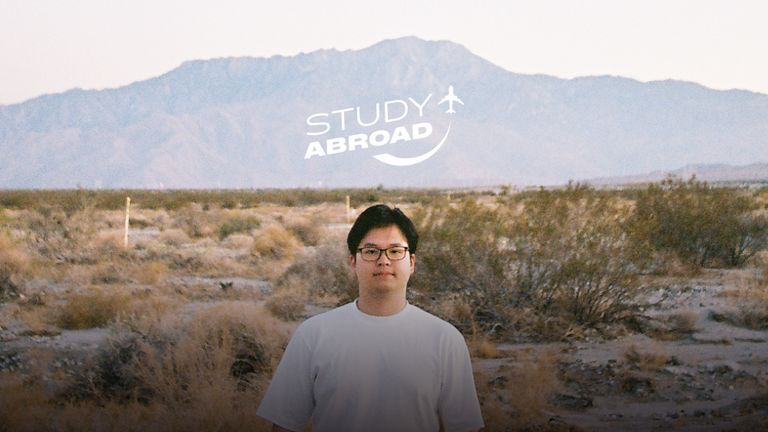
Source: Provided
A digital window on Google Meet connects Saigon to a softly lit apartment in New York City. On the other side of the screen, Chí Trần greets us with a relaxed smile and a simple black T-shirt. To his peers back home in Hanoi, Chí’s life looks like the ultimate study-abroad success story: moving to New York, studying media at NYU Steinhardt, working for Disney+, and directing award-winning short films like Visa.
Yet, beneath the polished professional resume lies a deeper, more fascinating contradiction: the further Chí gets from Vietnam, the more intensely Vietnamese he becomes. Whether he is binging the latest MCK rap album, cooking a steaming pot of phở for his international friends, or drawing film inspiration from traditional Vietnamese funeral rituals, his creative soul remains deeply rooted in Hanoi.
We sat down with Chí via video call to discuss identity, the reality of living abroad, and how the distance taught him to appreciate the steep cultural edge of home.
When you first left Vietnam to pursue film, what were your expectations? And what did success look like to you back then?
It’s funny to look back now, but when I was nine years old, my family visited New York. I wrote a note on Facebook declaring that I was going to attend NYU. Ever since I was four, I knew I wanted to be a director, though I had no idea how to break into the industry. I eventually chose NYU Steinhardt’s Media and Communications program because it was more affordable than Tisch, but my dream of directing never wavered.
Before leaving Hanoi, I had a very black-and-white view of success. I believed that if you worked incredibly hard, did everything your parents set out for you, and made all the right moves, you would automatically get rewarded. I prepared my entire young adulthood for New York, believing it was the ultimate destination.
My preparation actually started early in Vietnam. When I was 12, I enrolled in the TPD Center for Youth Filmmaking in Hanoi. My teacher was Bùi Thạc Chuyên, one of the premier Vietnamese directors working today. I did everything from editing documentaries to composing music. During the pandemic, I landed a film development internship at CJ ENM in Ho Chi Minh City. I would work from 9:00 AM to 6:00 PM, and then attend my NYU online classes from 8:00 PM to 3:00 AM. It was an 18-to-19-hour day, but I loved every second of it.
And what was the reality of New York when you actually landed? What did you find challenging?
When I first arrived, it felt amazing. It was like a fish meeting the ocean. I made friends quickly, and it felt like the place I was always meant to be. But New York is also an incredibly costly city.
My first apartment was a two-bedroom where I lived in the living room with curtains hanging over my space to separate it. I could hear every single person coming in and out, doing everything in the house. I was too embarrassed to ever have friends over because I didn't want them to see how I was living. But I had a view of the city, and it constantly reminded me that no matter what, I was grateful to be there.
I’m really interested in the community you’ve built in New York. Did you seek out Vietnamese circles to remind you of home, or did your friendships mostly form through your work and film circles? Do they feel like a safe space where you can fully be yourself?
That’s a great question, because I’ve always felt like there are two parts of my brain when it comes to that. There’s a part of my brain that hangs out with Vietnamese international students studying at NYU, Columbia, or Pace. And then there’s another part of my brain that hangs out with my film friends and international friends.
Because of that, I’ve always had a bit of a split identity. When I’m with my Vietnamese friends, I’m much more Vietnamese. We talk about cultural nuances, or the impact of the new MCK album, without me having to skip a beat or explain the cultural context of everything. With my international friends, it feels like a different version of me—the version that formed after I turned 18. I find myself wanting to learn more about them than talking about myself, so my brain is constantly shifting gears. It’s a strange sensation, and I'm still learning how to balance it.
You’ve mentioned that living in New York has actually made you love and appreciate Vietnam much more. How did that realization happen?
When I lived in Vietnam, my field of vision was very narrow – it was just the path from my house to my school, and from school to my friends' houses. It was a great childhood, but it was only when I moved to the US and looked back that I realized how incredibly privileged I was. I was able to make films and explore my creative side at a young age, while many other kids had fewer opportunities to explore creative pursuits early on.
Being in New York acted as a mirror. I realized that the cultural edge of Vietnam is much steeper than in the US. In the US, you can easily assimilate and migrate into the culture. But in Vietnam, if you don’t understand the deep, unspoken cultural norms, you can easily lose your footing. Learning to navigate that steep cultural landscape gave me the mental flexibility to go to any country, adapt, and be deeply respectful of their perspective and background. It made me appreciate my family, my parents, and my heritage so much more.
Your most successful film, Visa, became a viral hit. Why do you think that story resonated so deeply, and how has it shaped your next projects?
Visa is a dark comedy about an international student at the end of his work visa who tries to get hate-crimed in order to secure a permanent green card. I had that idea in my head for two years because of the increasingly hostile political climate toward Asian people in the US.
When I was making it, I debated whether to make the character Vietnamese or not, because Vietnamese people are very proud. But I chose to be 100% authentic to my own Vietnamese self. Because I stayed true to that, the film became a viral hit on NextShark, Instagram, and YouTube. I received so many DMs from international students sharing their own heart-wrenching visa stories. It taught me that authenticity is a filmmaker's ultimate superpower.
Right now, I have two films in the pipeline. One is a romantic comedy shot on 16mm about a green-card marriage, commissioned by Migrate Mate. The other is a horror film rooted in a deeply personal Vietnamese tradition. When my grandmother passed away, my family was so caught up in the logistics of the funeral that we barely had time to grieve. It made me think about the traditional ritual of guarding the deceased person's body for one night before the burial. It’s a eerie, atmospheric concept, but it's also my way of communicating with my grandmother and honoring my roots.
On the topic of visas, how hard is it to manage a work visa in such an unpredictable industry? Does it ever feel like an anxiety-inducing part of your daily life?
It’s a very funny question, and obviously a sensitive topic with how unpredictable the immigration system can be. Very recently, I was planning a trip to Europe. I'm currently on a STEM OPT extension because my Media and Communications major counts as a STEM subject. To maintain that status, you must work for an E-Verified company. Just two days before my flight, I discovered that the company’s E-Verify status had been temporarily terminated.
My life was set. I had a contract through next year and thought I was completely secure. Suddenly, I was in a panic, emailing and messaging everyone in HR and my boss. It was a rude awakening. You get hit with these moments that remind you: 'You are still just a visitor in this country'. I do intend to go back home to study and learn more later, but that is the quiet reality of being on a work visa.
Is there a support system you can turn to when that reality feels too heavy or isolating?
Honestly, it’s not that hard. I feel like once you have a job, you have a deep responsibility to yourself, to your parents who paid for your education, and to everyone looking up to you. You have to fight for yourself to stay here, because you’re not just living for yourself; you’re living for them too.
And actually, I miss my parents a lot, and I feel guilty all the time. Recently, my sister moved to Singapore, meaning my parents became empty nesters for the first time. I get incredibly anxious thinking, What are they doing? What if they fall? I feel guilty because I haven't been able to make enough money yet to give them an easy, comfortable life, and they are getting older. But I know I have a responsibility to be here and become the person I'm destined to be.
And I want to be a successful director. To do that I have to hold down a job, have a savings account, and keep health insurance so I don’t have to worry about the basic emergencies of life. When you don't have to stress about the basics, you have the freedom to pursue what you love. So it’s not hard; it’s just that every day brings a new challenge. I just take it in stride and call it a "10% silly tax", you lose a little money or energy, but you keep moving.
Your ultimate goal as a director has evolved. What is "your Vietnam" that you want to put on screen?
I want to make films in Vietnam, about Vietnam, representing a side of our culture that has never been seen before on film. It doesn't have to be a standard coming-of-age drama or a pure commercial comedy. It could be about cooking, food, or the ghosts that lived in my closet when I was little.
The Vietnamese film industry is growing, but it's very fast-paced and financially motivated. Producers often rush screenwriters and jump on whatever genre is lucrative, like horror or comedy. I want to go back and bring a personal, patient, and artistic lens. I want to prove that a Vietnamese filmmaker can tell authentic stories that travel globally.
If all of this—the films, the jobs, the New York life—were to disappear tomorrow, would leaving home and chasing this dream still have been worth it?
Yes, 100%. If everything vanished tomorrow, I would still be incredibly happy with what I’ve done. Had I not left Vietnam for the US, I would not be the person I am today. My films would probably suck because I wouldn't have traveled, made these memories, or experienced these harsh, realistic realizations about how life works. I would have been a very boring person.
When I was 18, I was a very easily overwhelmed person. Now, at 24, New York and this unpredictable industry have taught me radical adaptations. Recently, I was producing a set where we had a major car accident involving seven or eight crew members. Everyone was physically fine, but most of the crew couldn't work for the rest of the day. If I hadn't learned to adapt, the entire production would have fallen apart. Now, you could place me in the middle of a hailstorm and I'd just calmly figure out a way out.
Where do you see yourself in five years?
In five years, I see myself having directed at least one feature film. I want to make a horror film, and I want to shoot a film in Vietnam. But I don’t want to make another “Vietnamese film”. I want to tell my version of Vietnam that I grew up with. It could be about food. It could be about familial ghosts. It could be about my grandmother. Whatever the story is, I want it to feel unmistakably Vietnamese because it’s honest, not because it fits a stereotypical idea of what Vietnam should be.
Ultimately, my goal is to travel freely between Vietnam and the US, making authentic, personal films in Vietnam with Hollywood-level production quality. When my name—"Directed by Trần Dân Chí"—appears on the screen, I want the audience to be entertained, to laugh, cry, or be scared. But more than that, I want to show that Asian creators have earned the right to entertain the world in our own mother tongue, and the industry is finally ready to listen.
This interview has been conducted by Tory Trần and Thanh-Trúc.