Chôl Chnăm Thmây Festival: A Khmer Cultural Imprint In Vietnam
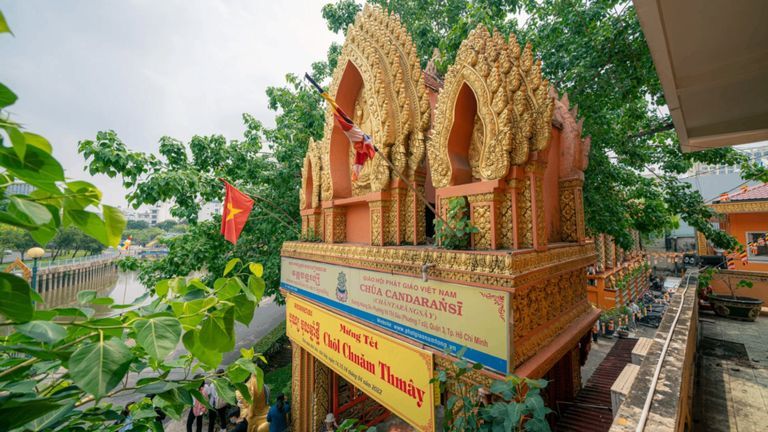
The gate of Chantarangsay Pagoda (Ho Chi Minh City), established in 1946, is deeply rooted in Khmer culture, specifically adhering to the Theravada Buddhist tradition. | Source: Saigoneer
If Thailand splashes into Songkran and Laos welcomes Pi Mai with water and prayer, Vietnam also has its own April New Year, deeply rooted in the rhythms of the Mekong Delta.
From April 14–16, Khmer communities across southern Vietnam celebrate Chôl Chnăm Thmây - a three-day festival which has been passed down through many Khmer generations across ASEAN.
Khmer ethnic group in Vietnam holds over 30% of a Mekong Delta province’s population
Many studies have affirmed that the Khmer people in Vietnam are descendants of immigrants from the Chenla Kingdom, a Khmer civilisation considered to be the predecessor of the Khmer empire at Angkor. They migrated to this area in waves for a variety of reasons. Along with the Vietnamese and the Chinese, the Khmer were among the earliest populations in the Mekong Delta.
Today, Khmer communities are concentrated across Mekong Delta provinces, making up over 30% of the population in Soc Trang, Tra Vinh, Bac Lieu provinces. Khmer culture is deeply rooted in Theravada Buddhism (Phật giáo Nam tông), with over 400 vibrant pagodas acting as focal points for their community life.
The heart of Khmer culture in the Mekong Delta
To understand Chôl Chnăm Thmây, you have to go to south Vietnam where cultural overlaps create exclusive festivals throughout the year. Chôl Chnăm Thmây, celebrated in mid-April, is the Khmer community’s largest annual festival in Vietnam’s Mekong Delta, blending Buddhism with traditional celebrations.
Khmer communities presence in the Mekong Delta traces back centuries, linked to the legacy of Chenla Kingdom, a precursor to the Angkor Empire, today part of ASEAN countries. Long before modern borders were drawn, Khmer communities had already settled, farmed, and built spiritual life along these waterways.
Unlike the lunar-based Tet Nguyen Dan, Chôl Chnăm Thmây follows the solar cycle, marking the end of the dry season and the beginning of a new agricultural year. Its timing reflects deeper historical layers, shaped by ancient Indian cosmology and preserved through Theravada Buddhism, the dominant spiritual system of Khmer communities.
New Year begins at temples and living community spaces
During the festival, these temples transform into gathering grounds where communities return, reconnect, and reset. The celebration unfolds over three days, each carrying distinct meanings:
- Day 1 - Moha Sangkran: Families clean and decorate their homes with flowers and incense to welcome the "New Angel" or deity sent to protect the world for the year. People dress in their finest clothes and bring offerings to local pagodas for a procession ceremony.
- Day 2 - Wanabot: A day of charity and giving. People offer food to monks at the temple and donate to the poor. A key ritual is banking up sand hillocks (sand stupas) at temples, which is believed to wash away sins and bring prosperity.
- Day 3 - Lom Sak: The final day focuses on purification. The Buddha Bathing ceremony (Pithi Srang Preah) involves using scented water to wash Buddha statues. Families also wash the hands and feet of their elders as a sign of respect and to ask for forgiveness.
But the festivals are also celebrated beyond the temple grounds. Across villages, the festival spills into daily life: communal meals, traditional games, music, and dance bring entire communities into motion. It is during these moments that Khmer cultural identity becomes most visible and lived.
Preparations begin days in advance. Families gather, cook traditional dishes like bánh tét, and prepare offerings. For many, this is also a time of reunion, a chance for children and grandchildren to return home after a year of work, reinforcing family ties and cultural memory.
Tradition is keeping alive with modern support
In recent years, local initiatives have helped sustain and amplify these practices. Community events are organized to engage younger generations and reinforce cultural continuity. One example is the Khmer Farmers' Football Tournament, a long-running event that blends modern activity with traditional gathering, turning the festival into both celebration and social glue. With support from the government and authorities, the tournament is organized by the Vietnam Television Center (VTV10, VTV5), making it the largest Khmer farmers' football tournament ever held in the Mekong Delta region.
Journalist Vo Ngoc Van Quan, head of the organizing committee, shared with Tuổi Trẻ news that “Through this tournament, we hope to contribute to spreading the message that sports are not just about competition, but also about the foundation of health, quality of life, and sustainable community development.”
Another example is in An Giang province, local authorities have introduced community-based activities that reframe tradition as something to be practiced, not just observed. In April 2026, the provincial Women’s Union, Department of Ethnic Minorities and Religions, and Labor Union coordinated a competition featuring traditional Khmer cake-making and fruit tray decoration, both essential elements of the New Year’s offering rituals.
Within Khmer communities, Khmer New Year carries the same weight that Tet does elsewhere: a moment of renewal, reunion, and a reminder that Vietnam’s cultural identity is layered by many communities whose stories continue to unfold.