Extreme Travel Or Genuine Danger? The Fine Line On Ha Giang Loop
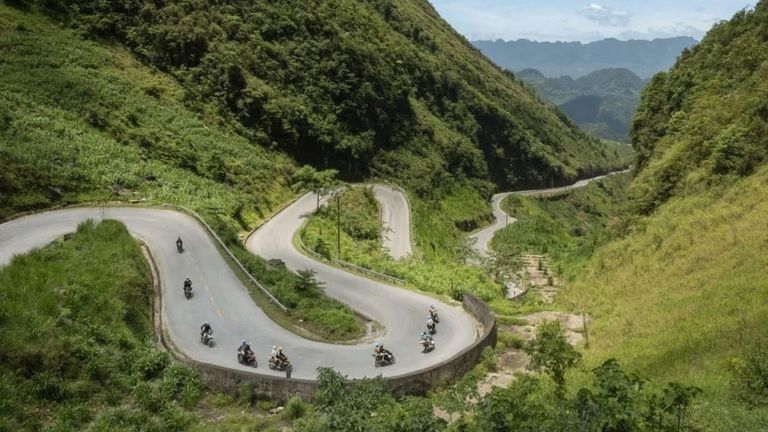
Ha Giang Loop. | Source: VOV
Ha Giang Loop is often told as a once-in-a-lifetime ride: a viral journey through northeastern Vietnam’s mountains, where travellers chase freedom on two wheels and leave with what many call the “best four days” of their lives. But the same route has also been the site of serious crashes that happen “almost daily”, and recently, a fatal accident involving a young British tourist.
The 350-km Ha Giang Loop (now located in Tuyen Quang province) has become a rite of passage for backpackers in Southeast Asia. Widely promoted on social media as a must-do experience, it offers an accessible version of “extreme” travel, with three to four days on motorbikes through remote mountain terrain.
Yet behind that narrative, the Loop sits on a fine line between extreme travel and genuine danger, where risk is embedded in the terrain, softened in the marketing, and rarely measured in any systematic way.
The affordable version of extreme travel
The Ha Giang Loop was originally a network of mountainous roads connecting local communities across the former Ha Giang province, linking lowland areas to the highland districts of Quan Ba, Yen Minh, Dong Van and Meo Vac.
Around 2020, the Loop began gaining traction on social media as a motorbike route through northern Vietnam’s mountains. The high-altitude ride through winding roads and striking limestone landscapes offers a sense of openness and distance that contrasts with more crowded urban destinations.
But it was not until 2023 that the route truly surged in popularity, alongside a wave of tourism investment in homestays, ecolodges and “easy rider” tours. In Nam Dam – a cultural village of the Dao ethnic community – the shift has been palpable, as quiet evenings have increasingly given way to nightly drinking and karaoke.
In early March 2024, the route was ranked among the world’s most impressive road trips by the UK-based tour operator Affordable Luxury Travel, placing 3 out of 14 destinations on its “Top 14 Must-Visit Holiday Destinations in March 2024” list. In 2026, it was again recognised by the UK travel magazine Time Out, in the “51 most beautiful places in the world” list.
However, the route carries significant risks. Steep passes, sharp bends and sections without guardrails make it particularly dangerous for inexperienced riders or in poor weather.
National Geographic has described the Ha Giang Loop as “one of Vietnam’s most dangerous roads”. Yet with four-day tours typically priced between USD $99-150, the experience remains more affordable than formally recognised extreme adventures such as rock climbing or bungee jumping.
Weak oversight creates genuine danger
In early April 2026, a 19-year-old British tourist died in an accident while taking part in an “easy rider” tour on the Ha Giang Loop. The incident drew widespread coverage in both Vietnamese and international media, bringing attention to a side of the Loop that is less often highlighted: the risk.
That side of the Ha Giang Loop had previously been mentioned by National Geographic. According to writer Christina Fang, drivers in the area report seeing crashes, injuries and even deaths “almost daily”.
Beyond the challenging terrain of steep mountains on one side, sheer drops on the other, with narrow roads, sharp bends and stretches lacking guardrails, the current system around motorbike tourism remains loosely regulated and often unsafe.
Some rental operators operate in a grey zone, offering tours under the guise of bike rentals; therefore don’t have contracts, insurance or qualified guides. Some tour operators fail to implement basic safety plans, do not provide insurance or assign qualified guides, and do not comply with regulations governing tour contracts.
At the same time, many young travellers without valid licences or experience riding on mountain roads are able to access motorbikes with relative ease, while local enforcement remains limited and inconsistent.
Across Asia, similar routes point to a common pattern. In Pai in Thailand, Bali in Indonesia, and Ladakh in India, motorbike tourism operates in a grey area where rules exist, but enforcement is uneven.
In Pai, rental shops routinely hand over scooters with little verification of licences, while inexperienced riders navigate winding mountain roads with minimal protection. In Bali, laws require proper licences and safety gear, yet tourists often rent from informal vendors and ride in dense traffic without meeting those standards. In Ladakh, restrictions on rental vehicles are widely bypassed, with riders taking on high-altitude routes despite limited experience or preparation.
The result is a familiar model: low-cost, easy access to high-risk experiences, but regulation lags behind demand, and safety is inconsistent.
Tighten oversight on the Ha Giang Loop
In the wake of the fatal accident, the Tuyên Quang Department of Culture, Sports and Tourism has stepped up inspections, signalling a broader push to bring tighter control to the rapidly growing motorbike tourism sector.
The new measures place responsibility squarely on tour operators. Companies are required to adhere strictly to contract terms, implement route-specific safety plans, and ensure that only licensed guides accompany travellers throughout the journey. Rental providers, meanwhile, are barred from informally organising tours and must only supply vehicles and drivers that meet legal standards.
Inspections have been intensified since early 2026, focusing particularly on motorbike tours in mountainous areas, with targeted checks on suspected illegal operations expected to continue through April.
The move comes as the Loop’s popularity continues to surge. Local authorities say the route drew around 500,000 visitors in 2025, generating 27,000 jobs. Maintaining that growth, officials acknowledge, will depend not just on demand, but on whether safety oversight can keep pace.
The Ha Giang Loop remains a rare kind of travel experience, where the thrill of riding and the pull of dramatic landscapes converge. Yet, safety is important to discuss. As more travellers take to its roads, the issue is no longer whether the journey is worth the risk, but who is expected to bear it.