Four Perspectives on Making Media: Meet Vietcetera’s 2026 Summer Interns
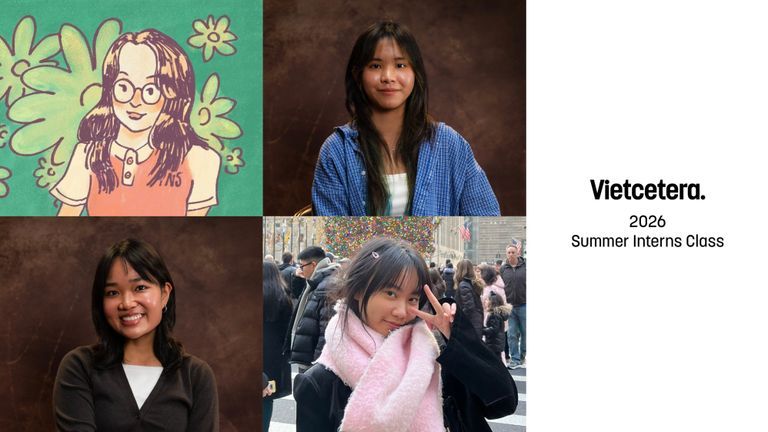
Source: Vietcetera
The 2026 Vietcetera intern class spans different cities, time zones, and disciplines, with interns working remotely from Hanoi and Saigon, Vietnam, to New Jersey, United States. Despite the distance, we share a common goal: bringing Vietnam to the world, and the world to Vietnam.
In this article, our interns reflect on what drew them to Vietcetera, the projects and moments that shaped their experience, and the advice they would pass on to the next class.
Tory Trần: Finding Her Way Back to Vietnam Through Storytelling
Age: 21
Based in: New York and Ho Chi Minh City
Studying at: New York University (NYU)
Position: Marketing Intern
What did you expect your internship at Vietcetera to be like?
My sister worked as an editor at Vietcetera in 2020. She told me it was where she began to love storytelling and journalism, so I arrived hoping to try different kinds of work, collaborate with different teams, and meet people whose paths might never otherwise cross mine. I was excited, but also nervous about speaking Vietnamese at work after spending so much time abroad.
I was heading into my junior year in the US, and I knew I might not have many more chances to spend an entire summer at home. For years, Vietcetera’s stories had helped me follow what was happening in Vietnam from afar. Applying felt like a chance to step outside my phone and get to know the place I’d been reading about.
Was there a project that made you feel you were truly creating a media product?
The Hands Behind Vietnam. It began with a simple wish: to spend my summer learning about the people behind objects and traditions I’d seen all my life but rarely stopped to consider.
Before I could head out to meet artisans, I had to figure out what the series was really about. I revised the pitch deck several times, asking why these stories needed telling and what I wanted people to take away from them. I knew I wanted to photograph hands, but I had to understand what those hands could reveal: the skill behind a familiar object, the years of practice behind an ordinary gesture, and the people keeping a craft alive.
The project took me to Củ Chi, Bình Dương, Đồng Tháp, and workshops around the city. Speaking with artisans brought me closer to crafts I had known only through their finished products. Back at my desk, I had to decide what each photograph revealed, which details a viewer needed, and how the words and images could guide them through the story.
Seeing those choices come together was when I felt I was making a media product. The idea had taken me into the field, changed through what people shared with me, and become something I could offer to an audience curious about Vietnamese culture.
What have you learned about audiences that you hadn't considered before?
Before this internship, I didn't spend much time reading comments. I probably would have seen a critical response as a sign that a post had failed. Now I'm more curious about what people choose to respond to. Sometimes a comment shows that something was unclear. Sometimes it brings an experience to the story that we couldn't have included ourselves.
Engagement alone doesn't tell you whether a post worked. But the conversation beneath it can show you which questions people are still carrying. I've learned that publishing isn't always the end of a story. It's also the moment you find out how people received it.
What would you tell yourself on your first day at Vietcetera?
I'd tell myself: You're going to be trusted with more than you expect, and you don't have to carry all of it alone.
This was the first internship where I got to come up with projects, lead them, and figure out how to work with collaborators across different teams. At times, that responsibility felt overwhelming. I thought that if I was leading something, I should already know how to solve every problem myself.
My manager kept checking in and showed me that asking for help is part of leading well. A conversation could turn something I'd been worrying over alone into a plan we could work through together. So I'd tell my first-day self to speak up when I'm confused, stay excited, and say yes even when I'm still learning how. I didn't need to have the whole route mapped out before taking the first step.
You're studying in the US but chose to intern at a Vietnamese media company. What drew you to Vietcetera?
Vietcetera was already one of the ways I stayed close to Vietnam. I followed its article reshares on Instagram from the US, and they helped me keep up with what was changing at home. I liked finding a story about something familiar, then realizing there was still so much I didn't know about it.
After years of learning about Vietnam through a screen, I wanted to be here for a while. I wanted to go out, speak Vietnamese, meet people, and hear their stories in person.
Is there a Vietcetera story that you think could change how Vietnamese people abroad see their home country?
I hope The Hands Behind Vietnam can offer that experience. When you live abroad, your picture of home can become fixed around the last time you were there. Spending time with artisans made me look again at objects and traditions I might once have passed without thinking. Behind each one were practiced hands, long days, and knowledge someone had taken the time to pass on.
Study Abroad Stories changed my perspective in another way. The people I interviewed spoke about leaving, belonging, and returning in ways that didn't always fit neatly together. Their stories reminded me that you can feel close to Vietnam, distant from it, or both at once, and that all of those feelings deserve room.
Tell us about the projects you worked on at Vietcetera. What stands out from each experience?
TL;DR gave me the chance to host and become more comfortable speaking on camera.
With The Hands Behind Vietnam, I got to take an idea I cared about into the field. Our photographer helped me capture it, and our designer helped turn the images into a series. I'm grateful for what we made together. It taught me how much the order of photos, a few lines of text, and a consistent visual identity can shape the way someone experiences a story.
I wanted hands to be the muse of the series. I'd been inspired by a street photographer who captured hands in ordinary moments, and I began thinking about what hands could reveal about Vietnamese craft: the patience behind a repeated movement, the knowledge passed through a family, and the work that keeps a tradition alive. The project took me to Củ Chi, Bình Dương, Đồng Tháp, and workshops around the city. I got to speak with artisans about work I knew little about and might never have encountered on my own. Their hands drew me in, but it was their stories that stayed with me.
I was also responsible for the daily article reshares on Vietcetera International's social media. At first, I thought the task was mostly about making an article shorter. I soon learned how much care goes into deciding what someone should see first: the weight of a title, which details deserve a slide, the words to emphasize, and what a reader can take in before they swipe away.
Because the posts went out every day, I got to practice those choices again and again. I'd never used Adobe Illustrator before, and I spent my first days clicking around, wondering if I'd ever get the hang of it. Eventually, it started to feel familiar. Every round of feedback trained my eye a little more, and I began to see how small edits could make a story much clearer.
Study Abroad Stories taught me to listen for the tensions people might not name right away. As I planned each story, I kept asking myself what would make me, as a reader, want to hear it. I related to so much of what the students shared, the uncertainty, the distance from home, the search for where they belonged, which made leading the project especially meaningful to me. I wanted to give their stories the care I would hope someone would give mine.
At first, interviewing people I'd just met was intimidating. With guidance from our editor, I learned to build questions around an angle, notice when someone was getting close to something important, and give them room to go deeper. I led the conversations, but I never had to learn how to do it alone.
More than any single project, I'll remember the patience of my manager and the marketing team. They never made me feel self-conscious about my Vietnamese, and each person was generous with what they knew. Their feedback helped me raise my standards for my own work. I came in hoping to tell better stories; I'm leaving with a sharper eye, more confidence in asking questions, and a much deeper appreciation for the people who help a story take shape.
Ngô Ngọc Thùy: Learning to See Beyond the Words
Age: 20
Based in: Ho Chi Minh City
Studying at: University of Social Sciences and Humanities, Vietnam National University Ho Chi Minh City
Position: Editorial Interns
What did you expect your internship at Vietcetera to be like?
The work I experienced during my internship wasn't too different from what I'd imagined. I expected to research and write about a range of topics, which was both an opportunity and a challenge because most of my previous writing had focused on social issues. I also expected to attend events and take part in different Editorial team projects. In reality, the team really did take me along to learn and experience all kinds of things.
One thing I hadn't anticipated was getting to participate in an intern project: a small initiative created by interns to contribute to the company and leave our own mark during the internship. It was my first time working on a project intended to create value for a business. I learned a lot about project management while taking part in the process of building the final product.
Was there a task or project that made you realise you were creating a media product?
I think all of them did, whether it was the articles I wrote, the videos I appeared in, or the intern project I worked on. Each was made for a public audience, whether readers, viewers, or users, so every stage required careful preparation and guidance from the team.
I'm especially grateful for how much the team supported me throughout the process. Creating something for a wider audience also pushed me to become more meticulous. I'm naturally a little careless and tend to overlook details, so learning to prepare work for public consumption helped me develop a greater sense of care and precision.
What did you discover about audiences that you hadn't considered before?
Before joining Vietcetera, I underestimated how much audiences still wanted to learn. With AI, endless scrolling, and short-form content becoming increasingly common, I'd assumed people were reading less and that media companies would need to focus more on content that was trendy, quick, and easy to consume.
But through researching and writing articles, I realised there's still a substantial and loyal audience that wants to gain knowledge. People still want to read and understand the world around them. The way we deliver that knowledge simply needs to adapt to how people consume information today.
As a writer, I've come to see the importance of finding, filtering, and communicating valuable information in a way that meets those needs. For me, that's an important part of Vietcetera's role as a publication.
What would you tell yourself on your first day at Vietcetera?
I'd tell myself to enjoy the time here, learn more, connect with more people, and make the most of every opportunity.
Before starting, I thought three months would feel like a long time. Looking back, it went by much faster than I expected. I've done and learned a lot, though some of the plans I had for the internship never came to fruition for various reasons.
If I could start again, I'd encourage myself to make the most of those three months because I might not get the same opportunity twice. After all, as the saying goes, you can never step into the same river twice.
How has studying sociology shaped the way you approach editorial work?
My background in sociology has been very relevant to Editorial. What I've learned at university has shaped the way I observe, think about, and discuss social issues, while helping me develop my writing and critical-reflection skills. I've found these skills particularly useful when researching a topic and deciding how to approach it.
Still, I was only a second-year student when I started the internship, and I knew my writing wasn't yet as assured as that of the more experienced editors on the team. When working on unfamiliar subjects, I often wondered whether I was placing too much emphasis on theory and debate.
Trúc and Vân helped me a great deal during that process. Their feedback on how to approach a topic, structure an article, and restrain the theoretical discussion helped me understand that knowledge needs to be both rigorous and accessible. With their guidance, I gradually broadened my perspective and became more confident in my writing.
What made you realise that editorial work involves more than writing?
Almost every task I worked on during the internship taught me that Editorial is more than writing. It might sound like an obvious answer, but I began to see how each task consists of many different steps. Together, those steps made editorial work feel much more strategic than simply sitting down and putting words on a page.
Before writing begins, the team has to observe the trends and social phenomena people are discussing, while keeping readers at the centre of the process. What are audiences interested in? What are they talking about and how are they behaving on social media? Is a topic relevant to them? And how can we attract attention without turning an article into something superficial?
Once a topic is selected, research and fact-finding require just as much care. A single inaccurate detail can affect how readers understand an issue. Then come the decisions about structure, wording, and pacing, all of which shape the reading experience.
I've come to see Editorial as a process of observing, researching, selecting, and making decisions to create something valuable to readers while meeting the goals of a media business. A good article doesn't begin with the first sentence. It begins with how well you understand the people you're writing for.
You also worked with the A/V and Tech teams on an intern project. Did that change how you think about content?
Working with A/V and Tech on our intern project gave me a completely new experience. Our project, Nhân Vị, was a personality-based game that recommended articles to users based on their personalities, with the aim of improving their content-discovery experience.
Because it wasn't a conventional editorial project, I faced quite a few challenges. I had to seek advice from colleagues and figure out which elements of the content I should prioritise and what else the project needed.
With help from Bảo in HR, Lợi in Development, Gừng in A/V, and Tiên in Tech, we were able to bring the project together. It taught me that when content is part of a product outside the traditional scope of Editorial, the way I approach it has to change. Instead of focusing only on the story itself, I also have to consider the project's broader goals and the experience of the people using it.
Ginger Nguyễn: Finding Her Place in the Bigger Picture
Age: 23
Based in: Hanoi and New York
Studying at: School of Visual Arts (SVA), New York
Position: Audio & Video (A/V) Interns, Illustrator and Graphic Designer
What did you expect your internship at Vietcetera to be like?
Honestly, when I first received my offer letter, I was incredibly excited about all the opportunities ahead of me! I didn't think too much about the specifics. I just told myself I'd use my artistic strengths and whatever insights I had to contribute to projects and be as proactive as possible. I hoped the experience would give me more opportunities to learn in a professional studio environment.
Was there a project that made you feel you were truly creating a media product?
Definitely the 10,000 Hours series! It was the first project where I got to contribute creatively to the set design and thumbnails, as well as actively help out on set.
I had a lot of fun and learned a great deal from my supervisor about working on a film set. I'd previously worked on photoshoots, so this was a very different experience. It was nerve-racking at first, but everyone was so helpful and welcoming, even when they were busy. I'm incredibly grateful to them for that throughout my internship.
What did you learn about audiences that you hadn't considered before?
I became more critical of the projects I work on because I was now creating for a much wider audience. I constantly remind myself to consider whether something fits the target audience and the project's overall art direction.
What would you tell yourself on your first day at Vietcetera?
I'd tell myself to be more open and introduce myself to more people. That way, I could have made more friends even sooner!
You specialise in illustration. How does your approach change when graphics become part of a video rather than a standalone piece?
With illustration, you consider how shapes, composition, and colours can help communicate the meaning you're trying to convey. The same applies to graphic assets in video. The difference is that they now belong to a bigger picture.
In A/V, graphics aren't necessarily what viewers notice most. How do you know when a graphic is doing its job well?
If the graphic assets are clear, follow the art direction, and communicate whatever they need to convey in that moment, then they've done their job.
What do you remember most about seeing Nhân Vị go live on Vietcetera?
It was surreal to see all the team's hard work finally being seen and acknowledged by someone outside the team!
Before the web experience went live, we were all locked in, making the final adjustments before publishing. That feeling of everyone working together towards the same goal made me so giddy! I love being part of a team, and I think that's what I miss most.
What do you remember most fondly about your time at Vietcetera?
Honestly, the little things, like when the team ordered bánh chuối chiên or had cold brew mơ. They might seem ordinary, but those are things I can’t easily find in New York. Looking back, they made working at Vietcetera feel so distinctly Vietnamese. I think I’ll miss those small, everyday moments the most.
Trần Thị Thùy Tiên: Building Better Experiences Behind the Scenes
Age: 21
Based in: Huế, Vietnam
Studying at: University of Information Technology
Position: Backend Interns
What surprised you most about working at Vietcetera?
I expected to focus on my assigned tasks and report my progress in weekly meetings. In reality, we had daily check-ins, afternoon walks, and opportunities to work with people outside the Tech team. One surprise was collaborating with Thùy from Editorial and Linh from A/V on a small cross-functional project.
When did you first feel you were contributing to a media product?
It was during the cross-functional project, when we had to figure out how to keep readers engaged and improve both the content and the interface. Before this, I hadn’t thought much about how these different elements come together to shape a media product.
What did you learn about audiences that you hadn’t considered before?
I used to think audiences would see content the way the team saw it when creating it. I’ve since realized that readers only experience the final product. They don’t see how complicated the systems behind it might be. What matters to them is whether the content feels relevant enough to keep reading.
What would you tell yourself on your first day?
Be more confident about talking to people, and don’t worry too much about not knowing everything yet.
How has your understanding of Tech at a media company changed?
I used to think the Tech team mainly developed new features to attract users. Now I see that its work extends beyond the company website. Tech also builds tools that help colleagues work more efficiently, as well as websites for events and clients.
You’re the only woman on the Tech team. Has that shaped how you approach problems?
I don’t think the way someone approaches a problem necessarily comes from being the only woman on the team. It has more to do with each person’s past experiences. Working with my teammates has helped me learn approaches to problem-solving that I hadn’t considered before.
What was different about collaborating with Editorial and A/V?
Each team brought a different perspective to the same problem. From the Tech side, I focused on optimizing the recommendation system.
Editorial had a stronger understanding of which content would make readers want to keep exploring and what might spark their curiosity on the website. Ginger from A/V brought another perspective, thinking about user experience, visual effects, and ways to personalize the experience. Seeing these approaches come together helped me understand how different kinds of expertise can shape a better product.