From Anime To Rare Earths: 4 Key Takeaways from Vietnam–Japan Talks
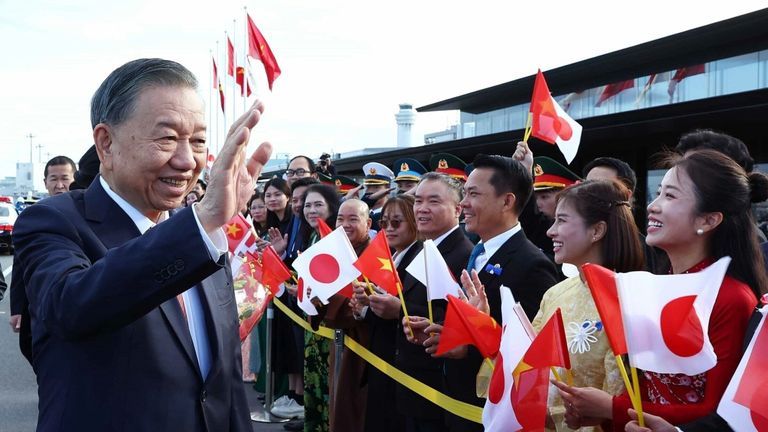
Source: TTXVN
From November 8 to 11, Vietnamese General Secretary and President To Lam paid an official visit to Japan at the invitation of the Japanese state.
Beyond meetings with Japan’s imperial family and senior leaders, the visit brought new cooperation agreements, bilateral talks and joint commitments, opening up further opportunities for collaboration between the two countries.
From anime copyright protection to rare earth development, here are four key takeaways from the visit.
Strengthen Japanese Content’s Copyright Protection
During talks on November 9, Japanese Prime Minister Takaichi Sanae called for stronger action against copyright infringement in Vietnam, particularly against operators of pirate websites distributing Japanese content, including anime.
According to Japan’s Content Overseas Distribution Association (CODA), 74.2% of respondents in Vietnam reported watching pirated audiovisual content. The association’s investigations also found that numerous pirate websites distributing Japanese content were operated from Vietnam.
Vietnam was the only country designated a Priority Foreign Country (PFC) in the Office of the United States Trade Representative’s (USTR) 2026 Special 301 Report, which described it as having the highest incidence of online piracy in the Asia-Pacific region. Since the designation in May 2026, Vietnamese authorities have launched a series of crackdowns on online piracy to strengthen copyright protection online.
In August 2026, Hanoi police, working with CODA, brought criminal charges against three individuals linked to Phim Ne, a website and app that streamed Japanese films and anime without permission. The case marked Vietnam’s first criminal enforcement action against copyright infringement involving Japanese content. Prime Minister Takaichi called for further action to build on that precedent.
Addressing Concern Over Vietnamese Workers In Japan
Nearly 700,000 Vietnamese nationals live in Japan, and a growing share are skilled workers, according to the leaders’ joint statement. Japan was the top destination for Vietnamese overseas workers in the first half of 2026, receiving 28,488 people, mostly in manufacturing, nursing and caregiving.
Meanwhile, the criminal rate among Vietnam nationals in Japan is on the rise. Vietnamese National Assembly member Vu Van Tien said Vietnamese nationals accounted for the largest number of cases and arrests among the foreign nationals covered by Japanese police statistics. At an October 27 parliamentary hearing, Japanese lawmaker Haruo Kitamura suggested screening Vietnamese applicants more strictly or taking their province of origin into account when deciding whether to grant entry.
During their November 9 meeting, the two leaders agreed to begin preliminary talks on mandatory consular notification. Under the proposed arrangement, Japanese authorities would notify Vietnamese consular officials whenever a Vietnamese national is arrested or detained, even if the person does not request it. Vietnam would do the same for Japanese nationals.
Under Vietnam’s Decree 283, which took effect on September 10, Vietnamese workers who intendedly remain abroad unlawfully after their employment or vocational training contracts end can face fines of VND 80 million to VND 100 million. The measure addresses overstaying, an issue Japanese authorities also face among Vietnamese nationals.
New Direct Flight Between Da Nang and Osaka
Vietjet Air announced a new nonstop service between Da Nang and Osaka at the launch of the 2027–2028 Vietnam–Japan Tourism Cooperation Year. The airline plans to operate four round trips a week starting December 20, 2026.
Vietnam and Japan recorded nearly 1.5 million visitor arrivals between them in 2025. The new route aims to bring more Japanese visitors to Vietnam and strengthen ties between local authorities and tourism businesses in both countries.
For Japanese travelers, Da Nang offers beaches, regional cuisine and a gateway to central Vietnam’s cultural heritage sites. In the other direction, Vietnamese visitors can explore Osaka’s food scene and temples. For other travelers, the route makes it easier to combine central Vietnam’s beaches and heritage towns with Japan’s Kansai region in a single trip.
Rare Earth Development
At their November 9 meeting in Tokyo, Vietnamese and Japanese leaders agreed to explore joint projects in critical minerals. Japan’s Foreign Ministry singled out rare earths as a priority. Neither government announced a specific mine or investment at the summit.
Japan is pursuing rare earths at home and abroad as Chinese export controls squeeze supplies of minerals used in high-performance magnets. In February, Japanese researchers recovered rare-earth-rich mud from nearly 6,000 metres below the surface of the Pacific. A larger trial is planned for February 2027. Tokyo is also working with Washington to develop alternative sources of supply.
Vietnam holds an estimated 3.5 million tonnes of rare-earth reserves, according to the U.S. Geological Survey, putting it fifth among countries for which the agency reports figures. Vietnam’s deposits have also drawn European interest. On October 14, ahead of Vietnamese leader To Lam’s visit to Brussels, Reuters reported that EU officials saw Vietnam as a potential supplier of rare earths and tungsten as the bloc sought to reduce its reliance on China.
Vietnam already plays a role in Japan’s supply chain. In 2025, it supplied about 2,265 tonnes, or 27.5% by weight, of Japan’s imports in rare-earth metals, scandium and yttrium. In Hai Phong, Japanese manufacturer Shin-Etsu refines and recycles raw materials and produces finished neodymium magnets at the same plant. The question is whether Vietnam can turn its rare-earth reserves into lasting gains for its own economy.