Hanoi, Ho Chi Minh City Among World's 50 Highest Heat-Risk Cities
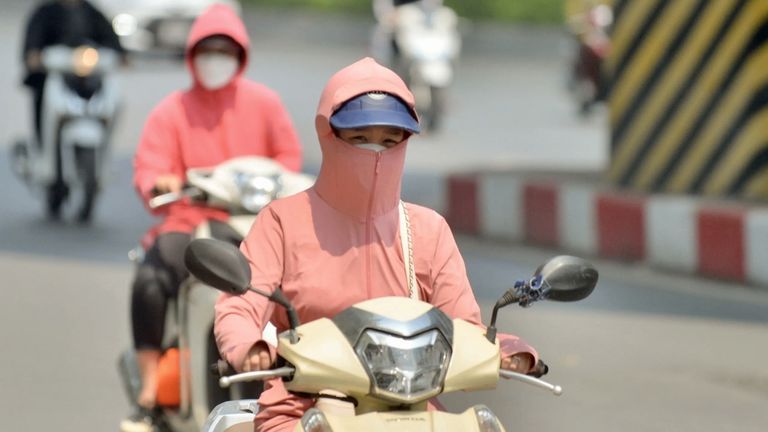
Hanoi and Ho Chi Minh City are among the world's 50 cities facing the highest heat risk. Source: Thanh Nien
A new study by the University of Oxford, published in the journal Sustainable Cities and Society, has found that Hanoi and Ho Chi Minh City are among the world's 50 cities facing the highest heat risk.
According to the ranking, Ho Chi Minh City placed 16th globally, while Hanoi ranked 34th. Ho Chi Minh City was also the second highest heat-risk city in Southeast Asia, behind only Quezon City in the Philippines.
Heat Risk Goes Beyond Temperature
The study argues that heat risk is not only high air temperature. It is measured across three dimensions: hazard exposure, population vulnerability, and coping capacity.
Hazard exposure is measured using the Universal Thermal Climate Index (UTCI), which evaluates how outdoor weather conditions affect the human body. Population vulnerability considers demographic characteristics and economic capacity, reflecting how susceptible groups such as children and older adults are to extreme heat. Coping capacity is assessed through indicators including vegetation cover and electricity affordability, which influence a city's ability to mitigate and respond to heat stress.
Taken together, these indicators suggest that a city's heat risk is shaped not only by climate but also by the quality of its urban infrastructure, socioeconomic conditions, and its capacity to protect vulnerable populations.
As a result, some cities including Kuala Lumpur, Bangkok, and Jeddah, rank lower in overall heat risk despite experiencing high levels of heat exposure, thanks to their stronger coping capacity.
On the other hand, more than 95% of cities in the highest-risk category are in South and Southeast Asia, as well as Sub-Saharan Africa. Vietnam’s highest-ranked city is Ho Chi Minh City, ranked 16th globally with the hazard score of 1.00. Hanoi ranks 34th, with a hazard score of 0.75.
More Than The Environmental Issue
This is not the first study to warn about heat risks in Vietnam's largest cities. Previous research has highlighted rising heat hazards and limited adaptive capacity in both Hanoi and Ho Chi Minh City.
A 2025 study found that more than half of Ho Chi Minh City's wards and communes (158 out of 318) recorded a Heat Vulnerability Index (HVI) above 60%. Most were located in densely built urban areas, where concrete surfaces, high building density and limited green space intensify heat exposure.
The study also found that rural areas are not less vulnerable than cities. Some communes recorded high HVI scores despite lower surface temperatures because of weaker healthcare systems, poorer infrastructure and lower adaptive capacity. Rural communes such as Pham Van Coi, Cu Chi and Hoa Phu were among those identified as highly vulnerable.
Outdoor workers are among the first to feel the impact. Informal workers, street vendors and construction workers spend long hours under direct sunlight and often cannot afford to stop working during heatwaves.
A 2026 UNDP survey of 734 outdoor workers found that 94% had experienced heat-related health problems. About two-thirds (66.2%) reported spending more to cope with extreme heat, while nearly half suffered income losses. On average, workers lost 2.4 working hours a day during heatwaves.
This suggests that heat risk in Vietnam is more than an environmental issue. It is also a public health challenge, a threat to labour productivity and a growing social welfare concern.
Closing The Adaptation Gap
Vietnam has introduced a series of policies to strengthen climate resilience in recent years.
In 2021, the prime minister approved Decision No. 438/QD-TTg, a national plan to develop climate-resilient cities between 2021 and 2030. The plan requires local authorities to assess climate impacts, vulnerability and risks in urban planning and infrastructure investment.
The government's commitment was reaffirmed in Conclusion No. 75-KL/TW, issued by General Secretary To Lam on July 19 2026, which calls for environmental protection and climate adaptation to be placed at the centre of development decisions.
To reduce urban heat, national and local authorities have promoted nature-based solutions, including expanding parks, planting more street trees, protecting waterways, and creating green corridors and public spaces. Ho Chi Minh City plans to develop 75 parks in 2025-2026. By early 2026, 14 vacant sites had already been converted into public parks.
During periods of extreme heat, the Ministry of Health has also issued public health guidance, advising people to avoid outdoor activities between 12 p.m.and 3 p.m., stay hydrated, wear protective clothing, and take measures to keep homes cool. The ministry has also released recommendations to help protect outdoor workers from heat-related illnesses.
However, these measures have yet to fully address heat vulnerability, which is the social and economic factors that determine who is most at risk during extreme heat, regardless of temperature alone.
While researchers have developed tools such as the Heat Vulnerability Index (HVI) and the Universal Thermal Climate Index (UTCI) to identify at-risk communities, Vietnam's adaptation measures have largely focused on reducing heat exposure through greener urban design. Experts say these approaches need to be complemented by more targeted, data-driven policies that identify and protect the populations most vulnerable to extreme heat.
Heat advisories also remain largely reactive. Public health recommendations are typically issued during heatwaves, encouraging people to stay indoors, avoid outdoor activities and remain hydrated. Such guidance, however, is difficult to follow for outdoor workers, informal labourers and gig workers, whose incomes often depend on working through periods of extreme heat.
As temperatures continue to rise, the question is no longer whether Vietnam's cities will become hotter. It is whether they can become more resilient – especially for the millions of people who cannot escape the heat.