Ho Chi Minh City Wants To Join The World’s 100 Most Livable Cities
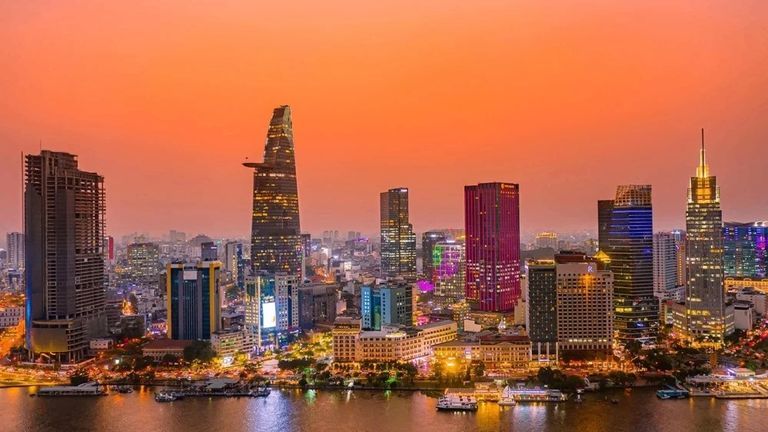
Ho Chi Minh City announced a 100-year plan to transform into a leading city in the Asia Pacific. | Source: Vinpearl
In May 2026, the Ho Chi Minh City People's Committee approved the framework for the city's master plan for the 2025–2050 period, with a 100-year vision, aiming to transform Ho Chi Minh City into a leading city in the Asia-Pacific region.
Under the plan, Ho Chi Minh City aims to rank among the world's top 100 most livable cities while strengthening its role as a regional hub for finance, trade, services, logistics, tourism, education, healthcare, science, technology, and innovation. The city also seeks to raise living standards, with incomes and quality of life among Asia's leaders.
A metropolis worth USD 800 billion
The master plan covers the entirety of Ho Chi Minh City's post-merger administrative boundaries, spanning approximately 6,773 square kilometres, including 168 wards and communes, the Con Dao special zone, and future land reclaimed from the sea.
The blueprint highlighted the economic ambitions: By 2030, the city aims to grow its economy to roughly USD 120 billion, reach a population of 16 million, and sustain annual growth above 10%. By 2050, Ho Chi Minh City is envisioned as a metropolis of 22–25 million residents with an economy worth USD 800 billion.
To accommodate that growth, Ho Chi Minh City plans to move away from its traditional model of expanding outward from a congested urban core. Instead, the city would be reorganised as a multi-polar megacity built around a "5-5-10" framework: 5 economic growth poles; 5 strategic transportation corridors spanning road, urban railways and TOD, waterway and air networks; as well as 10 governance zones designed around distinct economic functions.
Urban planners say the model is built on two key concepts. The first is the "15-minute city," where residents can access essential services within a short walk or commute from home. The second is a "30-minute multi-layered city," where modern transport systems and digital infrastructure enable rapid connections between the city's major growth centres
To compete globally, Ho Chi Minh City plans to establish 6 strategic zones, ranging from semiconductor and robotics clusters to a free trade zone, an international financial centre, a digital innovation hub, a clean energy centre, and a cultural and creative district. Each would operate under special policy frameworks designed to attract investment and accelerate growth.
The plan is not solely focused on economic targets but also “places people at the centre of development.” It aims to raise the city's Human Development Index (HDI) above 0.8. In education, Ho Chi Minh City aims to provide at least 300 classrooms for every 10,000 school-age residents by 2030.
In addition, Ho Chi Minh City’s social infrastructure, including healthcare facilities, universities, schools, social housing, elderly care services, and other community amenities, would be developed across the city's emerging urban centres, rather than continuing to cluster around the historic core.
As climate risks intensify, the blueprint also adopts environmental carrying capacity as a guiding principle for future growth. Critical ecological assets, including the Can Gio mangrove forest, would be strictly protected as a natural buffer against climate threats. The city also plans a broader transition toward a low-carbon urban model, prioritising electric buses, waterborne transport, and energy-efficient buildings.
A framework for imagining the future
This is Vietnam's second century-long urban blueprint, following Hanoi's announcement of its own 100-year vision earlier in May. Both plans share a common goal: to provide comprehensive frameworks for addressing long-standing urban challenges, from development concentrated in city centres to mounting environmental pressures.
Unlike Hanoi's plan, which places greater emphasis on building a model capital city, Ho Chi Minh City's vision is more about becoming a more livable metropolis. The blueprint focuses on improving residents' quality of life by addressing social challenges such as housing shortages and unequal access to public services and social infrastructure.
The plan also places a strong emphasis on economic development, seeking to capitalise on the city's expanded geographic footprint following its merger with the former provinces of Binh Duong and Ba Ria–Vung Tau. By integrating industrial corridors, seaports, logistics networks, and coastal resources into a single urban region, planners hope to create new engines of growth beyond the traditional city centre.
Whether the city can turn those ambitions into reality remains an open question. While both Hanoi and Ho Chi Minh City have outlined ambitious goals, neither has provided detailed implementation timelines or long-term governance mechanisms. Given the realities on the ground and the track record of urban planning in Vietnam, neither city has yet demonstrated its ability to successfully deliver a project on such a vast scale and over such an extended timeframe.
According to architect Pham Thanh Tung, Chief of Office of the Vietnam Association of Architects, a 100-year plan should be viewed primarily as a strategic vision rather than a fixed roadmap. By nature, such long-term plans will need to be revised as circumstances evolve.
To avoid becoming a "paper plan" that remains unimplemented, he argues that a century-long blueprint must be designed with a high degree of flexibility. It should be open enough to adapt to different development scenarios over time while preserving its core strategic direction.
More importantly, Tung argues that policymakers must move beyond what is commonly referred to in Vietnam as a "term-based mindset" — the tendency of officials to prioritise short-term achievements and immediate gains during their time in office, often at the expense of long-term national development.
"A 100-year plan cannot be dictated by the short-term cycles of individual administrations, whether five or ten years. Urban leaders must adopt a long-term perspective, viewing today's planning decisions as the foundation they leave for future generations,” Tung told The Architecture Magazine
Ho Chi Minh City's 100-year vision is more than an ambitious target for economic growth or urban expansion. It is an attempt to imagine what one of Southeast Asia's largest urban regions could look like by the end of the century. For now, the blueprint offers not a prediction of the future, but a framework for imagining what that future might be.