Inside the Female-Led, DEI-Nominated Set of Vietnamese Director Zen Nguyễn’s Blue Season
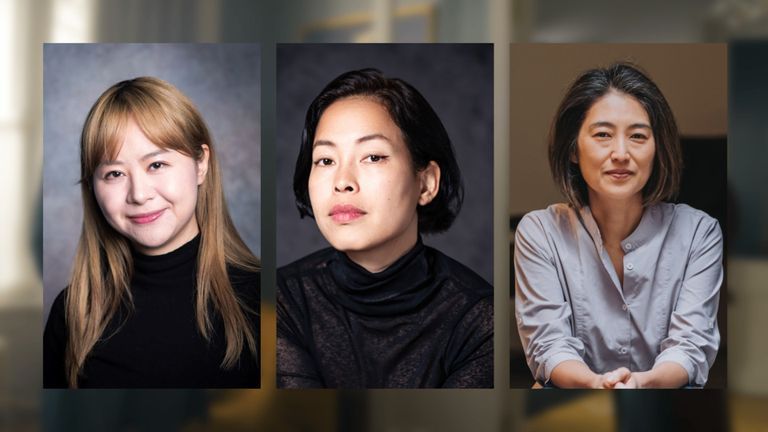
From left to right: Producer Sylvia Wang, Director Zen Nguyễn, and Director of Photography Mari Yamamura. | Source: Provided
This year, the gritty British crime noir series Blue Season will make its official debut on Galaxy Play, following an exclusive preview screening and Q&A in Ho Chi Minh City on July 21st. Directed by Zen Nguyễn, co-produced by Sylvia Wang, and lensed by veteran Director of Photography Mari Yamamura, the series is a fast-paced, high-stakes police drama set entirely on the cold, atmospheric winter streets of London.
Behind its suspenseful narrative lies a production of remarkable caliber. With women leading most key creative departments,including an all-female camera team, Blue Season offers an uncommon production model for a British crime drama. The approach earned the series a nomination at the 2026 Global Production Awards in the DEI category.
Ahead of the premiere, Vietcetera International sat down with director Zen Nguyễn, producer Sylvia Wang, and DP Mari Yamamura to demystify the mechanics of building tension, the visual psychology of lighting, and how they built a world-class thriller by rejecting lazy storytelling shortcuts.
British crime dramas are one of the UK's most established television genres. What made you want to tell this story through that format?
Zen Nguyễn: Crime is universal. Everybody loves a good crime story, and British crime dramas already have a strong audience. What interested us was how we could bring something new to that space. Both of our lead detectives come from Asian backgrounds. One is British French with Vietnamese heritage and one is British Chinese. But the story isn't about them being Asian. They just happen to be Asian.
For us, that's actually the most exciting form of representation. Instead of fitting Asian characters into a stereotype, we wanted them to exist naturally within a mainstream story.
You've said before that Blue Season isn't trying to be an "Asian story." What do you mean by that?
Zen Nguyễn: We experienced the film and television industry in the UK and realised Asian people are still underrepresented on screen.
British East and South East Asian (BESEA) acting talent has appeared in a main role in just 17 British theatrical releases over a 10-year period — 1.7% of all British films.
We knew we wanted to use our craft to address this gap. But rather than making a story entirely about identity, we wanted to tell a compelling crime drama that happened to feature Asian characters. We wanted audiences to see them as detectives, sisters, suspects, victims, colleagues.
How did you avoid falling into familiar stereotypes while writing those characters?
Sylvia Wang: While Zen and I are first-generation immigrants, our lead actors are second- and third-generation immigrants. They brought a completely different nuance of thinking, behavior, and lived experience that we couldn't have written ourselves.
For instance, the two lead sisters in the show have the same mother but different backgrounds. The actresses spent weeks rehearsing and bonding, translating that real-life chemistry into the script.
Zen Nguyễn: It also saved us from lazy storytelling. Initially, we thought about having the British-Chinese protagonist speak a few lines of Cantonese just to "hint" at his identity. But the actor Earl Wan rightfully challenged us, saying: "Show, don't tell". Spoken Cantonese for the sake of it can be a lazy trope. Instead, the actors invested their own personalities and generational immigrant experiences into their characters, making them feel incredibly grounded and alive.
Blue Season is unmistakably British, yet shaped by Asian voices behind and in front of the camera. How did London make that combination possible?
Sylvia Wang: I always describe Blue Season as a truly international series. Not "international" in the stereotypical sense, but genuinely shaped by different cultures. London made that possible. It's a city where people from different backgrounds naturally coexist, so our Vietnamese, British Chinese and British characters don't need their identities explained. They're simply part of the world.
That's what I love most about London. We didn't have to force diversity into the story. It already exists there.
The show brings together a Japanese DP, a Vietnamese director, a Hong Kong-born editor, and a diverse British-Asian cast. How did this cross-cultural fusion impact the production?
Mari Yamamura: It wasn’t diverse just for the sake of ticking a box. This was a true international collaboration born because Zen and Sylvia had the open-mindedness to tackle underrepresentation from the top down. Actors contributed ideas. Departments contributed ideas. Nobody felt locked into a rigid hierarchy. That openness created a really creative atmosphere.
The production of Blue Season was incredibly tight—a 14 -principal photography day winter shoot, and a few additional days for general view shots. Each shooting day lasted 10 hours, with a one hour break. How did having a female-led creative department shape the operational efficiency on set?
Sylvia Wang: When you are running a tight, high-pressure shoot, the day-to-day environment can make or break a film. And in some cases, the atmosphere can sometimes feel rigid or aggressive. But on our set, because we had key departments led by women, there was a deeply supportive, calm, and highly organized environment. The camera crew would constantly check in on each other, maintaining an immense sense of trust and speed.
Many conversations about women in film focus on representation. But beyond who was on set, what did female leadership actually change about the way Blue Season was made?
Sylvia Wang: I noticed lots of small things that you might not think about. Sometimes someone would hand you a piece of equipment with a little note on it. They were tiny gestures, but during a stressful 14-day shoot they made a real difference. It created an environment where people felt supported rather than just expected to keep going.
Zen Nguyễn: One day we were filming at London's Embankment under huge time pressure. We were racing against daylight, and I was also on my period. I stepped outside for a moment because I felt overwhelmed, and Mari came over and simply said, "It's fine. We'll do it together." It sounds like such a small moment, but when you're leading a production, that kind of understanding can completely change your day. It reminded me that collaboration isn't just about solving technical problems. It's also about taking care of each other.
Mari Yamamura: Our camera and lighting team were organized, motivated and they were totally on-board on this tough shoot with me. What I did notice was that atmosphere. When the leadership at the top sets a collaborative, open-minded tone, that positive energy permeates the entire crew. When everyone feels comfortable speaking up, ideas travel much more freely. I think audiences may not consciously notice that, but they may feel it in the finished work.
You described the set as calm, supportive and collaborative. Was there a day when those qualities became essential to getting the job done?
Zen Nguyễn: That same day at London's Embankment was when those values were really put to the test. We were racing against the fading winter light, juggling an incredibly tight schedule, and everyone was under pressure. It wasn't just how we solved the logistical challenges, but how we looked after one another while doing it. Mari's reassurance reminded me that a calm, supportive environment isn't just nice to have, it allows people to keep thinking clearly and making good decisions when everything is on the line.
Mari Yamamura: I remember we were all under enormous pressure that day. We were losing daylight rapidly and we hadn’t shot half of the day’s schedule. Zen and I had a quick chat on the spot. We made a split-second decision to adjust our plans. Instead of moving to a secondary location which we would have lost, we brought the cast into our existing location.
We also simplified several big complex scenes into 2~3 shots each to get through the scenes. In the end, we avoided showing the street lights and the buildings with lit windows in our frames, and by supplementing the daylight with our portable lights, we managed to complete all the schedule. We used the grade to match later shots with the earlier day scenes in the post.
As we cut the final take, the Big Ben gongs started chiming at 7:00 PM wrap time. And right as the actor walked out of the tunnel, a real crowd of tourists—whom we had no control over—naturally walked in front of him, allowing him to disappear into the crowd as intended in the script. It was a magical moment.
The "female gaze" is a concept that is often discussed but rarely demonstrated. How did having a female-led creative team impact how intimacy and emotional connections were portrayed on screen?
Zen Nguyễn: When depicting the central romantic relationship, we wanted to portray a deep, authentic connection rather than objectifying the characters. It’s about tenderness, shared breathing, the eye contact, and mutual desire, rather than explicit, voyeuristic imagery.
We worked closely with an intimacy coordinator to build choreography that made the actors feel entirely comfortable and safe. We also instituted a strict "closed set" protocol, allowing only essential crew members in the room. Having that baseline of safety allowed the actors to perform with absolute vulnerability.
After making this series, what does authentic representation mean to you?
Zen Nguyễn: Like I have said, authenticity isn't about ticking boxes. It's about letting people who have lived those experiences contribute to the storytelling. We had actors who challenged our assumptions. We had conversations about family dynamics, language and identity. Sometimes the best decision was actually to remove something we'd written because it felt too obvious.
For us, representation is about allowing Asian characters to feel like complete people.
Zen, bringing Blue Season to Galaxy Play in Vietnam feels like a massive homecoming. What do you hope Vietnamese audiences, and particularly young filmmakers, take away from this show?
Zen Nguyễn: It is a huge milestone in my journey. Living, studying, and working in the UK, I always look for ways to weave my Vietnamese heritage into my films, whether through casting or characters. To bring a mainstream British crime thriller back to Vietnam is incredibly emotional. I hope it inspires young Vietnamese filmmakers to realize that they, too, can direct mainstream international projects, break into traditionally male-dominated departments, and tell complex, high-caliber stories that resonate globally without losing who they are.
Blue Season at a Glance
Genre
British crime noir / Police procedural
Directed by
Zen Nguyễn
Story Created and Written by
Dennis Gallagher
Produced by
Zen Nguyễn & Sylvia Wang
Director of Photography
Mari Yamamura
Starring
Earl Wan, Catherine Dauphin, Kate Cook, Ray Calleja, Matt Penson
Producion Companies
Featherstone Pictures UK & Golden Finger Entertainment Singapore
Vietnam Preview Screening & Q&A
July 21, Ho Chi Minh City
Featuring director Zen Nguyễn, Earl Wan and Kate Cook - the series' lead actors.
The official release date for Galaxy Play will be announced at the event.