Lead By Letting Go: Niklas Wagner On ‘Enabling Leadership’ And AI Innovation at New World Saigon
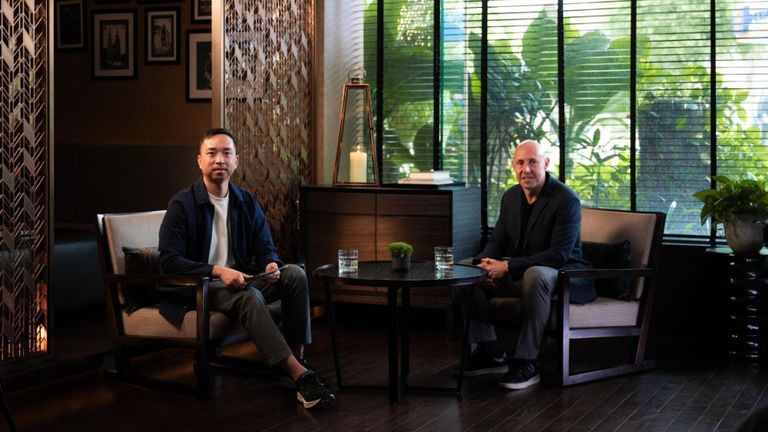
Source: Khooa Nguyen for Vietcetera
Have you ever hesitated to book a long-haul flight due to travel worries?
For Niklas Wagner, General Manager of New World Saigon Hotel, these subtle travel anxieties are real factors currently shaping premium travel in Vietnam. When recent geopolitical shifts in the Middle East led to higher ticket prices and minor transit concerns, many long-haul travelers from Europe and Australia chose to holiday closer to home. However, this shift has redirected travel patterns, driving a wave of Asian-centric and independent travelers to Vietnam.
Returning to the Vietnam Innovators podcast for Episode 399, Niklas Wagner, and a close friend of host Hao Tran, brings an honest, sharp, and deeply optimistic perspective on how the hospitality industry must adapt to capture Vietnam’s next chapter of growth.
Navigating Global Shifts and Changing Demographics
The shift in travel patterns has made the current market highly Asian-centric. Vietnam is seeing consistent demand from North Asia, including China, Korea, and Japan alongside a rapidly growing market in India.
While group bookings (which are generally more cost-conscious and sensitive to flight prices or government travel guidelines) saw a temporary softening, individual travelers have quickly filled the void. Backed by Middle Eastern carriers adjusting their fares, Niklas expects a strong year-end finish.
“The demand is there. People want to come to Vietnam, so we expect a very strong fourth-quarter rebound.” - Niklas Wagner
What if a highly precise transport scheduling app, saving a five-star hotel tens of thousands of dollars, was built in just... three days using AI?
While AI is often discussed in abstract terms, Niklas takes a highly practical approach. He believes guest experience is driven by compounding small, daily improvements rather than grand gestures.
To support this, the hotel recently updated its IT Manager’s role to Technology Experience Manager. The philosophy is simple: any tech deployed must directly make the guest's stay better.
A prime example of this is how they streamlined their transport scheduling. Previously, managing the private fleet of cars and drivers relied on manual Excel spreadsheets—a process prone to errors, such as assigning the same driver to two trips simultaneously, and taking up to 15 minutes just to verify vehicle availability.
Using Large Language Models (LLMs), the Technology Experience Manager wrote the code and developed a custom, secure in-house app in just three days:
- How it works: The team uploads a PDF of all transport bookings into the app.
- The result: The system automatically schedules the drivers, assigns the cars, and optimizes routes in seconds.
“In the past, you would pay $20,000 to $30,000 and wait months to develop this app. Our Technology Experience Manager built it in three days using these tools. It allows us to move quickly on small improvements by developing them safely in-house on our own servers,” Niklas explains.
Following this success, other departments, like the laundry team, have requested similar custom tools to track staff uniforms. These micro-improvements extend to sustainability and community projects as well, such as bringing four eco-friendly heat pumps online, installing in-room water dispensers to reduce plastic waste, and partnering with local brand Marou Chocolate for premium in-room amenities.
Preparing For The Great Infrastructure Shift
The landscape of Ho Chi Minh City is undergoing a major transformation, led by two massive projects: Metro Line 1 and the upcoming Long Thanh International Airport.
While Long Thanh Airport, designed to eventually support 100 million passengers annually, is an absolute positive for the city’s long-term accessibility, Niklas notes the short-term operational hurdles. Because it is located further outside the city center, a 2-to-3-day MICE group might struggle with a two-hour commute each way in heavy traffic. Basically, one day of the trip is just dedicated to transport. Over a ten-year horizon, however, this infrastructure will pave the way for a new wave of luxury hotel developments.
Meanwhile, intra-city transit is already seeing immediate benefits. Located just a two-minute walk from the iconic Ben Thanh Metro Station, New World Saigon is in a prime position.
Instead of braving an hour of heavy road traffic to reach the lively culinary and nightlife scene of Thao Dien, hotel guests can now jump onto Metro Line 1 and arrive in just 20 minutes. It is a major step toward making Ho Chi Minh City a seamless, world-class destination.
The Irreplaceable Premium Of The “Human Touch”
With the rise of automated check-ins and service robots, is the human element of hospitality fading away?
For Niklas, the answer is a resounding no—at least not for the upper upscale and luxury segments. While budget hotels may transition to fully automated models, five-star hospitality will always place a premium on human connection:
As technology adoption increases, our natural need for human interaction will become the other trend that really skyrockets. Because you need humans to feel human.
To illustrate, Hao Tran shared a personal memory of leaving an umbrella behind at a hotel restaurant in Japan. Through casual conversation, the host picked up subtle clues, figured out Hao's hotel, and quietly sent the umbrella directly to his room without even calling. This unexpected, personalized gesture went the extra mile and built lasting loyalty.
Technology, Niklas argues, should serve as an enabler to make service quicker and easier. But at the end of the day, face-to-face connection is what truly matters.
Enabling Leadership: Trust Over Control
Managing a landmark property with over 500 rooms requires a leadership style that favors trust over micromanagement. Niklas describes his approach as “Enabling Leadership”.
Instead of dictating orders, Niklas works alongside his executive team in a communal space, fostering rapid problem-solving and open communication.
“I am not a bossy boss, let’s put it that way. I’m not a fan of micromanaging. I like to have the team make their decisions, and I often push questions back to ask: ‘You decide—what would you do?’ Over time, they build the confidence to take the right risks. If they make a mistake, that's fine, we fix it together.”
By blending a trusted foundation of long-serving employees with the tech-forward energy of younger team members, New World Saigon is successfully bridging its storied legacy with Vietnam’s vibrant, digital-first future
Watch the full episode of Vietnam Innovators with Niklas Wagner on YouTube.