New Climate Report Ranks Hanoi Among World’s Most Vulnerable Cities: What It Means For Vietnam?
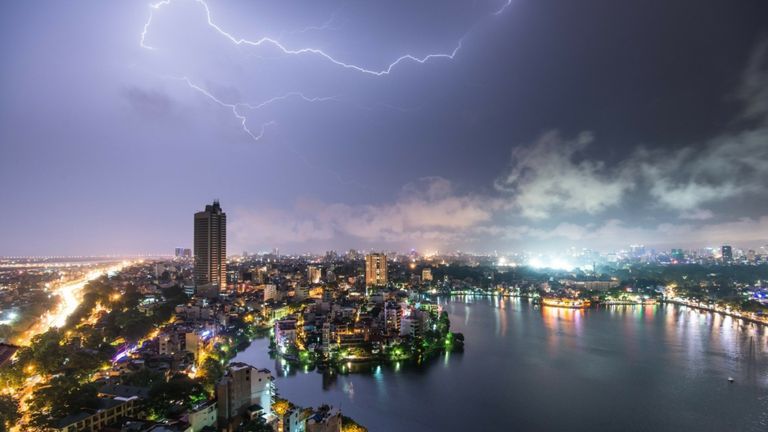
Source: Wallpaper Abyss - Alpha Coders
Hanoi has been ranked among the world’s least resilient major cities to climate risk. In AlphaGeo’s 2026 Climate Risk & Resilience Index, which assesses 72 of the world’s largest cities, the Vietnamese capital ranks 14th among the 20 cities with the highest resilience-adjusted risk. The index looks beyond exposure to hazards such as flooding, heat, drought, wildfire, and storms and also considers how infrastructure, governance, policy, and other forms of adaptation can reduce the risk that remains.
The number is striking. But perhaps the more important question is what sits behind it. A city’s climate risk is not determined by geography alone. It is also shaped by the resources, infrastructure and institutions available to prepare for a shock, limit its damage and recover afterwards.
Beyond Geography: Why Hanoi’s Real Risk Lies Below the Surface?
There is a common assumption that climate risk is a fixed sentence handed down by geography alone. Coastal cities face rising sea levels, tropical capitals endure extreme heat, and river basin settlements face seasonal flooding. Under this traditional lens, Hanoi’s exposure seems obvious: anchored in the Red River Delta, the capital has spent centuries navigating seasonal monsoons, river swelling, and increasingly suffocating summer heatwaves.
Yet, the core methodology behind AlphaGeo’s Climate Risk & Resilience Index relies on a crucial distinction: separating a city’s raw physical exposure (the natural incidence of flooding, heat stress, or tropical storms) from its Resilience-Adjusted Risk (RAJ). The index measures the residual risk that remains after accounting for a city's existing infrastructure, governance, emergency planning, and adaptation policies. Two cities facing identical weather hazards can experience vastly different outcomes depending on their institutional and structural capacity to absorb the shock.
Hanoi’s position on the ranking list is not simply a matter of bad luck on a map. Instead, it signals a systemic gap between the escalating physical hazards confronting the capital and the current capacity of its urban systems to mitigate them.
The Asian Spectrum: From Shanghai’s “Sponge Cities” to Dhaka’s Warning
Hanoi does not navigate this crisis in a vacuum. Across Asia, expanding metropolises present a living ledger of how rapid economic growth intersects with escalating climate risk, and what happens when urban expansion outpaces institutional capacity.
At one end of the spectrum lie mega-cities like Shanghai, Shenzhen, and Beijing, which recorded the report’s highest adaptation rates by successfully mitigating nearly half of their baseline physical risks. Over the last decade, China converted decades of relentless economic expansion into state-backed urban adaptation, championing the ambitious “Sponge City” doctrine. By systematically replacing impervious concrete sprawl with permeable pavements, restored urban wetlands, and massive subterranean water vaults, these cities proved that explosive capital growth can be harnessed to absorb nature’s worst shocks.
At the opposite extreme sit cities like Dhaka and Ahmedabad, cautionary tales where hyper-density without matching adaptation investment has trapped vulnerable populations in a cycle of flood damage and suffocating heat. Yet closer to home, Hanoi's delta peers offer a more immediate blueprint. Facing near-identical geographical vulnerabilities, Bangkok has increasingly relied on a hybrid strategy: pairing heavy industrial drainage tunnels with green, nature-based infrastructure. Parks like the Chulalongkorn Centenary Park are deliberately engineered not just as public green space, but as retention basins capable of storing millions of gallons of seasonal runoff.
Hanoi now stands at this precise urban crossroads. Armed with expanding fiscal reserves and record infrastructure budgets, Vietnam’s capital possesses the financial firepower to choose its trajectory. The question facing municipal planners is no longer whether the city has the resources to build resilience, but whether it will deploy that capital toward holistic, public-facing urban adaptation, or allow unmanaged growth to push it toward the precarious fate of its less-prepared neighbors.
The Inequality of Impact: Who Pays the Price on Hanoi’s Streets?
Climate disasters are not merely environmental shocks; they are magnifiers of existing social hierarchies. Sociologist Ulrich Beck once noted that while wealth accumulates at the top, risks accumulate at the bottom. In modern-day Hanoi, this “risk society” is a daily reality visible on any given street corner during extreme weather.
Consider a severe summer heatwave where temperatures exceed 40°C. For the burgeoning middle and upper classes, the extreme heat is an inconvenience buffered by air-conditioned cars, climate-controlled Grade-A office buildings, and premium shopping malls. But for the backbone of Hanoi’s informal economy like the street food vendors, the construction workers building the new skyline, and the thousands of ride-hailing drivers navigating the chaotic traffic, the heat is an inescapable occupational hazard. They remain fully exposed to the elements, lacking the financial privilege to simply “stay indoors”.
The same spatial inequality applies to flooding. A torrential downpour might trigger a massive, state-of-the-art private pumping station to protect a high-end financial district or a gated residential community, dramatically boosting the city's overall resilience score. Yet, the working-class neighborhoods and narrow alleys (ngõ) on the city's periphery might be left to absorb the displaced runoff.
Even when physical infrastructure holds up, recovery is strictly tiered by class. If a flood paralyzes the city for two days, a white-collar professional with savings, insurance, and remote-work flexibility absorbs it as a minor disruption. A daily-wage worker or an informal vendor experiences the exact same flood as a devastating financial crisis.
What a Truly Resilient Hanoi Looks Like?
Vietnam possesses the economic momentum to engineer its way out of immediate physical risks, but true resilience cannot be bought with concrete alone. Elevating roadways and constructing isolated flood barriers offer temporary relief, but long-term adaptation demands a shift toward nature-based urbanism, turning rigid concrete expanses into permeable, water-absorbing spaces through urban wetlands and retention parks.
Yet physical engineering addresses only half the equation. Lasting resilience requires municipal planners to treat climate defense as a public good rather than a localized privilege. This means directing municipal drainage investments toward vulnerable peripheral neighborhoods rather than solely shielding commercial hotspots, while establishing basic social safety nets, such as public cooling centers and extreme-heat protections for the informal laborers who keep the city running under an unforgiving sun.
A street vendor or low-income family cannot take shelter inside a rising GDP figure or an aggregate index score. Ultimately, the true measure of Hanoi’s resilience will not be whether its glass towers survive the next storm, but whether every citizen is given an equal chance to recover from it.
A National Blueprint for Vietnam’s Urban Growth
Hanoi’s ranking is less an isolated anomaly than a case study for Vietnam’s broader economic trajectory. According to the World Bank’s Country Climate and Development Report, unmitigated climate impacts could cost Vietnam up to 3.5% of its GDP annually by 2030, a risk heavily concentrated in the urban corridors that generate over 70% of the national economy.
Each key metropolis faces a distinct operational challenge: Hanoi navigates river flooding and extreme heatwaves, Ho Chi Minh City manages tidal surges compounded by land subsidence, and coastal hubs like Da Nang fortify against severe typhoons.
Because these cities drive the nation's growth engine, climate adaptation is fundamentally an exercise in capital allocation and risk management. Hanoi’s situation offers a clear playbook for the country: rapid economic expansion must be paired with proactive public investment. By treating resilience as a core public asset rather than a reactive cost, Vietnam can ensure its urban boom builds lasting, inclusive stability across all its major cities.