No More Free Online Movies And Soccer Matches: Vietnam Cracks Down On Pirated Content
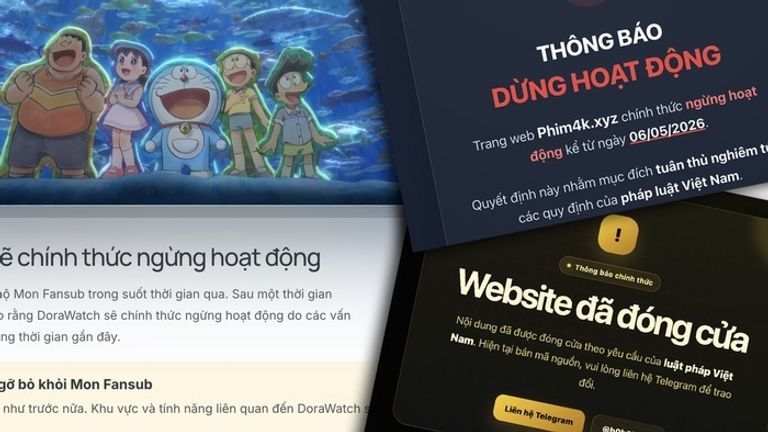
A lot of pirate websites were shut down after the copyright crackdown. | Source: Nguoi Lao Dong
Thousands of free online content disappeared on May 7 after the Vietnamese government launched a sweeping crackdown on copyright infringement across Vietnam.
The move came after Vietnam was placed on the Priority Foreign Country Watch List by the Office of the United States Trade Representative over concerns about intellectual property infringement. On May 5, Deputy Prime Minister Ho Quoc Dung signed Official Dispatch No. 38, which calls for aggressive measures to handle copyright violations strictly.
The unspoken question: Is it free?
For years, in Vietnam, watching a Hollywood blockbuster, streaming a Premier League match, or downloading a programme often came with an unspoken question: Is it free? Pirate websites, Facebook groups, and Google Drive links have quietly become part of the country’s digital routine, shaping a generation that grew up consuming content without ever paying for it.
The scale of that habit is difficult to ignore. According to a 2025 survey by the Coalition Against Piracy (CAP) and the Asia Video Industry Association (AVIA), 56% of Vietnamese users admitted accessing pirated digital content within the past 12 months, placing Vietnam among the highest piracy markets in Asia-Pacific.
Among younger users, the figure is even higher. A separate youth survey by CAP and AVIA found 65% of Vietnamese aged 18 to 24 regularly accessed pirated content.
CAP estimated Vietnam lost around USD 348 million in 2022 alone across the television, film, and digital music sectors due to piracy. The coalition also found that 62% of Vietnamese users had cancelled paid subscriptions after discovering free alternatives.
The 2020 study by researchers at Ho Chi Minh City University of Technology found that users do not consume pirated content because they cannot afford legal alternatives, but because everyone around them does. Studies by CAP also show 71% of surveyed users said they would be willing to pay for legitimate services if illegal platforms were effectively blocked, suggesting that convenience, not just price, remains a major driver of piracy.
According to Media Partners Asia in 2025, around 15.5 million Vietnamese continued to consume pirated content, making Vietnam the third-largest piracy market in the Asia-Pacific region.
In early 2026, Vietnam was also placed on the Priority Foreign Country Watch List by the Office of the United States Trade Representative — the highest, most serious warning level for countries with intellectual property right violation. Vietnam is the only country in this list.
The major crackdown on pirated content
Vietnam actually has strict copyright regulations, with the country’s Law on Intellectual Property explicitly defining copyright infringement as illegal. Under Decree No. 341/2025/ND-CP, which took effect on February 15, 2026, direct financial penalties will be imposed on the unauthorised reproduction, distribution, or broadcasting of copyrighted works, including pirated audiovisual content. Violations may carry fines of up to VND 250 million (USD 9,500) for individuals and VND 500 million (about US D 19,000) for organisations.
Copyright infringement is also criminalised, under Article 225 of the 2025 Criminal Code (Amended), when the offence causes damages of at least VND 50 million (USD 1,900) or is committed for commercial purposes. Offenders may face fines, non-custodial reform for up to three years, or imprisonment ranging from six months to three years, depending on the severity of the offence.
On May 5, the Deputy Prime Minister signed Official Dispatch No. 38, focusing on a major crackdown on copyright infringement on a national scale from May 7 to May 30, 2026
The measures include stricter inspections, the immediate blocking of pirate websites, and the removal of copyright-infringing content within 24 hours.
Authorities are also inspecting businesses suspected of using cracked software or illegally distributing movies and TV content. Cases involving major financial losses could lead to criminal charges. The government aims to cut access to pirate websites by 50% compared with 2025 levels.
Just a few days into the campaign, a wave of websites offering pirated content, from movies and music to video games, either voluntarily shut down or were blocked. Besides movie and sports streaming platforms, several fan-run subtitle and translation websites also announced their closure, saying their current content-sharing models no longer aligned with Vietnam’s evolving legal standards.
The inconvenient change
The crackdown has brought mixed feelings, especially among Vietnamese Gen Z – a generation raised on free content, now forced to confront a digital reality where convenience no longer comes for free.
In Facebook discussions, while many expressed nostalgia for what some called “the end of the free era,” others were quick to accept the new reality, saying it was time to comply with the latest regulations and show greater respect for copyright.
However, for many users, accessing legal content is not as simple as just paying for it.
For creative university students, the sweeping crackdown could mean the end of cracked Adobe software, a tool many have relied on for years to edit videos, design portfolios, or complete class assignments.
Yet for many, legal alternatives remain financially out of reach. An individual subscription to Adobe’s All Apps plan typically costs between USD 20 and USD 30 per month, or roughly VND 500,000 to VND 800,000. Given that the average monthly living expense is around VND 6 million (USD 242), such a subscription remains financially challenging for many Vietnamese students.
The appeal of pirate websites goes beyond price; it is also about accessibility and convenience. For movie lovers, pirate platforms often offer thousands of titles in one place, instead of forcing users to jump between multiple streaming services to find what they want.
This suggests that affordability is only part of the equation. For many users, illegal platforms succeed not just because they are free, but because they offer a level of convenience and content accessibility that many legal services still struggle to match.
The crackdown is undoubtedly necessary, reflecting Vietnam’s growing determination to break long-standing digital habits and build a more responsible culture around intellectual property.
But habits, especially those shaped over years of convenience and easy access, do not disappear overnight. That level of convenience may not be something legal platforms can replace in people’s minds within just a matter of days.
For now, the crackdown is not only testing copyright enforcement, but challenging a digital culture where asking “Is it free?” has long felt more natural than pulling out a credit card.