Portraits Of Vietnamese Women In Propaganda Art
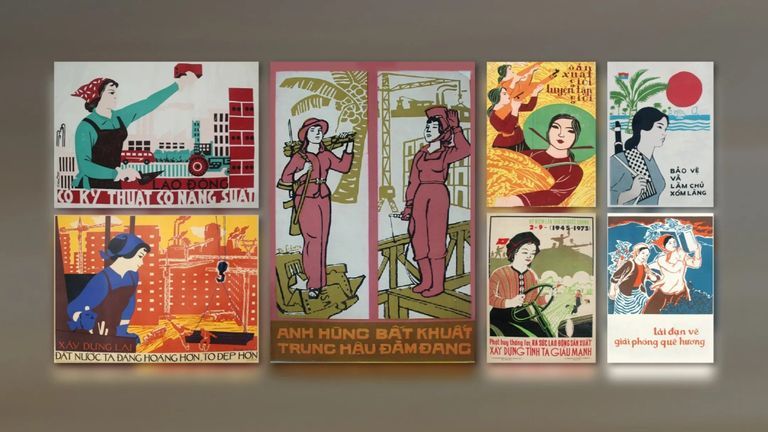
Portraits of Vietnamese women in propaganda posters. | Source: Compiled from various sources
On the occasion of International Women’s Day (March 8), revisiting the propaganda posters preserved at the Vietnam Women’s Museum reveals how Vietnamese women were placed at the center of history.
From wartime to the early years of peace, women in these artworks were not confined to the domestic sphere. They stepped into the national landscape: on the fields, in factories, on training grounds, and at the borders.
All photos from this article belongs to Vietnamese Women’s Museum.
On the frontline: When women took up arms
During the war years, propaganda art portrayed women in resolute stances:
- Militia members holding both rifle and plough.
- Young female volunteers stationed along the front lines.
- Female soldiers depicted with steady gazes and determined expressions.
Vietnamese women in propaganda posters were portrayed not only as the steadfast backbone of the home front, but as indispensable figures on the front lines. They stood shoulder to shoulder with men, embodying a readiness across all arenas: from direct combat and local militia forces to agricultural production and logistical support for the battlefield.
This imagery reflected a profound shift in social perception. Women were no longer seen solely through domestic roles, but as a true “strategic force” in the struggle for national liberation and postwar reconstruction.
On the fields and in factories: Production as a frontline
Alongside wartime scenes were powerful depictions of labor and productivity:
- Women harvesting rice, planting crops and gathering produce.
- Female factory workers operating machinery and assembly lines.
- Women mastering new techniques and modern agricultural tools.
The visual message was clear: production was a strategic mission, and women were central to it.
Many posters depicted women to master technology, roles once assumed to belong exclusively to men.
These images celebrated Vietnamese women’s resilience, adaptability and command of science and technology. From operating complex factory machinery and engaging in scientific research to applying technical advancements in agriculture, they were portrayed as fully capable of taking on major responsibilities and contributing meaningfully to the country’s broader development.
After 1975: Building peace, safeguarding achievements
Entering the 1975–1986 period, the tone of propaganda art shifted. Fewer posters focused on women, but the themes became more specific:
- Calls to increase food production.
- Mobilising labour to drive economic development.
- Protecting the achievements of the revolution.
The colors remained vivid, yet rifles gave way to baskets of rice, fruit and expansive fields. Women continued to appear as primary laborers, anchoring the imagery of reconstruction.
Notably, ethnic minority women in traditional dress began to feature in distinct contexts. In posters urging citizens to “protect revolutionary achievements,” they were often the only female figures, standing alongside male soldiers and representing frontline communities, particularly in border regions.
In works emphasising ethnic solidarity in defending the nation, women in traditional attire sometimes appeared prominently within minority groups—visually reinforcing unity and shared responsibility in safeguarding the country.
This may simply have been an artistic choice, a way to foreground highland cultural identity, where women often hold central roles in community life. Though never explicitly explained, their placement within these compositions suggests that women were intended to symbolize the community itself.
Beyond traditional gender roles
Taken as a whole, propaganda art from these two periods did not frame women strictly within domestic narratives. They were not depicted solely as mothers or wives confined to the home, but as a strategic force of the nation.
At the same time, these portrayals carried implicit expectations. Women were envisioned as meeting new social demands while still fulfilling traditional responsibilities. They fought, they produced, they managed.
This idealisation reflects a particular historical moment, when collective goals outweighed individual roles. Even as domestic care was rarely shown, it remained an assumed duty. The focus of propaganda art was to encourage individuals to rise beyond conventional boundaries.