The 84-Year-Old Fight Against Chemical Giants: Inside Tran To Nga’s Quest for Agent Orange Justice
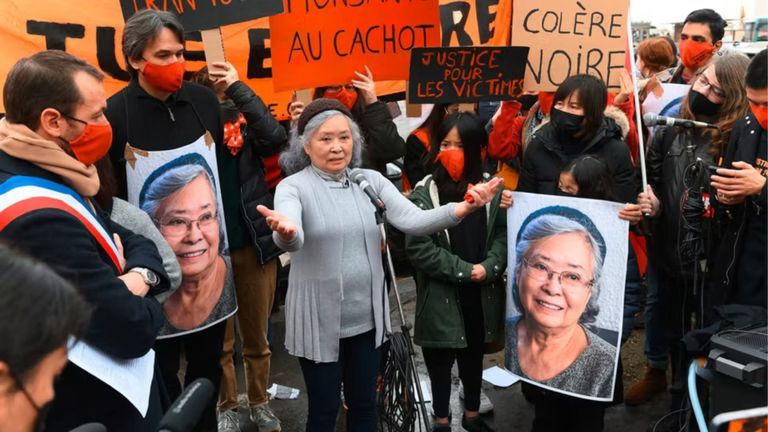
Tran To Nga developed several illnesses following her exposure to Agent Orange. She is pictured at a Paris rally supporting victims on January 30, 2021. | Source: Le Monde
For decades, the physical war in Vietnam has been consigned to history books, documentaries, and silent memory. Yet, in courtroom corridors from Paris to Washington, its invisible casualties continue to fight a battle that has extended across generations—written not in military tactics, but in medical charts and legal briefs.
At the center of this modern crusade is Tran To Nga, an 84-year-old French-Vietnamese woman who has spent over a decade waging an extraordinary legal battle against 14 multinational chemical corporations, including some of the world's largest agricultural chemical producers.
Her lawsuit is not merely a personal bid for restitution. It represents one of the most significant David-versus-Goliath legal battles of the 21st century, challenging how international law interprets corporate accountability, government contractor immunity, and the lingering, lived legacies of armed conflict.
The Toxic Footprint And A Mother’s Grief
To understand Tran To Nga’s legal crusade, one must look at the devastating footprint of Agent Orange—a herbicide deployed at scale by the U.S. military during the Vietnam War between 1961 and 1971. While the tactical objective was to strip away dense jungle foliage to uncover enemy positions, the chemical formulation contained high concentrations of 2,3,7,8-Tetrachlorodibenzo-p-dioxin (TCDD), commonly known as dioxin—one of the most toxic synthetic compounds known to science.
During the conflict, a young Tran To Nga worked as a wartime correspondent in the thick forests of southern Vietnam. She still recalls the sticky, oily mist falling from military aircraft—a substance that felt harmless at the time, but would quietly rewrite the course of her life. In the years that followed, the full extent of dioxin poisoning revealed itself as she developed chloracne, type 2 diabetes, cancer, and rare blood disorders.
The tragedy, however, cut far deeper than her own health. Her first daughter, born in the wartime jungle, died of a congenital heart malformation at less than 17 months old. Her surviving children and grandchildren continue to carry chronic, unexplained conditions—a painful reminder that the toxic footprint did not stop with her generation. According to the Vietnam Association for Victims of Agent Orange/Dioxin (VAVA), an estimated 4.8 million Vietnamese people were exposed to Agent Orange, with over 3 million suffering severe complications that continue to ripple through third and fourth generations.
Echoes Of The Past: How Previous Courts Handled Dioxin
Tran To Nga’s journey is shaped by a complex history of prior litigation. When U.S. military veterans sued chemical manufacturers between 1979 and 1984, the cases concluded with a $180 million out-of-court settlement. While this established a trust fund for affected veterans, it occurred without any admission of fault or liability, leaving the manufacturers legally unblemished.
A major attempt by Vietnamese victims through VAVA between 2004 and 2009 in U.S. federal courts ended in dismissal. American judges ruled that herbicide spraying did not violate international customary law regarding chemical weapons at the time, and private manufacturers were shielded by the Government Contractor Defense. Meanwhile, South Korean veterans achieved partial orders for compensation in domestic courts during the 2000s, though cross-border enforcement against American parent firms proved exceptionally difficult.
These precedents demonstrated a recurring theme: whenever victims sought justice in domestic or American courts, the legal shield surrounding government contractors remained nearly impenetrable.
The French Legal Frontier And The Fight For Cassation
Armed with medical records and decades of quiet grief, Tran To Nga initiated a new chapter in 2014 before the Évry Judicial Court (Tribunal judiciaire d’Évry) near Paris. As a French citizen, French civil procedure granted her standing to sue foreign corporate entities in domestic courts for tortious harm sustained abroad, bypassing the procedural roadblocks that had stymied previous claims in the United States.
The legal defense mounted by the 14 chemical manufacturing defendants did not primarily debate the medical toxicity of dioxin. Instead, they anchored their defense on a foundational doctrine of public international law: Sovereign Immunity (Immunité de juridiction). The corporations argued that because they manufactured herbicides under compulsory military requisitions and strict government specifications for the U.S. federal government during wartime, their actions constituted an extension of sovereign state action (actes de puissance publique).
This defense persuaded the Évry court in May 2021, which declared it lacked jurisdiction (incompétence) to adjudicate the claims. Undeterred, Tran To Nga appealed to the Paris Court of Appeal (Cour d’appel de Paris), which in August 2024 upheld the first-instance judgment, reaffirming that French courts lacked jurisdiction because the firms operated as mandatory government contractors fulfilling sovereign military orders.
Refusing to let procedural exhaustion stop her, Tran To Nga and her legal team elevated the case to France’s highest judicial authority, the Court of Cassation (Cour de cassation). Unlike lower courts, the Court of Cassation does not re-examine physical facts or medical evidence; its sole function is to review whether the Court of Appeal applied the law correctly. The central legal question now rests on a pivotal boundary: Can private commercial enterprises claim derivative sovereign immunity for manufacturing products that result in severe human rights and environmental harm, even when produced under state requisition?
Beyond The Courtroom: A Lasting Moral Precedent
While the legal strategy awaits its final test before the Court of Cassation, Tran To Nga’s suit has already achieved outcomes that extend far beyond courtroom walls.
By directly challenging corporate liability in armed conflict, the case forces a re-examination of modern business ethics. A decision by the Court of Cassation defining the limits of contractor immunity could set a crucial benchmark for future international litigation involving defense contractors and chemical manufacturers worldwide. Furthermore, the systematic destruction of Vietnam’s forest ecosystems originally inspired bioethicist Arthur Galston to coin the term “ecocide” in 1970; Nga’s high-profile trial has kept environmental jurisprudence in the international spotlight, bolstering global efforts to codify ecocide alongside genocide and crimes against humanity.
At 84 years old, managing deteriorating health and frequent hospital visits, Tran To Nga is acutely aware that time is a luxury she does not have in abundance. Yet, walking into courtrooms with quiet dignity, her persistence has galvanized civil society organizations, legal scholars, and younger generations who see her as a living bridge to history.
“I don’t fight for myself alone. I fight for my lost child, for millions of victims who have no voice, and for future generations who deserve a world where corporations cannot cause mass harm under the cover of sovereign orders.” — Tran To Nga
Regardless of the procedural outcome before the Court of Cassation, Tran To Nga has achieved a profound moral victory: ensuring that the toxic legacy of Agent Orange is not quietly erased, but remains an active, unclosed chapter in global jurisprudence and human conscience.