The Newest Food Trend from Vietnam Is Not a Bánh Mì Variation, But A Delicacy Deeply Local
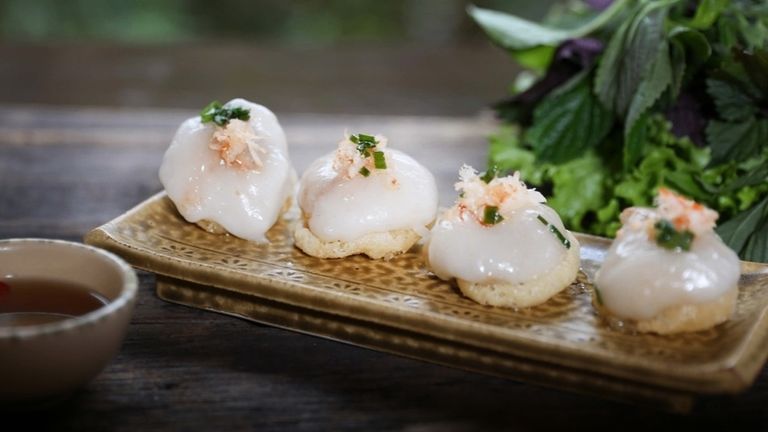
Bánh Ram Ít, a delicacy from Central Vietnam | Source: Bảo Ảnh Việt Nam
Scroll through international food TikTok lately and something unexpected keeps appearing. Foreign creators are handing out perfect scores — not to another bowl of phở or a reinvented bánh mì, but to a hyper-local dish from central Vietnam that most of the world has never heard of.
The virality has produced a strange echo back home. Vietnamese youth, watching clips of foreigners discovering the dish before they have, are flooding social media with a single question: Does anyone know where to find this in Ho Chi Minh City?
The internet has found Bánh Ram Ít. Its rise suggests that the next wave of Vietnamese food culture abroad may arrive not through adaptation, but through dishes that remain stubbornly, unmistakably themselves.
The Best of Both Worlds
Bánh Ram Ít is, structurally, two entirely different cakes stacked into one. The base is bánh ram: deep-fried, golden, built for a loud, satisfying crunch. On top sits bánh ít trần, a soft steamed dumpling of glutinous rice that offers the dense, yielding chew that central Vietnamese cooking prizes as much as any flavor.
In the fifteen seconds it takes to consume on video, you can’t fathom the labor behind it.
True artisans in Hue don't reach for standard flour. They use nếp hương (fragrant glutinous rice) ground by hand and pressed under weights in cloth bags to drain naturally.
The filling is a whole little tôm đất, small local shrimp slow-cooked in scallion oil. The fried base is golden and hollow; the steamed top, translucent white. The whole thing is finished with tôm chấy, a fine golden shrimp powder, and eaten in a single bite with sweet-spicy fish sauce.
An Overlooked Genre of Vietnamese Cuisine
Vietnamese cuisine reached the world through a handful of highly visible representatives: phở, bánh mì, fresh spring rolls. Yet beneath those global exports exists an entire category of dishes that rarely crossed borders at all. Bánh Ram Ít belongs to a broader world of Vietnamese savory dishes built from rice flour, tapioca, fresh shrimp, pork, and mung beans. Despite their local prominence, these dishes have not achieved the same international recognition as Vietnam's famous broths and noodle varieties.
It’s the genre where culinary culture treats texture as seriously as taste, producing a dense constellation of small-portion dishes. Some of the names include the flat, banana-leaf-steamed bánh nậm; the translucent, chewy bánh bột lọc; the delicate bánh bèo, topped with shrimp floss and crispy pork fat. Light and intricate, they belong to the register of afternoon snacks and gentle breakfasts, not the heavy main event.
None of them made it onto the global menu… until now.
The Florida Bánh Ram Ít Problem
Among the wave of foreign praise, one comment stood out: "This crunch is really appealing. I have to ask my mom if she knows how to make this. I've never seen it in Florida."
It's a small observation, but it maps something real. Phở and bánh mì traveled because they were adaptable. Both of the famous dishes are structurally simple enough to survive transplantation, legible enough to attract a broad audience. Savory cakes like Bánh Ram Ít did not make the crossing. Too labor-intensive, too perishable, too rooted in the specific rhythms and ingredients of a particular place. What reached the diaspora was a selection; what stayed in Vietnam was much of the depth.
For Vietnamese communities abroad, watching Bánh Ram Ít go viral isn't quite the same as discovering a food trend. It's a sudden, public window into a craft their parents carried in memory but couldn't always carry in practice, a piece of inheritance that, by surviving intact and largely unknown, turned out to be exactly what the internet was waiting to find.
The Strange Journey Home
Among the thousands of comments praising Bánh Ram Ít, another pattern began appearing beneath the videos. Not from foreigners, but from Vietnamese viewers.
"Where can I find this in Saigon?"
"I've never seen this before."
"I'm Vietnamese and this is my first time hearing about it."
The reactions are amusing at first glance. How does a dish become internationally viral before some people in its own country have tried it?
The answer says something about how Vietnamese food actually moves, or doesn't. Regional cuisines here remain genuinely regional. A dish that feels unremarkable in Hue or Binh Dinh can be invisible to someone two hundred kilometers away in a city. For generations, geography was the barrier. Now the algorithm decides what surfaces, and to whom.
In that sense, Bánh Ram Ít did not simply travel from Vietnam to the world. It made a strange loop back home. Foreign creators discovered it, rewarded it with millions of views, and in doing so reintroduced it to a generation of Vietnamese who might otherwise never have encountered it.
The internet often gets blamed for flattening cultural differences. Occasionally it does the reverse by fixating on something specific and local and hard to categorize, it hands people a map to corners of their own culture they didn't know how to look for.