The Stories Behind Vietnam’s Province Names — Part 4: The Mekong Delta
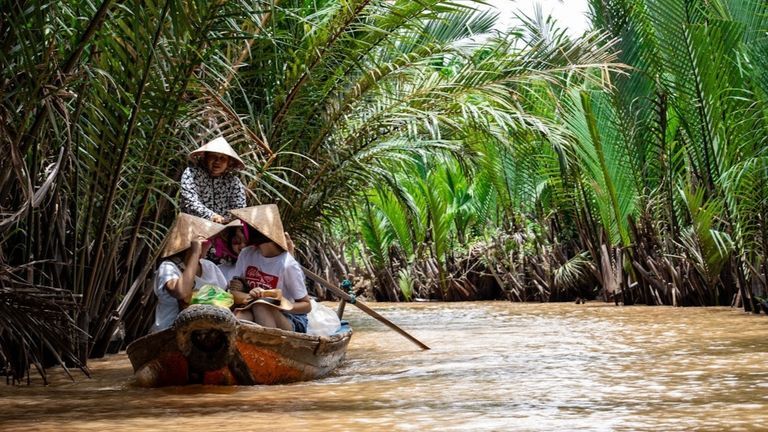
Experience local life by hand-rowed sampan (xuồng ba lá) through Mekong River | Source: Tomáš Malík for Unsplash
This final chapter will flow through Vietnam’s Southernmost area where life follows the rhythm of the river.
Often called Vietnam’s rice bowl, the Mekong Delta produces more than half of the country’s rice output and plays a vital role in feeding both the nation and parts of the world. For centuries, this vast lowland was home to Khmer communities and was part of the cultural sphere of the Khmer Empire. Beginning in the 17th century, waves of Vietnamese settlers moved southward, transforming swamps and forests into bustling towns, canals, and rice fields. Along the way, they adopted and adapted many place names from Khmer, Chinese, and indigenous languages.
As a result, Mekong Delta’s province names reveal natural features such as rivers, mountains and fertile plains, or some preserve traces of Khmer words.
Can Tho
One of the most beloved explanations traces the name to the phrase Cầm Thi Giang (the river of music and poetry). According to local lore, when Nguyen ANh, the future Emperor Gia Long, traveled through the Mekong Delta while fleeing political turmoil, he anchored his boat at the confluence where Cần Thơ now stands. In the stillness of the night, he heard voices reciting poetry, accompanied by traditional instruments and folk songs drifting across the water. Moved by the scene, he is said to have named the river Cam Thi Giang. Over time, local pronunciation transformed Cầm Thi into Cần Thơ.
Another explanation is rooted in agriculture. Historically, the riverbanks were said to be lined with rau cần (water celery) and rau thơm (herbs). Boats carrying produce filled the waterways, and some believe the phrase “Cần Thơm” gradually evolved into Cần Thơ.
In Địa Danh Nam Bộ (Geographical Names of Southern Vietnam), scholar Le Trung Hoa suggests the name may derive from the Khmer term Kìn-Tho, referring to a local species of gourami fish. This interpretation aligns with a broader pattern in southern Vietnam, where rivers and settlements were frequently named after plants and animals common to the area.
The expanded Can Tho now encompasses the former city of Can Tho together with Hau Giang and Soc Trang province. It captures the agricultural richness of a Mekong Delta city often celebrated in the famous line:
Cần Thơ gạo trắng nước trong,
Ai đi đến đó lòng không muốn về.
(Can Tho, where the rice is white and the water clear;
Whoever arrives there never wishes to leave.)
Vinh Long
Vĩnh Long was intentionally created using Sino-Vietnamese characters. “Vĩnh” means everlasting, while “Long” conveys prosperity and abundance. Together, the name can be understood as “enduring prosperity” or “lasting flourishing.”
The province occupies a strategic position between the Tien and Hau rivers, at the very center of the Mekong Delta. For centuries, this location made it an important crossroads linking inland waterways with broader regional trade networks.
The roots of the province date back to 1732, when the Nguyen lords established Long Ho Palace, one of the earliest administrative centers in the south. During Emperor Minh Mang’s major administrative reforms in 1832, the area was formally designated as Vinh Long.
The name reflects both geography and aspiration: a fertile land sustained by rivers, and a hope that prosperity would continue for generations. Today, the new Vinh Long was formed by merging the former Vinh Long, Ben Tre, and Tra Vinh.
Dong Thap
Besides the official name Dong Thap, this province is also locally called Đồng Tháp Mười. “Đồng” means plain or field, and “Tháp” means tower. But the story becomes more intriguing with the addition of “Mười,” which means “ten.”
Đồng Tháp Mười was one of the largest wetland ecosystems in Southeast Asia. Historically, this vast floodplain stretched across present-day Dong Thap, Long An, and Tien Giang.
Several explanations exist. One popular theory suggests that the region contained the tenth tower in a network of ancient Khmer or Funan religious structures. Archaeological discoveries at Go Thap - including Oc Eo artifacts, Sanskrit inscriptions, and temple foundations dating back some 1,500 years, lend weight to the idea that the area was once an important spiritual center.
Over time, the historic name of the region became the name of the modern province, officially established in 1976 after the reunification of Vietnam. Today, Dong Thap includes both the former Dong Thap and Tien Giang province. The province continues to evoke a landscape of lotus-filled wetlands, a symbol immortalized in one of Vietnam’s most beloved folk verses that compares the purity of the lotus to the greatness of President Ho Chi Minh.
Tháp Mười đẹp nhất bông sen,
Việt Nam đẹp nhất có tên Bác Hồ.
(The finest flower of Thap Muoi is the lotus in bloom;
The finest name in Vietnam is that of President Ho Chi Minh.)
An Giang
An Giang combines two Sino-Vietnamese elements: “An” meaning peace or stability, and “Giang” meaning river. The resulting name “peaceful river” or “peaceful waterways” is particularly fitting for a province defined by the branching channels of the Mekong and by its long role as a frontier between Vietnam and Cambodia.
The region was once part of Tam Phong Long, a territory incorporated into Vietnamese administration in the 18th century. During Emperor Minh Mang’s reforms in 1832, An Giang became one of the six provinces of Cochinchina.
Over time, it developed into one of the most culturally diverse regions in Vietnam, home to Kinh, Khmer, Cham, and Hoa communities. The expanded An Giang Province merges the former An Giang and Kien Giang provinces, creating one of the largest and most geographically diverse provinces in the Mekong Delta.
Ca Mau
At Vietnam’s southernmost tip lies Cà Mau, whose name has one of the clearest linguistic origins in the region. Most scholars agree it derives from the Khmer phrase Tuk Khmâu, meaning “black water.” In Khmer, tuk means water and khmâu means black.
The description is strikingly accurate. In the forests of U Minh, fallen leaves from mangroves, melaleuca trees, and nipa palms decompose in the wetlands, turning canals a dark tea-like color. The name was already recorded in Gia Định thành thông chí (Gazetteer of Gia Dinh Citadel) in the early 19th century, indicating that it predated formal Vietnamese administration and reflected an earlier Khmer understanding of the landscape.
The new Ca Mau Province was merging the former Ca Mau and Bac Lieu Province, uniting two coastal provinces at the southernmost reaches of the country.