Unlocking Green Capital: How The New Vietnam-EFTA Agreement Accelerates Value Chain Upgrades
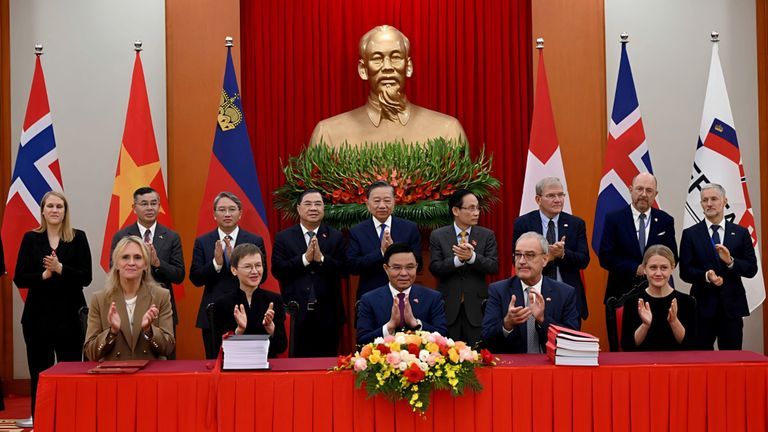
Source: Ministry of Industry and Trade
For decades, Vietnam has been viewed primarily as a low-cost manufacturing hub for foreign multinationals, a model in which the Vietnamese economy itself only retains around 5% to 15% of the final retail value. But now, Vietnam is strategically pivoting towards a higher-value, tech-driven manufacturing model, and the newly signed Vietnam–EFTA Free Trade Agreement (VEFTA) could be the key that unlocks this innovative future. Yet, after a 14-year negotiation marathon to seal the deal, can Vietnam withstand the intense institutional pressure and elevated market standards at this next level of the game?
Overview of the Vietnam-EFTA Agreement
On October 18th, 2026, Vietnam and the European Free Trade Association (EFTA) - including Switzerland, Norway, Iceland and Liechtenstein - signed a free trade agreement in Hanoi, marking the completion of the nation’s broader European trade portfolio.
Vietnam is now one of the only nations in Southeast Asia with trade coverage across all of Europe. From the UKVFTA to the EVFTA, and finally the VEFTA, Vietnam holds the “FTA-Superhub” position in the Southeast Asian global market with preferential access to 32 European markets.
The free trade agreement with the EFTA spans across 14 different chapters including these core areas; trade in goods and services, rule of origin (ROO), investment, intellectual property (IP), trade and sustainable development. The main notable term of the agreement is the asymmetric tariff elimination timeline, where EFTA will impose a 100% tariff cut immediately upon agreement force on all Vietnamese industrial goods and seafood, while Vietnam will get a period of gradual decrease in tariffs of up to 11 years for industrial goods and 16 years for specialized agricultural goods. This gives the domestic Vietnamese firms time to establish a fair market position before allowing stronger European enterprises to enter the game.
Ultimately, this new free trade agreement with EFTA unlocks fresh market opportunities for Vietnam, attracting high-tech foreign direct investment and green capital to drive a genuine upgrade across the domestic supply chain.
Moving Beyond Cheap Labour: The Catalyst to Vietnam’s Green Transition
Foreign enterprises control 62% of the manufacturing revenue in Vietnam, causing massive economic leakages in low-margin assembly. The VEFTA offers a strategic upgrade for Vietnam, leveraging Swiss technological advancements and Nordic green capital funds to jump-start Vietnam’s green transition.
For two decades, Vietnam relied on low-cost labor to attract foreign assembly lines like apparel, footwear or electronics, contributing nearly 30% to the Vietnamese GDP. However, the reality looms over the Vietnamese economy as rising labour costs, constant low value retention and government policy changes prove this growth strategy to be unsustainable in the long run. Vietnam’s Region I minimum wage rose to 5.31 million VND (~ $210 USD) in 2026, reflecting a 20% increase from 2020. While signaling economic growth, this wage inflation erodes Vietnam’s cost-competitiveness against regional peers like Cambodia, Bangladesh, and India. Furthermore, the domestic economy only retains around 5% to 15% of the final retail value for basic assembly lines, underscoring significant economic leakage from over-reliance on traditional FDI.
As a result, the Vietnamese government recently mandated a national shift of “FDI quality over FDI quantity”, targeting green energy, advanced technology and ESG compliance. Since the EFTA is stacked with four small but mighty economies, VEFTA serves as a crucial mechanism for Vietnam to execute this qualitative FDI transition.
Switzerland is the center of global wealth management and biotechnology, the VEFTA will open new doors for advanced technology to flow directly into the Vietnamese economy. Due to the strict intellectual property (IP) agreements enforced in the VEFTA, Swiss pharmaceutical giants will gain legal confidence when establishing actual R&D centers in Vietnam, not just another sweatshop exploiting cheap labour. Beyond capital, these advanced production facilities deliver vital transfers of knowledge that foster domestic innovation. Thus, Switzerland can help divert FDI flows towards productivity and higher-paying jobs in the Vietnamese economy.
Norway and Iceland, on the other hand, offer immense opportunities for Vietnam’s green transition. Norway stands as a global leader in offshore wind and sustainable marine engineering, while Iceland pioneers geothermal energy and carbon-offset frameworks. Norway’s approach to investment is strict under the ESG standards, thus institutional funds cannot deploy into a market with environmental degradation risk. The VEFTA acts as a legal stamp of approval for Norwegian funds to operate in Vietnam, unlocking direct equity for offshore wind, smart grid infrastructure, and industrial decarbonization. Likewise, Vietnam holds significant geothermal potential - with 260 to 300 recorded natural hot water and geothermal sources - Iceland can deploy its capital and technical frameworks for renewable grid stabilization and carbon-credit trading system.
In short, the VEFTA is the key ingredient to building a diverse FDI portfolio for the Vietnamese economy, shifting away from merely a cheap labour manufacturing hub and towards a green-economy.
The 14-Year Journey And Why Now?
After 21 rounds of formal negotiations, the VEFTA took nearly three times longer than Vietnam’s average trade dealing duration. What are the main friction points throughout 14 years of negotiations, and why was the deadlock finally broken this year?
There were several diplomatic tension points between Vietnam and the EFTA that led to such a long process of dealing. Firstly, Switzerland was pushing for strict IP protections - including a 10-year test data exclusivity and patent linkage - for Swiss biopharmaceuticals in the domestic economy. Vietnam resisted to keep essential medicines affordable for its public health system and protect domestic pharmaceutical manufacturers from foreign monopolies, resolving the issue by granting Swiss firms a 5-year data protection window while retaining legal rights to produce low-cost generic medicines during national health emergencies.
Secondly, Norway demanded near-zero tariffs on its premium cold-water seafood exports like Atlantic salmon and cod. To shield domestic firms from dominant foreign competitors, Vietnam resisted opening up its market without reciprocal access and a phased tariff removal schedule was proposed, with Vietnam gradually reducing tariffs and Norway supporting in funding green technology.
Another diplomatic friction point was the strict Environmental, Sustainable and Governance (ESG) as well as Trade and Sustainable Development (TSD) enforcement. The EFTA wanted full adherence to the International Labour Organization (ILO) conventions like independent trade unions or anti-forced labour rules, alongside international climate agreements that Vietnam was not ready for. Vietnam preferred a cooperative and flexible trade agreement that can foster growth without disrupting current domestic export manufacturers. The conflict was resolved with a consultation-based dispute panel paired with EFTA funding to help Vietnamese factories track ESG compliance.
Identifying the tension explains the delay, but what made 2026 a crucial turning point? The breakthrough was driven by two main catalysts; global trade tensions and Vietnam’s institutional evolution. Driven by over 3,000 new unilateral trade restrictions per year and global manufacturing tariffs climbing toward 4.7%, the Trade Policy Uncertainty (TPU) index is at its highest yet. This trade volatility forces Vietnam and the EFTA to seek a stable hedge that can diversify trade risks, leading to securing their trade agreement. Additionally, Western stricter imposition of carbon penalties on industrial imports pressure Vietnam exporters to turn to EFTA for support in developing clean energy to remain competitive in the global market.
Apart from external pressure, Vietnam itself has been evolving institutional frameworks to meet international standards. A prime example is Vietnam’s revised Labor Code in 2019 where workers, for the first time, are granted the legal right to form or join an independent representative organization at the enterprise level outside the traditional Vietnam General Confederation of Labor (VGCL) network, fitting to the ILO standards. Furthermore, IP laws and government procurement transparency were modernized and more flexible to partner with Western markets. This combined with ongoing global trade unpredictability and supply chain disruptions pushed Vietnam and EFTA towards locking in the agreement in order to remain competitive and sustainable in the fluctuating global market.
In the end, the strategic partnership between Vietnam and EFTA is not only the key to a brighter and greener future, but also a crucial hedge against the instability of today’s global markets.
The Reality Check: Can Vietnam Withstand Western Pressure and Retain True Value?
The VEFTA undeniably opens vast economic opportunities for Vietnam. However, the agreement’s ultimate reward depends on how effectively technology and knowledge spillovers are redirected into local industrial development.
Attracting advanced technology is useless if the domestic labor pool remains isolated. Without training to absorb high-tech capital, lower and middle-income workers will become stranded, widening national inequality. Low-wage factory jobs will eventually decline while the real value of FDI leaks out of the Vietnamese economy. To move local suppliers beyond low-tier component assembly, Vietnam must invest heavily in STEM education and mandate tech-spillover partnerships. Ultimately, the success of this agreement depends on Hanoi’s commitment to vocational training, ensuring the working class isn’t left behind in a dying sweatshop sector.
Green capital and high-tech firms also require fast and transparent investment approvals, delayed administrative processes may divert foreign capitals to competing regional hubs like Malaysia or Thailand. As a result, Vietnam must streamline bureaucracy to build a clear and predictable investment timeline and maintain global competitiveness. Additionally, EFTA’s population might be small, but it holds one of the strictest environmental standards in the world, with rigorous requirements on carbon traceability and emission reductions. Thus, Vietnamese firms will face immediate pressure to raise sustainability benchmarks to meet EFTA’s ESG and TSD obligations. But for the vast majority of undercapitalized domestic SMEs, the cost of verifying ESG compliance threatens to become an overwhelming barrier, locking local suppliers out of the very supply chains the agreement was designed to open.
Capturing new opportunities isn’t hard for Vietnam, the real challenge lies in navigating elevated pressure in a way that maximizes domestic value and fosters sustainable economic growth.
Sealing the VEFTA after 14 years cements Vietnam’s position as Southeast Asia’s trade superhub, linking it directly to Europe's wealthiest, greenest economies. By locking in strategic ties with EFTA’s capital and technology giants, Vietnam has built an essential hedge against global trade volatility while opening pathways to high-value industrialization. However, the agreement’s true dividend will not be measured by export percentages alone, but by domestic absorption. Can Vietnam truly retain the value of this new trade agreement?