“We Should Find Meaning Outside Of Being Just An immigrant”: Film Director Dužan Duong
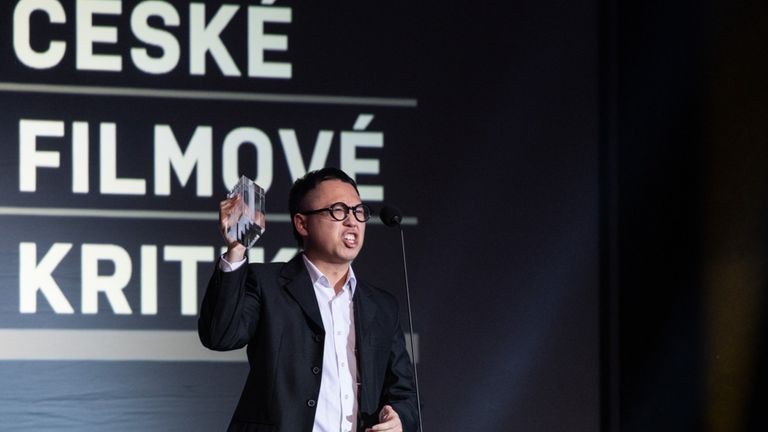
Director Dužan Duong.
Summer School, 2001 is the first film about Vietnamese people in the Czech Republic. Inspired by director Dužan Duong’s own childhood, the film explores the lives of Vietnamese immigrants in the country in the early 2000s.
The film has already drawn attention on the European festival circuit, including at the Czech Film Critics’ Awards 2026, where it won Best Screenplay and Duong was named Discovery of the Year.
At the centre of the story is Kien, a red-haired teenager who returns to his family’s market stall in the Czech border town of Cheb after spending ten years in Vietnam. The reunion is not what he expected. Instead of warmth, he finds a distant father, an exhausted mother, and a younger brother who greets him with hostility.
Duong structures the film as a triptych, told through three perspectives. The father runs a counterfeit fashion stall in the market and worries constantly about money; he speaks mostly Vietnamese. Kien, the older brother who has just returned to Czechia after a decade away, speaks Czech with a distinct Vietnamese accent. Tai, the youngest brother who was born there, speaks fluent Czech. Through these shifting perspectives, the film reveals the generational differences within an immigrant family and the cultural identities each of them carries.
Following a screening in New York on March 16 presented by Citrus—marking the first Czech-Vietnamese theatrical release in North America—I spoke with Dužan Duong about what this moment means to him, and why Summer School, 2001 is more than just another immigrant story.
Your work often focuses on identity and cultural memory. How did this focus come about? Was it a choice from the beginning of your career, or was there a particular story or moment that made you realize you wanted to explore these themes?
Growing up in Czechia, I had no clue what identity or cultural memory was. Back then, our community was still very young, and we had to figure it out on our own. I am considered the second generation of Czech Viets. We were the first ones to know how to navigate in predominantly white society. We were the ones to translate to our parents when they didn’t know the language. And now we are the ones who have the power to tell our niche immigrant stories. So, to answer your question - no, it was not a choice made by me, but it was a choice made by my cultural background and upbringing. But having finished Summer School, 2001, I feel that my urge to find the answers to all my identity questions is finally calmed down. Now I have the opportunity to move on to more universal topics in society.
Some people believe that as an immigrant, one should shed their old identity and adopt the identity of the country they now live in. What are your thoughts on this idea?
The funny thing is that you can sometimes hear this opinion in the Czech Republic, mostly from the ones whose ancestors have been living in the country for generations. But the truth is that the Czech majority very much loves our cuisine and culture. They are so interested in our way of living that you can sometimes feel the positive racism! Many Viet kids are considered to be smart and do well at schools. Many Viets are considered to be the top achievers. So, from my experience, you should not abandon what’s dear to you. Embrace it and use it to stand out.
What was the inspiration behind Summer School, 2001? Could you walk us through the process of developing the story and its characters? Were there any details you hesitated to include?
The story of my debut film was in the making ever since I stepped out of the plane from Hanoi to the Czech Republic. I was only 4 years old and wouldn’t ever imagine myself to be a storyteller. But I was always good at watching people, mostly my community. These stories told among my uncles and aunties were the base for Summer School, 2001.
I like to say that all three main characters are a blend of my own personality and many other characteristics from our diaspora. I like to keep them real and authentic. To me, that is the key to a successful first film about an underrepresented community. It took me almost 6 years to write the script. Why? Plain and simple, I was scared to be intimate and personal. It was the last two years that I finally committed to making this a family drama.
The context of Summer School, 2001 has been described as “a family searching for language, belonging, and love”—a theme often seen in immigrant stories. Do you think we need more Asian or Vietnamese immigrant stories? Why or why not?
I think we definitely need immigrant stories.
But I always tell myself:
"Don’t be the victim of your own destiny, be in charge of it.” To me, it means that we should find meaning outside of being just an immigrant.
My dream is to make films that have a strong opinion about whatever that needs to be told at the current situation. I hope that my own story can be more than just "a Viet boy making Viet movies". My immigrant childhood trauma is healing and I am ready for new challenges. But I strongly encourage young creators to make films about whatever they feel is important to them! Trauma is supposed to be healed!
How would you describe “the ache of growing up between worlds”?
We can call it “the ache” but we can also call it “the perk”. On the positive side, you have two cultures, which you can draw inspiration and energy from. On the negative, you can sometimes feel alone and without guidance. That’s why it is important to have such stories, that can help you feel surrounded by the people who have the same struggles.
What does bringing Summer School, 2001, an Asian coming-of-age story, to North American audiences mean to you?
If you are a teenager from Europe, you consume mostly American culture. And now we can distribute our small Czech-Vietnamese film in North America too? It surely feels like a dream come true. I just recently found out how big the diaspora in California is!
Even though we grew up on different continents and our ancestors might have been against each other during the American-Vietnamese war, through our shared immigrant experience, we learn that we are after all quite similar. A Vietnamese from the North or South? It doesn’t matter anymore. The heart is still Vietnamese nonetheless.
Summer School, 2001 unfolds through three narratives that highlight generational differences within an immigrant family—the father, Kien, and Tai. The story is set in 2001. Looking back 25 years later, does the story still hold the same relevance? How have the dynamics between generations of Vietnamese immigrants changed over the past two decades?
The story of a family looking for a way to talk to each other and to find a way to overcome their distance is very relevant to this day. It doesn’t work only for the Vietnamese but in general for all the families.
I think that the first two generations were very concerned about the work and how to provide for their loved ones. With the third generation coming up, there are different challenges. Nobody is starving and living in poverty anymore. What Viets are really good at is making money. Provide the wealth for the generations to come in only two or three generations? Incredible!
But if you chase the wealth, you might forget about what is truly important and that is the family. The connection. The trust. The generation alpha is now looking for a way to genuinely connect with other humans.
Being an individual torn between worlds is no longer the issue. The issue is how do they truly connect in the technological era.
In one of your previous interviews, you mentioned that “the biggest challenge was how to show this story to the Czech majority, who have little understanding of our traditions and complicated family dynamics.” The film is set within a counterfeit goods market run by Vietnamese immigrants, and portrayals of overseas Vietnamese communities are often associated with poverty, illegal labor, and working-class struggles.
While representation is important, were there concerns about portraying Vietnamese immigrant life through this lens? How would you feel if international audiences came to associate the Vietnamese community with these images, especially when many may not yet have a broader understanding of Vietnamese culture?
It never concerned me how the community would perceive the negative image. I think it is very important to be honest not only about the good stuff but mostly about the bad stuff. That is my Czech side talking. My goal is to be honest.
I grew up in a family where we didn’t know how to be like that. I can at least achieve it through my art. If you are not honest, you are fake and that would be a shame. So I encourage everybody reading this interview to embrace their mistakes and be real. In the age of generated images and digital makeup filters, there is nothing more real than the reality itself.
At the end of the film, the father, Kien, and Tai reconcile in their homeland. What comes after reconciliation?
I hope that after the reconciliation comes the dialogue. I don’t know about others, but in our family, there was never enough of the chatter. We never talked about anything more than small talk about school or food. No real emotions, everybody was too scared to show the sensitive side. There will always be a conflict between kids and parents, but what makes our case special is that you have the combination of both generational and cultural conflict. I hope that families can watch this film together and open up their own traumas and start building a healthy relationship.