



When Time Out unveiled its annual ranking of the world’s coolest neighborhoods for 2026, placing Saigon’s Tân Định Ward at number 12, local urban observers felt a familiar sensation of quiet validation. Six years prior, the publication had plucked Bình Thạnh District from relative international obscurity, celebrating its gritty charm, labyrinthine canals, and thriving street food enclaves. Between those milestones came accolades for Thảo Điền’s riverside sanctuary and District 4’s vibrant Vĩnh Khánh food street. Yet, the recognition of Tân Định represents something deeper than a routine nod to Southeast Asian street life. It marks global appreciation for a very specific urban alchemy that Saigon has perfected over decades, a kinetic, layered formula where heritage, informal community life, and contemporary creativity collide without friction.
To understand why international travel editors consistently fall for neighborhoods like Bình Thạnh and Tân Định is to look beyond the superficial allure of tropical weather and cheap street food. Global travel media has moved past the era of extolling manicured resort strips or sterilized heritage quarters frozen behind glass. Today’s international aesthetic values authenticity, human-scale design, and organic urban friction. Tân Định, a compact enclave spanning less than a single square kilometer along the edge of central Saigon, delivers this exact formula in concentrated form. It is a neighborhood where a century-old wet market, a pastel-pink colonial church, mid-century modernist residential blocks, and hyper-modern specialty coffee bars do not merely coexist—they actively rely on one another to thrive.
The Symbiosis of Market Culture and Sacred Heritage
At the geographic and emotional heart of Tân Định lies a dynamic urban contrast framed by Hai Bà Trưng Street. On one side stands Tân Định Church, completed in the late 19th century and famously painted a striking shade of pastel pink inside and out in the mid-20th century. With its whimsical Gothic arches, delicate spires, and vibrant rose hue, the church resembles a fairytale vision dropped into the middle of a dense tropical metropolis. Directly opposite stands Chợ Tân Định, established in 1927 and historically dubbed the city’s “posh market” due to its premium selection of textiles, produce, and cooked foods.

In many global cities, a historic landmark of this architectural significance would be cordoned off, turnstiled, and surrounded by souvenir shops selling mass-produced trinkets. In Tân Định, high heritage is thoroughly democratized by the daily rituals of local commerce. Visitors capturing photos in front of the Pink Church share sidewalk space with motorbikes loaded with fresh herbs, elderly residents heading to morning service, and street vendors hawking steaming bowls of crab soup and crispy bánh xèo.
The wet market remains an indispensable engine of neighborhood life rather than a preserved relic. Beneath its weathered yellow facade and classic French-era corner towers, generations of stall owners maintain an intricate web of personal relationships with neighborhood residents. The sensory richness of Chợ Tân Định, the slap of fresh fish on marble slabs and the aroma of simmering broth, provides a grounding anchor that keeps the neighborhood rooted in its working-class heritage, even as surrounding property values climb.
The Spatial Magic Of Hẻm Culture And Mid-Century Chung Cư
If Hai Bà Trưng Street serves as Tân Định’s commercial spine, its quieter character reveals itself in the hẻm—the intricate network of residential alleyways cutting through the blocks behind it. In Saigon, the hẻm is more than a passage between streets. It is where domestic life, small businesses and neighborhood socializing overlap. Step away from the traffic-heavy thoroughfares and the rhythm changes: tiled thresholds replace storefronts, electric cables form an improvised canopy overhead, and the boundary between private life and public space becomes less defined.

This is also where Tân Định’s older residential architecture becomes part of the neighborhood’s contemporary appeal. Low-rise chung cư and former cư xá sit alongside narrow houses and shaded alleyways, many bearing the balconies, ventilation blocks, open stairwells and deep overhangs associated with Southern Vietnamese modernism. Their scale is markedly different from the towers rising elsewhere in central Saigon. A building can contain several households, a small business on the ground floor and something entirely different upstairs, all within the same compact footprint.
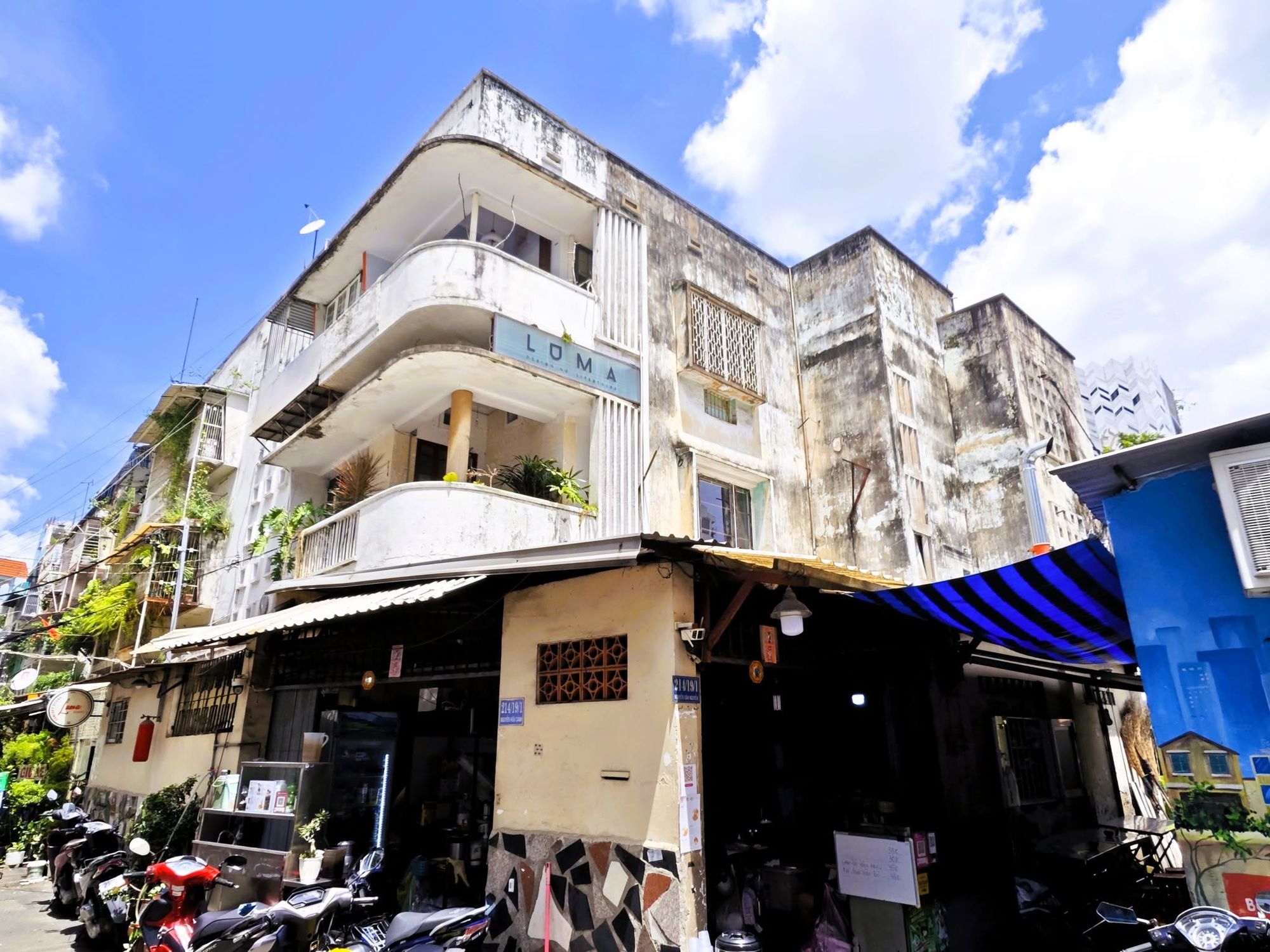
This spatial layout creates an ideal environment for organic urban revival. Because rents deep within the hẻm or on upper floors of aging residential blocks remain accessible, these spaces serve as natural incubators for young creatives and independent concept stores. A prime example of this dynamic plays out on Đinh Công Tráng Street, nestled directly behind the Pink Church, as this single street encapsulates the neighborhood’s multi-layered vitality.
Here, the legendary Bánh Xèo 46A—a sizzling street institution made famous by Anthony Bourdain and recognized by Michelin—operates just meters away from Hẻm 67 Đinh Công Tráng. Tucked inside this single alleyway is a full micro-community of modern lifestyle concepts: Nấm Vegetarian Bistro at 67C, the romantic bakery Blue Dream Bread at 67C, and Sturmfrei Haus at 67B, a vinyl-listening lounge and wine nook.
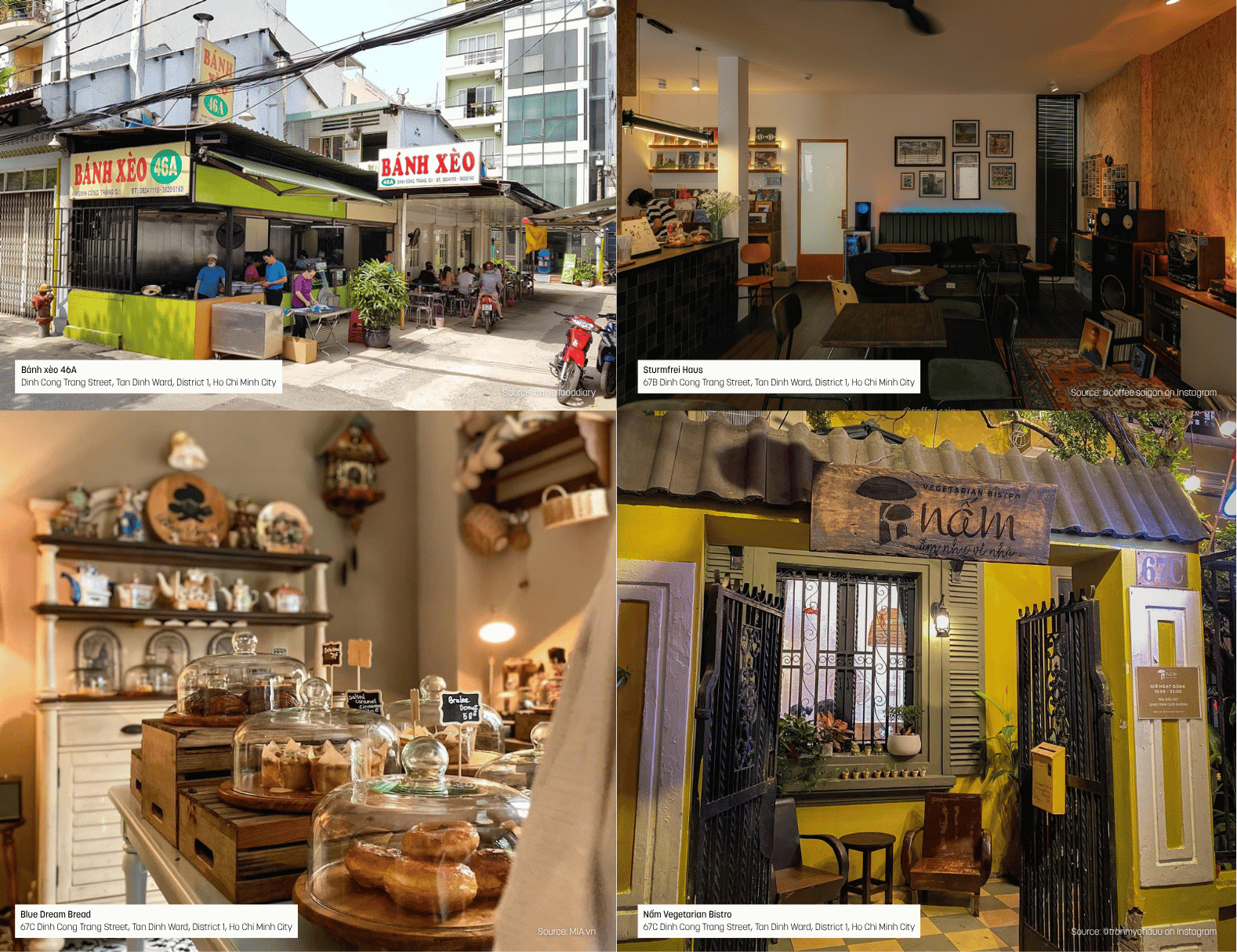
Just around the corner at 393/7 Hai Bà Trưng, Nay Mai operates as a tiny independent store for Vietnamese-designed clothing, zines and local creative goods. Elsewhere, hidden behind similarly unassuming addresses, places such as Can You Keep a Secret? Homebar at 1B Thạch Thị Thanh and Maiden Cocktail Bar at 63/13 Nguyễn Hữu Cầu turn residential-scale spaces into intimate night-time destinations. Grandmum Cafe, tucked into 86B1 in Hẻm 82 Võ Thị Sáu, offers another version of the same idea during the day.

To explore Tân Định, then, is less about ticking off landmarks than following these addresses. Turn into a hẻm, look upstairs, pass through an unassuming doorway and see what has taken root there. The neighborhood’s contemporary character is hiding in plain sight, layered onto a city that was already there.
Specialty Coffee and the Craft of Adaptive Reuse
No analysis of Saigon’s neighborhood appeal would be complete without examining its multi-tiered coffee culture. Vietnam’s relationship with coffee has long evolved beyond traditional cà phê phin served over ice on low plastic stools. Over the past decade, Saigon has emerged as one of Asia’s most creative capitals for third-wave specialty coffee, and Tân Định stands as its ultimate testing ground where all eras of caffeine culture seamlessly overlap.
What distinguishes Tân Định’s beverage scene from that of Tokyo, Melbourne, or London is its commitment to adaptive reuse and architectural contrast. Rather than constructing sleek, glass-box storefronts from scratch, young Vietnamese baristas and concept owners seek out hidden, unconventional architectural shells.
At Sipply Coffee Roastery (73 Đinh Công Tráng), specialty roasters craft single-origin pour-overs inside an aging residential house, pairing exposed brickwork and vintage floor tiles with state-of-the-art espresso machinery. Just down the main thoroughfare, Cộng Cà Phê (274 Hai Bà Trưng) occupies a retrofitted multi-story townhouse directly opposite the Pink Church, using army-green nostalgia and vintage props to repurpose Vietnam's mid-century aesthetic into a major cultural hangout.

As day shifts to evening, this ethos extends into spaces that blur the line between café and nightcap spot. Hidden within the neighborhood’s intricate hẻm networks, concepts like Giao Coffee & Wine create intimate sanctuaries where specialty roasts smoothly transition into curated natural wine selections, operating gracefully inside low-key residential structures.
Yet, despite these modern, dual-purpose additions, Tân Định’s coffee soul remains firmly grounded in its informal street stalls. On the shaded sidewalks surrounding Tân Định Church and along the perimeter of the wet market, street vendors still sling 20,000-VND cà phê sữa đá to regulars perched on plastic stools. This constant dialogue between sidewalk carts, retro coffee houses, specialty roasters, and hybrid café-wine bars creates a layered sense of discovery that international travel editors find irresistible, turning a routine coffee break into an immersive urban exploration.
Beyond Gentrification: The Resilience Of Organic Urbanism
The trajectory from Bình Thạnh’s recognition in 2020 to Tân Định’s triumph in 2026 reveals a consistent pattern in what makes Saigon’s urban design so internationally compelling. In many Western metropolises, when a neighborhood earns the label of “cool,” a predictable cycle of gentrification begins. Rising commercial rents displace long-time residents, unique street stalls give way to uniform luxury boutiques, and the area gradually loses the authentic character that made it desirable in the first place.
Saigon’s inner-city neighborhoods possess a natural resistance to this homogenization, powered by high physical density, multi-generational property ownership, and informal street economics. In Tân Định, the high-end and the humble exist in perpetual, vibrant equilibrium. A Michelin-selected restaurant sits a few doors down from an unpretentious noodle cart; an understated natural wine bar operates directly above an active family altar.
This chaotic harmony is not the result of master-planned municipal zoning; it is the product of organic urbanism, a living, breathing city shaped by the daily needs, resourcefulness, and social ties of its residents. International travel editors do not fall in love with Tân Định because it is pristine or polished. They fall in love with it because it is vibrantly, unapologetically alive.
As Saigon continues its rapid march toward modernization, neighborhoods like Tân Định provide a vital template for the future of urban life. They prove that a neighborhood can welcome global visitors, champion contemporary design, and participate in international trends without surrendering its soul, its history, or its people.