50 Years Of V-League: From The Unification Match To A Modern National Festival
Source: VPF
In its early days, Vietnamese football possessed a raw beauty. Passion coursed through the veins of players and fans alike, defying the immense hardships of the subsidy period. In that context, the rolling ball was not merely a sport, but a bridge connecting hearts.
November 7, 1976, went down in history as a national festival on the pitch. It was the first football match between the North and the South following the country's reunification – a clash between the General Department of Railways and Saigon Port at a packed Thong Nhat "Cauldron."
That match played a role far beyond a mere friendly. It stood as a symbol of national reconciliation, using the universal language of football to erase geographical and historical divides. The electric atmosphere of that day sowed the first seeds of a shared, nationwide playground.
However, as society embraced the market economy, the ball could not keep rolling on its old inertia. The national championship – the backbone of the country's football – also needed radical shifts to keep up with the times. Starting as a rustic spiritual staple for the masses, the top-flight tournament gradually donned a professional cloak. Looking back at the 10 historical milestones below, we can clearly see the contours of a massive metamorphosis.
1980 - The First Seed: "National A1 Championship"
Shortly after reunification, amid the severe socio-economic struggles of the subsidy era, the need for a national sports arena to unify the people was urgent. The launch of the "1980 National A1 Football Championship" (Giải bóng đá A1 toàn quốc năm 1980) was the first turning point, erasing regional borders to gather the 17 best teams.
Though the format was rudimentary, it made a massive impact. This milestone is associated with the historic champions, the General Department of Railways, and a golden generation including Mai Duc Chung and Le Thuy Hai – the pioneers who laid the first bricks for the national competition system.
1990 - Fanning the Flames of Competition: "Tournament of Strong Teams"
Entering the Renovation period (Thời kỳ Đổi mới), the A1 model revealed organizational limitations and a stark class divide between state-owned enterprise teams. To tighten quality and boost competitiveness, the tournament was restructured and renamed the "National Tournament of Strong Teams." (Giải các đội mạnh toàn quốc)
Downsizing the league and applying stricter standards made the matches much more dramatic and visually captivating. This era honored the identity of monuments like Army Club (Thể Công), who won the inaugural season of the rebranded league, or illustrious powerhouses like Saigon Port and Customs (Hải Quan), generating a boiling atmosphere across the stands.
1996 - The Prelude to Professionalism
In the mid-90s, Vietnamese football began strongly reintegrating into the regional arena (peaking with a Silver medal at the '96 Tiger Cup). For the national team to thrive, the domestic league needed a clearer tier system.
The "National First Division" (Hạng Nhất Quốc gia) was introduced as a stepping stone, marking the strict application of promotion and relegation rules, bringing it closer to global organizational models. Dong Thap FC, featuring legends like Pham Anh Tuan, Tran Cong Minh, and Trinh Tan Thanh, claimed the throne that year, becoming the ultimate symbol of the fierce vitality of Mekong Delta football.
2000 - The Millennium Boost and the Birth of V-League
The "part-time" football mechanism – where players worked in factories in the morning and hit the pitch in the afternoon – was no longer viable in the 21st century. The year 2000 marked the greatest milestone: the tournament officially transitioned to a professional model named V-League (2000-2001 season).
This revolutionary change allowed clubs to pay professional salaries, sign commercial contracts, and, crucially, open their doors to foreign players. Song Lam Nghe An, featuring the generation of Van Sy Thuy and Ngo Quang Truong alongside the Ugandan duo Enock Kyembe and Iddi Batambuze, went down in history as Vietnam's first professional champions.
2003 - The "Galacticos" Era and the Wave of Foreign Talents
The emergence of private economic conglomerates completely changed the game. V-League needed a media catalyst to become a spectator magnet. Expanding to 12 teams, coupled with a wave of heavy investments, turned Vietnam into Southeast Asia's most attractive destination.
The pinnacle was the 2002 shocker when Chairman Doan Nguyen Duc (Bầu Đức) brought Thailand's No. 1 superstar, Kiatisuk Senamuang, to play for Hoang Anh Gia Lai in the lower division. Immediately upon promotion, the trio of Kiatisuk, Dusit, and Chukiat led HAGL to the 2003 V-League championship. This was a pivotal period that defined the concept of "corporate football."
2012 - The Upper-Echelon Revolution with VPF
After more than a decade of professionalism, V-League faced stagnation in administration, refereeing, and broadcasting rights under the Vietnam Football Federation (VFF). Clear operational challenges led to the establishment of the Vietnam Professional Football Joint Stock Company (VPF).
This shift separated the state governing body (VFF) from the tournament organizer (VPF), injecting fresh energy into commercial exploitation and league management (unified under the name V.League 1).
2020 - Agility Amidst Adversity
As the COVID-19 pandemic swept the globe, halting all sports, V-League demonstrated remarkable adaptability. Facing the threat of cancellation, the league altered its format for the first time: a single round-robin in Phase 1, followed by a split into championship and relegation groups in Phase 2.
This format inadvertently created unprecedented intensity up to the final minutes. Under coach Truong Viet Hoang, Viettel FC deservedly took the crown, recreating the majestic aura of the old The Cong in a historically unprecedented context.
2023 - Bringing VAR Home
Endless controversies over refereeing were always the "Achilles' heel" hindering V-League's growth. In 2023, Vietnamese football officially implemented Video Assistant Referee (VAR) technology.
This was not merely an infrastructure upgrade but a commitment to transparency and fairness from the organizers. Despite initial growing pains, VAR helped professionalize matches, minimizing violence and foul play. VPF and the Vietnamese referee corps were the unsung heroes in the effort to bring the league up to FIFA's rigorous technical standards.
2024 - Synchronizing with the Global Rhythm
For years, V-League operated within a single calendar year, causing major headaches for national team call-ups and international transfer windows. From the 2023/24 season, V-League made a historic decision: transitioning to a cross-year schedule (from autumn to the following summer).
Fully synchronizing with AFC and FIFA schedules helps national players maintain scientific fitness regimens and allows clubs to easily recruit quality foreign players. Thep Xanh Nam Dinh, under coach Vu Hong Viet, became the first champions of this cross-year format.
2026 - Joining the V-League Festival
To maximize commercial potential and elevate its international image, V-League needed a modern new outfit without losing its core identity.
Looking toward the 2026/2027 season, the league launched a brand-new visual identity, utilizing a custom typography system integrated with motifs that exude the traditional cultural and festive spirit of the Vietnamese people.
This isn't just a visual graphic update initiated by VPF; it is a manifesto on the solidarity and resilient, unyielding spirit of Vietnamese football, turning V-League into a genuine "cultural asset" of the nation.
The Final Piece of the "Professional" Puzzle
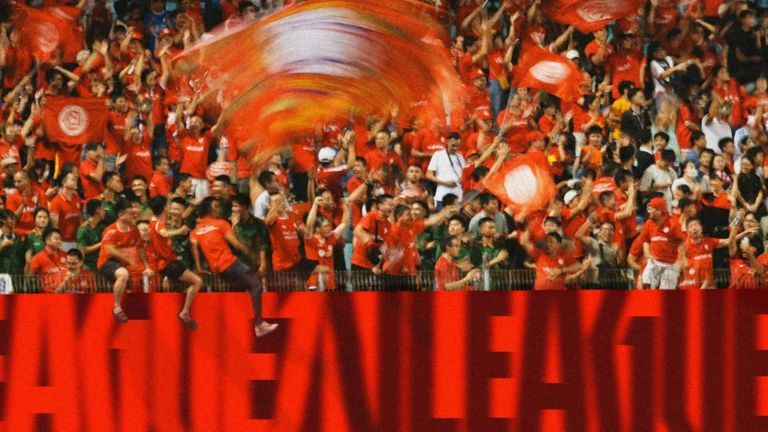
Vietnamese football fans are truly fascinating. They would accept sitting precariously on rough, cracked concrete stands, eagerly setting up ladders to climb over towering stadium walls, or even perching on nearby rooftops just to catch a glimpse of their favorite team's marquee matchup.
That fierce, primal, and pure love seems to have never faded; instead, it has multiplied in the hearts of successive generations of football lovers, walking in tandem with the league's relentless drive to elevate itself through each era.
And so, after a grueling half-century journey of development, V-League is finally earning its "professional" title more than ever. From bumpy, uneven pitches to the lush green grass covering stadiums across the length of the country; from the days when spectators had to lay old newspapers on their seats to a meticulously crafted, multi-platform experience provided by the organizers.
Vietnamese people can now proudly come together to enjoy one of their most vibrant spiritual staples with maximum excitement – exactly like a national festival that no one wants to miss.