Annie Nguyễn’s Journey To The Big World: From A Windowless Warehouse To Deloitte & Home Again
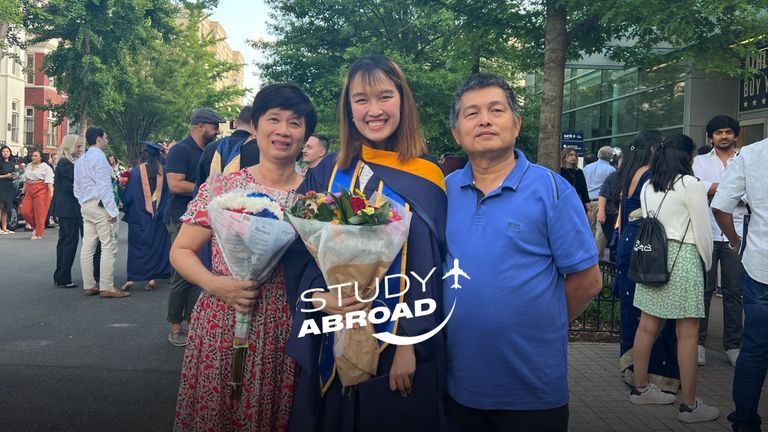
Source: Provided
The morning sun in Saigon is already heavy, pressing a humid 30 degrees against the glass. At 10:00 AM, the office Wi-Fi is acting up, turning our Google Meet connection into a series of pixelated pauses. On the other side of the screen, where it is just past midnight in Washington D.C., Annie Nguyễn sits in a brightly lit room. The video freezes every so often, and her voice occasionally drops into a robotic cadence before catching up again.
There is an irony in this fragile digital link. For the past eleven years, Annie has built a life in the United States around uncertainty—student visas, OPT extensions, and H1B lotteries. Now, at nearly thirty, she is preparing to leave it all behind and return to Vietnam permanently this September.
For Vietcetera’s Study Abroad series, we sat down with Annie to talk about what happens when the perfect, high-achieving plan falls apart, and how a year of relentless silence, a windowless warehouse, and a stack of heavy boxes became the unexpected turning point that led her back to herself.
Eleven years in the U.S. is a long time to build a life. You’ve achieved the corporate milestone many dream of at Deloitte, yet you are preparing to return to Vietnam. What led to this decision?
It really came down to a realization about what kind of life I wanted to live. As an international student in the U.S., you live under a chronic cloud of insecurity. No matter how hard you work, you are always at the mercy of factors beyond your control—visa restrictions, company restructurings, layoffs, and the pure luck of the H1B lottery.
When my H1B lottery didn't work out, my employer actually offered to relocate me to Europe permanently. It was an incredibly supportive gesture, but it forced me to pause and think. I was looking at moving to another foreign country where I had no family, starting over yet again. It felt like trading one temporary solution for another. I’m nearly 30 now. I realized I didn’t want to spend my limited energy waiting for a foreign government to decide if I could stay.
Moving back to Vietnam means leaving my U.S. comfort zone, but it gives me a sense of permanence. I am a Vietnamese citizen. I don't have to worry about getting kicked out of my own country.
You grew up with a lot of educational privilege, attending international schools in Vietnam since first grade before moving to the U.S. How did that background shape your expectations for yourself?
I’ve always been highly aware of the privilege I had. My parents invested heavily in me from day one. Because of that, I carried an immense amount of pressure, but most of it actually came from myself. I deeply wanted to make my parents proud and prove that their investment was worth it.
In Vietnamese culture, and especially in traditional Northern families like mine, there is a strong expectation of high achievement. Success to me back then was very linear: graduate, transition smoothly into a prestigious corporate job, and become financially independent. In my family, the expectation was that once you graduate, you stand on your own two feet. I wanted to show them I could do that.
We often hear about the romanticized version of moving abroad at 18, but your transition from Saigon to the U.S. was far from seamless. What was the reality of that sudden independence?
It was honestly traumatic. In Vietnam, I had attended the British International School (BIS) since first grade and grew up very sheltered—I was basically a "princess" at home. When I landed in the U.S., the sudden isolation hit me hard. My older brother was there, but he was busy with his own work, leaving me completely on my own.
For the first month, I cried every single day. I was so homesick that I would stay on the phone with my mother for hours, and the moment she went to sleep, I would call my nanny back in Vietnam just to hear a familiar voice. It got so bad that my dad finally bought me a plane ticket back to Vietnam that December, just three months after I arrived. But after spending a few weeks at home, when I flew back to the U.S. in January 2016, something in me shifted. I realized I couldn't keep running away. I had to learn to stand on my own two feet, throw myself into my studies, and actually build a life. That painful first year was the first time I actually had to grow up.
For a while, it felt like everything was finally falling into place. During my undergrad at Drexel, I completed three internships, including one in Singapore, and finished a semester early. By graduation, I genuinely believed I had done everything right and that the path ahead was clear.
But graduating in 2020 changed everything.
What was that period like for you?
It completely upended everything I had planned. When COVID-19 hit, there was no graduation ceremony, no celebration. Instead, I entered a job market that had completely shut down. I applied for jobs for an entire year and didn't get a single interview or response.
Out of sheer panic, I decided to cram for the GMAT and apply for an Wharton MBA, including at MIT, just for the sake of having a backup plan. But I was so stressed out and exhausted that I didn't score well. During the interview, they looked right through me and basically said, "It seems like you aren't sure what you actually want to pursue. It is best if you get a year or two of real work experience first."
Getting rejected from MIT and other programs was a massive reality check. It forced me to realize they were right: I wasn't ready.I was only running toward these degrees to escape the shame of my unemployment.
Rejection is hard, but what hurt most wasn't the silence on LinkedIn. It was feeling like I was letting my family down.. My parents had invested so much in my education, and going back to Vietnam without a job never felt like an option—not just because of what they expected, but because I expected the same of myself. The problem was that the job market had completely frozen. It was hard for my family to fully grasp what that looked like from where they were, and just as hard for me to explain it. Looking back, I know they wanted me to keep pushing forward. At the time, though, I felt incredibly lonely and lost.
In the middle of that stressful year, you took a job at a small supply warehouse. Tell us about that transition.
Honestly, I was desperate for any work.
My older brother helped me get a role at a tiny barber supply company with only four or five employees. I was hired as a salesperson making $18 an hour with no health insurance, no benefits, nothing. It was a physical, in-person job during the height of the pandemic, six days a week. The warehouse was cramped, and I barely saw the sun. I would go home with terrible back pain from carrying heavy boxes of travel kits.
But that warehouse ended up being the best thing that ever happened to me. Because it was so small, I didn't just sell; I watched how we imported goods from China, managed inventory fees, and coordinated with international distributors.
My marketing degree suddenly felt very abstract, but this physical warehouse felt real. I realized: This is supply chain. This is global operations. That warehouse sparked my genuine career passion. Marketing went right out the door, and I finally knew what I wanted to build my career on.
Once you discovered that passion, your academic and corporate trajectory took off rapidly. How did you navigate that climb?
Once I knew what I wanted, there was no looking back. I applied for a Master’s in International Business at George Washington University. I loved the coursework so much that I immediately pursued a second STEM-designated master's in Finance to extend my time in the U.S. It was during that second degree that the offers from Deloitte and even Tesla started coming in.
How did your parents react when you finally got that corporate validation?
(Laughs) It is actually a very funny story. When the Deloitte offer came, I immediately called my mom. She didn't know the company name and somehow thought I was telling her I got a job at a big pig farm! She asked, "Why are you working for a pig farm after all this education?"
Once my dad explained what Deloitte actually was, she was ecstatic. She finally started sharing my achievements with everyone. It felt like a massive weight had been lifted. I was so glad I could finally give them that pride.
Looking past the impressive credentials, who is Annie Nguyễn as a person today? How did eleven years of navigating this instability change how you define your own worth?
For a long time, I defined myself by external expectations and the heavy, self-imposed pressure to make my parents' massive investment in me "worth it". I used to constantly compare myself to others, especially on social media, wondering why my peers seemed to have smoother paths.
But these eleven years taught me that I am much more resilient than any corporate title or visa status could ever represent. I learned that I thrive on real-world experience rather than abstract theory. More importantly, I stopped asking "Why is this happening to me?" and started asking, "What is this obstacle trying to teach me".
For many, landing Deloitte and receiving a relocation offer to Europe would be the ultimate "making the most of study abroad" moment. Why is choosing Vietnam your true payoff?
When we talk about studying abroad, we often talk about it as a duty to make the most of the opportunities our parents gave us. But the deeper truth is that study abroad is about discovering who you are when you're stripped of anything familiar.
I spent years in the U.S. trying to prove myself to my parents and to the corporate world. I had to learn, through rejection and visa anxieties, what actually matters to me.
I finally know who I am, what I value, and that my peace of mind and family matter more than a corporate visa. I realized that security is being where my family is, where my roots are, and where I know I belong.
Returning to Vietnam doesn’t mean that I couldn't build a life in the West. It is a natural step forward for me as I am returning home because I want to. I am finally living life on my own terms, and that is the greatest success I could have ever asked for.