Bar Kap: Singapore’s New Lesson In Heritage Hospitality
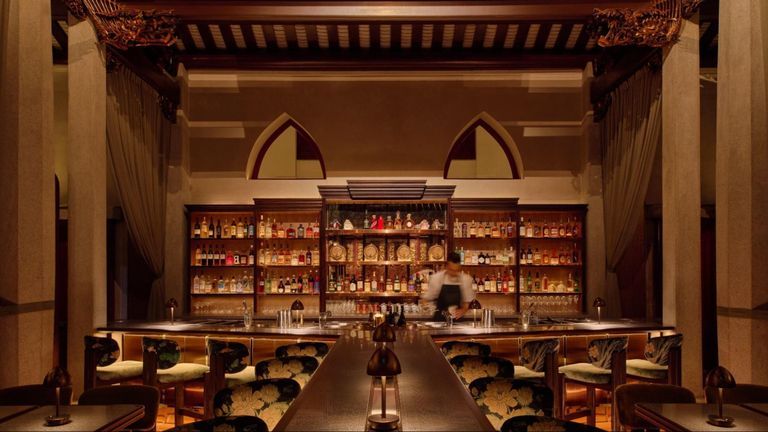
The intelligence of Bar Kap is that it treats the House as a script, not a stage set.
Singapore has been quietly perfecting a niche that Vietnam should be watching closely: heritage buildings that earn their keep. Bar Kap, which opened in May 2026 inside The House of Tan Yeok Nee on Penang Road, is the latest entry in that playbook, and it sets a high bar.
The House of Tan Yeok Nee is the last of Singapore’s famed Four Grand Mansions. Built by a 19th century Teochew pepper merchant, it has since cycled through lives as a British railway station master’s residence, a convent school for Eurasian girls, and a traditional Chinese medicine clinic. It is now a National Monument. By evening, it pours cocktails.
A building treated as a script
The intelligence of Bar Kap is that it treats the House as a script, not a stage set. The cocktail program, developed with Studio Ryecroft, is organised around four eras drawn from the building’s biography: the Kapitan Era of Tan himself, the Station Master Era of British colonial rail, the Order Era of the convent school, and the Dynasty Era of the recent TCM clinic. Each drink is a small act of historical interpretation.
Pepper Peddler (S$28) combines baijiu, gin, and makgeolli into a bright, peppery highball that recalls the spice trade Tan built his fortune on. Tank Road (S$28) reaches back to the colonial railway with roasted orange, bay, grapefruit, and scotch. TCM No. 3, a zero-proof drink of soy milk, ginger, honeydew, and gula melaka, arrives in ceramicware that nods to the building’s most recent occupant. By the fourth glass, a guest has absorbed a century of Southeast Asian history without anyone giving a lecture.
The most ambitious move is the clay-ageing program. Bar Kap is the first bar in Singapore to revive the practice of maturing cocktails inside traditional purple clay vessels, a method that goes back roughly 8,000 years. The Dynamo, a deep build of Irish whiskey, amaro, sherry, and Drambuie, comes out softer and rounder. Owner Chai Karim, principal of Gaia Lifestyle Group and the Karim Family Foundation, sums up the operating philosophy with a line worth pinning above every restoration meeting: “heritage in the walls, modernity in the glass, generosity at the table.”
What Vietnamese visitors can learn
Three lessons stand out.
First, heritage is a verb. Bar Kap insists it is not nostalgia. It is reinterpretation. The team’s job is not to freeze the past, it is to make the past legible to a contemporary guest. Vietnam has no shortage of old walls. We have a chronic shortage of credible programs to keep what happens inside them current.
Second, narrative as menu design. The era-based drink list gives the guest a doorway into the room they are sitting in. It works because someone took the building’s history seriously enough to put it in a glass.
Third, lost crafts are commercial assets, not museum pieces. Reviving an 8,000-year-old clay-ageing technique is the kind of detail that earns press coverage every operator wants. Vietnam has equivalent raw material on the shelf: son mai lacquer, Bat Trang ceramics, royal Hue cooking techniques, the entire vocabulary of Indochina-era cocktail culture. The lesson is to treat craft as a feature, not a decoration.
What we could bring back to Vietnam
Vietnam has the architectural inventory in abundance. The French villas of District 3, the colonnaded shophouses of Cho Lon, the imperial complexes around Hue, the entire fabric of Hoi An. The problem is rarely the building. The problem is the program inside.
A Vietnamese version of Bar Kap is a method, not a copy. Pick a building with a real story. Hire a creative partner who can translate the story into a menu, an interior, and a service posture. Treat the Cho Lon Teochew trade story, or Saigon’s Indochinois cocktail hour, or the royal teas of Hue, with the same seriousness Bar Kap gives to a Teochew merchant. Build a zero-proof list at the same level as the spirited one, which is increasingly how a younger Vietnamese audience drinks. Make a lost craft the anchor.
Note the funding model too. A private family foundation restored the building. A commercial hospitality group operates the venue. That structure is replicable in Vietnam, and arguably more replicable than waiting for the state to move at speed.
Why this is the room for your Singapore meeting
The next time you want to impress a partner, investor, or friend in Singapore, Bar Kap is the kind of address that does the work for you. It signals taste without trying.
The space is intimate by design. Forty-six seats in the main hall, fourteen in the Carriage Room, eight in The Chamber. A conversation that matters is possible. Cocktails are priced between S$18 and S$28, approachable by Singapore standards. The address, 101 Penang Road, is central. Because the menu doubles as a tour through a National Monument, you arrive with a conversation already built in, and walk out with your guest remembering both the venue and you.
For an afternoon read or a tea-only meeting, the adjacent Jing Studio, led by a tea master and open from 10am, handles the daytime register. By 5pm, the bar takes over.
The signal worth taking home
Bar Kap is one of those places that quietly raises the standard of the city around it. It is worth visiting on its own merits. It is also worth studying. The strongest signal it sends is not really about cocktails. It is about what becomes possible when a city decides its old buildings deserve a real second act.
BAR KAP at a glance
- Address: The House of Tan Yeok Nee, 101 Penang Road, Singapore 238466
- Hours: Bar Kap, 5pm to midnight daily. Jing Studio, 10am to 7pm daily.
- Capacity: Main Hall 46, Carriage Room 14, The Chamber 8, Jing Studio 6.
- Reservations: tablecheck.com or +65 8896 1035
More at barkap.sg