Beyond Bars And Clubs: Hanoi Explores A Controlled Night Economy
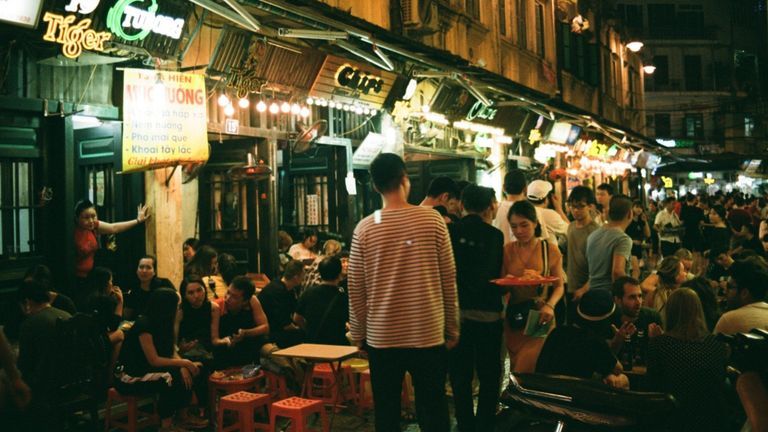
Hanoi wants to explore a “controlled nightlife”. | Source: Chatnarin Pramn
While Ho Chi Minh City has long been known as Vietnam’s “sleepless city,” with countless activities to enjoy at night, Hanoi has traditionally embraced a slower, more restrained pace, with most activities in the capital winding down before midnight.
Now, the capital city wants to change that. In July 2026, the Hanoi People’s Committee has issued a plan to implement a resolution on developing the night-time economy. By 2030, the city aims to make the night-time economy an important driver of its service sector, contributing around 5% of GRDP while gradually increasing its share of local budget revenues.
Into “The City That Knows How To Tell Stories At Night”
The night-time economy is not limited to bars and clubs. It encompasses a much broader range of commercial and entertainment activities taking place between 6 p.m. and 6 a.m., including culture and the performing arts, food and dining, shopping, festivals and events, tourist attractions that operate at night, and unique experiences available only after dark.
In many countries around the world, the night-time economy has become a significant contributor to economic growth. The U.K. is a striking example. The U.K.’s night-time industry contributes around 6% of GDP, with an estimated value of £66 billion, while supporting more than 1.25 million jobs. London alone accounts for around 40% of the sector, worth approximately £26.4 billion and generating 723,000 direct jobs.
Hanoi wants to unlock that potential. Under the latest plan issued in July, the city will review and select areas with suitable infrastructure to develop nighttime entertainment and service zones operating after midnight or around the clock. At the heart of the plan is the development of the cultural industries alongside nighttime experiences. The goal is not to become a “sleepless city,” but a “city that knows how to tell stories at night.”
To achieve this, Hanoi plans to develop and effectively operate several flagship night-time economic zones, each with a distinct function and supported by tailored policies.
The culture and heritage night-time economy zone will cover areas including Hoàn Kiếm, Cửa Nam, Ba Đình, Sơn Tây and Sóc Sơn, leveraging the capital’s historical and cultural assets. The modern entertainment zone will focus on areas such as Tây Hồ–Tây Hồ Tây, Mỹ Đình and Đông Anh.
Alongside these, Hanoi plans to develop creative night-time economy zones linked to the cultural industries, including creative spaces, theatres, cinemas and museums. In the city’s suburban areas, resort and cultural-experience zones will connect nighttime activities with destinations such as Bát Tràng, Ba Vì and Hương Sơn, as well as traditional craft villages.
Alongside this, Hanoi plans to gradually address some of the infrastructure and regulatory shortcomings that have constrained the development of its night-time economy. The city will invest in and upgrade its transport infrastructure, extend metro operating hours and introduce subsidised bus services to improve nighttime connectivity.
It also plans to invest in public lighting, soundproofing measures, green buffers and aesthetically integrated acoustic barriers at locations bordering residential areas. A network of mobile nighttime medical stations will also be established to help ensure public safety and urban security.
Bars and clubs have long presented a particular challenge for Hanoi, where authorities have struggled to strike a balance between maintaining public order and allowing the nighttime economy to grow. Under the new plan, the city will review and select areas with suitable infrastructure to establish licensed nighttime entertainment zones operating after midnight or around the clock. These zones could accommodate services including karaoke venues, nightclubs, bars, pubs and electronic gaming, while operating under requirements for public security, order and cultural standards.
“Not The Extension Of The Daytime”
In reality, policy discussions about Hanoi’s nighttime economy have been there for decades. From the foundational legal framework established by the central government in 2020, Hanoi had pilot schemes implemented between 2021 and 2023, and more recent action plans introduced in 2025–2026. The city has been paying increasing attention to the development of this economic model.
However, the reality paints a very different picture. As of 2025, Vietnam still lacked an official conceptual framework for the night-time economy. A 2026 study by researchers from the Banking Academy found that the country’s night-time economy remains small-scale, fragmented and poorly connected, with limited integration among its core, entertainment and ancillary activities.
Night-time activities in Hanoi currently tend to fall into two main categories. The first is bars and clubs, which are difficult to regulate while balancing economic interests with public safety and security. The second is night markets and food-related activities, which are largely spontaneous in nature and often lack depth in terms of products and experiences.
Hanoi has already introduced some cultural activities at night, such as night tours at the Imperial Citadel of Thang Long and Hoa Lo Prison. While these initiatives demonstrate the city’s efforts to build a distinctive nighttime identity and diversify its after-dark offerings, they remain relatively fragmented and disconnected from other nighttime activities, such as dining and entertainment.
Under the master plan issued in July 2026, Hanoi aims to develop its night-time economy in a more integrated, systematic and connected manner. The city also plans to designate and delineate specific areas for night-time economic development, separating them from residential zones while defining distinct functions for each designated night-time economy zone.
However, experts argue that alongside adding “more experiences,” Hanoi also needs to improve its public infrastructure and lighting to encourage visitors to stay longer. The city should also expand late-night services beyond restaurants to include supermarkets, gyms, bookstores and shopping malls.
“The night-time economy is not simply about doing business at night,” said Nguyễn Trần Hoàng Phương, director of the Institute for Social Tourism Research. “Staying open until 2 a.m. does not create a night-time economy if there is nothing worth spending money on after 10 p.m. The night-time economy must be a tourism product, not an extension of the daytime.”
What To Expect From Hanoi’s Nightlife
When you come to Hanoi now or in the near future, here’s what you can expect as the city rolls out its new night-time economy strategy.
More places will be allowed to stay open past midnight. Designated areas could operate until 2 a.m., particularly around Hoàn Kiếm, the Old Quarter, Tây Hồ and emerging cultural and tourism corridors. In selected pilot zones, bars, clubs and late-night F&B venues could operate until 6 a.m., but only within specifically designated entertainment areas that meet requirements for infrastructure, security and public order.
Expect more than bars and clubs from Hanoi’s night scene. The city wants to move beyond the familiar “bar + beer corner + night market” formula and build a more diverse range of nighttime experiences. That could include traditional music and contemporary performances, light shows at heritage sites, night tours of museums, temples and the Imperial Citadel, as well as digital and AR-based heritage experiences. Creative night hubs, night marathons, festivals and other events designed specifically for the evening could also become a bigger part of Hanoi after dark.
Ultimately, Hanoi’s ambition is not simply to keep the city open later, but to make the night worth staying for. The question is whether the capital can turn longer opening hours into experiences that give visitors and residents a reason to stay after dark.