Beyond The Checkup: How NURA Is Using AI to Look Deeper Into Our Health
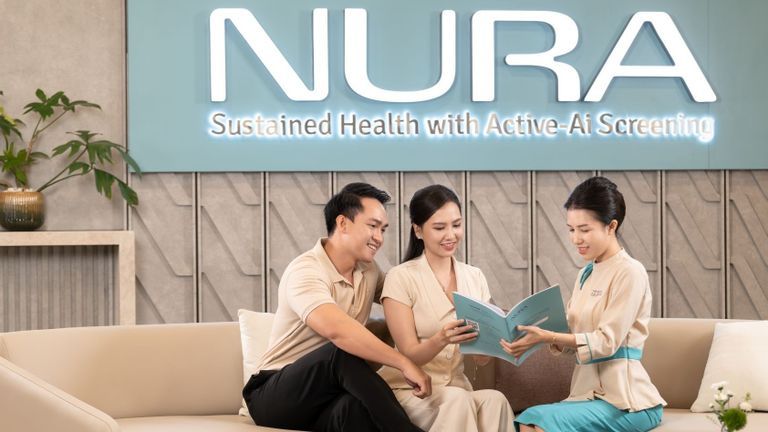
Source: NURA
You can track six months of resting heart rate data and still have no idea a lung nodule is quietly growing inside you right now. You can know your sleep score down to the minute and have zero visibility into what's happening in your liver, your kidneys, or your thyroid.
That's the gap I wanted to understand when I sat down with Sylvia Gawad, Head of International Growth at NURA Vietnam, an AI-powered, full-body health screening centre in Hanoi and Ho Chi Minh City. NURA runs each scan through up to 50 specialised AI algorithms, each trained to spot a different type of abnormality, drawing on a dataset of roughly 400 million data points to flag changes as small as 1 millimetre. That's a level of internal visibility that no wearable, no annual checkup, and no amount of self-tracking has ever been able to offer an otherwise healthy-feeling person.
Which raises the obvious question: if we're already this obsessed with tracking ourselves, why does this one blind spot still exist?
The Blind Spot In Self-Optimisation
Young professionals are already accustomed to tracking themselves.
Smart rings monitor sleep cycles. Fitness watches measure heart rate variability and workout recovery. Nutrition apps calculate macronutrients, while digital dashboards record productivity, spending, and investment growth.
Data has become part of how we understand progress. This mindset has also brought biohacking into the mainstream. Once associated with extreme diets, cold plunges, supplements, and Silicon Valley experimentation, the term is increasingly used to describe something more practical: using reliable information to make better decisions about how we live.
Yet the gap I opened with is real, and it's larger than most people realise. Many people know how long they slept last night but have little insight into what is happening inside their liver, lungs, kidneys, or thyroid. They can monitor their resting heart rate across six months, but may have no baseline against which internal changes can be compared.
"We track everything," Sylvia said. "We track our sleep, our workouts, our finances, even our net worth. So why aren't we tracking our health?"
Consumer wearables provide useful information, but they primarily measure behaviour and outward performance. Medical data offers a different layer of understanding: how the body itself is responding over time. A smartwatch can report seven hours of sleep. It cannot identify a small lung nodule. A fitness tracker can suggest that recovery is improving, but it cannot show whether an internal cyst has remained stable or begun to change.
One measures how we live. The other can help us understand what is happening beneath the surface.
What Makes This Different From A Standard Checkup
This is where the obvious skepticism comes in: preventive screening isn't a new idea. Annual checkups exist. Corporate health packages exist. So what's actually different about NURA's version of it, beyond another company saying "prevention matters"?
The difference is mechanical, not philosophical. A standard checkup typically moves a patient between several departments over multiple days, relies on baseline bloodwork and a physical exam, and often can't detect anything below a certain size or severity threshold. NURA compresses that into a single visit, with each scan cross-checked by dozens of algorithms trained on specific abnormality types rather than a single radiologist working alone.
That gap - between "screening exists" and "screening catches things early enough to matter" - is the actual argument here, not the fact that preventive care is a good idea in the abstract.
When Feeling Healthy Is Not The Full Picture
The consequences of discovering disease late extend well beyond medicine.
In July 2026, VnExpress reported the case of a 32-year-old father in Hanoi who was diagnosed with stage-three stomach cancer. The main breadwinner of his family, he had lived with stomach pain for years but assumed it was a minor problem and continued working, often taking night shifts to earn additional income.
By the time severe pain and other symptoms finally brought him to hospital, the disease had already reached an advanced stage. Faced with the potential cost of treatment, he considered giving up his chance at treatment so that the family's remaining savings could instead support his wife and children.
The story is confronting because the diagnosis did not affect one body alone. It immediately became a question of income, caregiving, savings, parenthood, and what a family could afford to lose.
Late detection, in other words, can become more than a medical problem. It can narrow not only treatment possibilities, but the choices available to an entire household.
"Ignorance is bliss until it happens to you or someone you love," Sylvia said. "Then you ask why it wasn't dealt with earlier."
Preventive screening cannot eliminate uncertainty, prevent every illness, or guarantee a particular outcome. But earlier visibility may create something valuable: more time, more context and, in some cases, more options.
With more than 15 years of experience across healthcare systems in Canada, Egypt, Uganda, and Vietnam, Sylvia has observed one pattern repeatedly: most healthcare systems remain reactive.
"We wait for symptoms to appear before seeing a doctor," she explained. "We wait until people reach a certain age before screening for diabetes or cancer. The system is built around responding after something has already happened."
For decades, that model reflected the limits of medical access. Advanced imaging was expensive, specialised, and generally reserved for patients with symptoms or known risk factors. As technology develops, however, preventive healthcare is beginning to offer another possibility: understanding the body before something feels wrong.
For Sylvia, this is not about replacing public healthcare systems or turning healthy people into patients. It is about giving individuals greater visibility into their health and more agency over the decisions that follow.
According to Sylvia, NURA has conducted more than 36,000 screenings over the past two years. During that period, the centre has seen findings among younger adults more often than many people might expect. This may reflect environmental, lifestyle, or genetic factors, but it also reflects something more straightforward: medical technology can now identify changes that might previously have remained unseen for longer.
Building A Health Baseline
The idea Sylvia returned to most often was not AI, nor technology, but baseline. A health baseline is a starting point: a record of what is normal for an individual at a particular moment. Its value grows when future results can be compared against it.
Imagine that a screening identifies a small thyroid cyst. Viewed alone, that finding may create uncertainty. But if later screenings show that it has remained stable or become smaller, the data offers reassurance. If it grows, the change may prompt further medical attention.
That is where health information becomes more useful: not as an isolated snapshot, but as part of a trend. This also helps address a common concern about preventive screening: whether more data simply creates more anxiety.
A single unexplained result can indeed feel overwhelming. But longitudinal data can give both patients and physicians more context. It can help distinguish between something that requires immediate action and something that only needs observation.
As Sylvia explained, knowing more does not necessarily mean worrying more. In many cases, uncertainty creates greater anxiety than a well-understood baseline.
Health self-reliance, however, should not be confused with self-diagnosis. More access to data does not reduce the need for medical expertise. It makes that expertise better informed. Screening results become genuinely useful when physicians interpret them in context, explain what matters, and guide the next step, whether that means lifestyle changes, follow-up imaging, further testing, or no action at all.
Nura As A Case Study In Medical AI
So how does this actually work, mechanically?
According to Sylvia, each CT scan can be reviewed by up to 50 specialised AI agents, with each model trained to focus on a different type of abnormality, from lung nodules and liver lesions to organ-specific findings. The system draws from up to 400 million data points and can support the detection of abnormalities as small as 1 millimetre. The purpose is not to replace physicians. It is to add another layer of analysis before doctors interpret the findings, determine their clinical significance, and advise on next steps.
AI also plays a role in image reconstruction. Sylvia explained that NURA's ultra-low-dose CT protocol can reduce radiation exposure by up to 97% compared with a conventional scan, bringing it closer to roughly three weeks of natural background radiation. Because lower-dose scans typically produce grainier images, AI is used to reconstruct and enhance the visual data for clinical review.
The process is also designed to be more streamlined imaging, AI-assisted analysis, blood tests, ultrasounds and a same-day doctor consultation, all completed in around two hours rather than spread across multiple departments and days. A comprehensive screening is priced at approximately US$370, positioned against what advanced, AI-assisted, same-day preventive imaging costs elsewhere: a fraction of what comparable screening typically runs when accessed overseas, without the added cost and disruption of travel.
From One-Time Results To Long-Term Decisions
A screening result is not a complete picture of health. It does not replace everyday habits, routine medical care, or specialist treatment. Nor can one scan predict every future risk. Its value lies in creating a reference point.
Over time, annual or periodic screening can help reveal patterns that a single result cannot. A stable cyst may require no intervention. A gradual rise in visceral fat may become a prompt to adjust diet and exercise. A new change in an organ may lead to earlier follow-up. This is where preventive healthcare becomes less about "finding disease" and more about making better long-term decisions.
The same logic already shapes how people approach other parts of life. Financial planning depends on tracking change over time. Fitness progress is rarely judged by a single workout. Career development is measured across years, not one performance review. Health may be moving in the same direction: from occasional reaction to continuous understanding.
A Different Relationship With The Body
For proactive screening to become a natural habit among young professionals, the ultimate barrier isn't technological, it is cultural.
For generations, we have been conditioned to treat health checks as an uncomfortable chore reserved for middle age, mandatory corporate checkups, or moments of physical distress. Yet the philosophy of modern wellness is already nudging us toward a different truth.
We go to the gym long before we develop cardiovascular illness. We brush our teeth and visit the dentist long before our teeth decay. We service our cars regularly so they don't break down on a quiet highway at midnight.
Preventive health screening operates on that exact same quiet wisdom. It does not guarantee an immortal life free of hardship, but it replaces blind hope with clear sight. It offers an honest, detailed map of where your body stands today, and alerts you if the terrain begins to shift tomorrow.
As younger generations grow increasingly comfortable navigating their world through data, the next frontier of biohacking won't be found in another gadget, a daily pill, or an extreme lifestyle trend. It will be found in a far deeper, more grounded form of self-knowledge: understanding the body from the inside out, establishing a trusted baseline, and making decisions alongside medical experts.
After all, the ultimate goal of biohacking is not to control every single outcome. It is simply to stop living, and making choices about our health, in the dark.
About NURA VietnamNURA Vietnam is an AI-powered, full-body health screening centre with locations in Hanoi and Ho Chi Minh City. Backed by Fujifilm technology, it combines medical imaging, artificial intelligence, and physician review to support a more proactive approach to healthcare.According to NURA, its CT imaging process can involve up to 50 specialised AI agents analysing different types of abnormalities across hundreds of millions of data points. The centre also uses ultra-low-dose CT protocols supported by AI image reconstruction to reduce radiation exposure while maintaining image quality.Screenings are designed to take around two hours, with findings assessed according to Japan-based standards and explained through a medical consultation. NURA positions screening as a way to establish a personal health baseline and monitor changes over time, rather than simply react to symptoms after they appear.Learn more about NURA, click HERE.