Beyond Tourism: How Hosting APEC 2027 Is Reshaping Phu Quoc
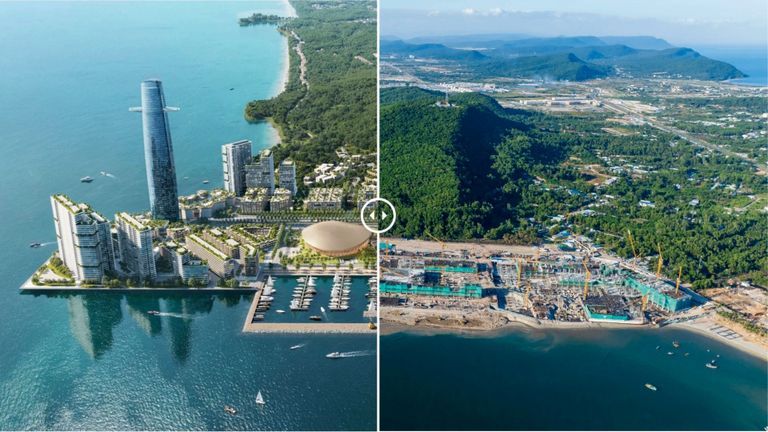
Construction of the 22 trillion VND (USD 836 million) mega-project to serve APEC 2027 in Phu Quoc. | Source: Z News
Phu Quoc island (now An Giang province), one of the designated areas of Vietnam's Special Economic Zones (SEZs), will become the third city in Vietnam to host the APEC Summit (2027), followed by Hanoi (2007) and Da Nang (2017).
Since June 2025, the island has broken ground on a series of major infrastructure projects, including the APEC Conference Center complex, a light rail transit system, the expansion of Phu Quoc International Airport, new resettlement areas, and Provincial Road DT.975 — a key traffic axis connecting the airport to the APEC site.
Why a resort island, not a mega city?
At first, the choice seems counterintuitive. Hanoi and Ho Chi Minh City face far greater congestion and transport demand. But Phu Quoc is not being positioned as a typical city. It is being shaped as a showcase city.
The island’s value has long been rooted in nature: beaches, forests, and a strategic location in the Gulf of Thailand, layered with large-scale resort and entertainment developments. With fewer residents, tighter land-use control, and a global tourism audience, Phu Quoc offers a controlled environment to test new urban models.
Phu Quoc towards a transformation phase
APEC 2027 marks a turning point aligned with Resolution No. 59 on Vietnam’s broader strategy for international integration. Phu Quoc’s value is now measured not only by tourism numbers, but by its global image and long-term positioning.
The USD 830 million APEC Conference Center complex has advanced at an unprecedented pace. By late 2025, most foundation and land reclamation work was completed. Steel structures are scheduled to finish in early 2026, exterior works by mid-2026, with full handover targeted for early 2027.
The complex is being built to global MICE (Meetings, Incentives, Conferences, and Exhibitions) standards, and is expected to become Vietnam’s largest conference venue, with a main hall capacity nearly three times larger than the National Convention Center in Hanoi. The main convention space can host up to 10,000 attendees, with banquet facilities for approximately 5,000 guests, and an international media center with a capacity of around 4,000 journalists.
Connectivity across the island is being upgraded in parallel. Phu Quoc International Airport is expanding across more than 1,000 hectares, including a second runway, a new terminal, and a dedicated VVIP facility. Structural works on the VVIP terminal have been completed, with the full airport upgrade expected to be operational by March 2027 — compressing a typical five-year timeline into just 18 months.
New arterial roads and ceremonial boulevards are also taking shape, stitching together the airport, conference zone, and urban areas.
At peak periods, thousands of workers and machines operate around the clock to meet fixed handover deadlines ahead of 2027.
Beyond tourism: signaling to policymakers and investors
Behind the infrastructure surge is a broader ambition: repositioning Phu Quoc beyond a holiday destination. Hosting APEC 2027, combined with its elevation to a Class-I city, is expected to accelerate tourism growth, urban development, and socio-economic transformation.
The scale and speed of investment — driven largely by private capital from groups such as Sun Group and Vingroup — signal that Phu Quoc is being prepared as a platform for international visibility and investment confidence.
Yet this transformation comes with conditions. According to Dr. Vo Tri Thanh, Director of the Institute for Brand and Competitiveness Strategy (BCSI), long-term planning, institutional coordination, and alignment between central authorities, local government, and investors will be critical to ensure post-APEC infrastructure delivers sustainable value.
After the spotlight fades
Vietnam has seen this pattern before. Da Nang’s transformation ahead of APEC 2017 accelerated upgrades that might otherwise have taken decades. Phu Quoc is now following a similar trajectory.
The real measure of success, however, begins after the event ends. Will this infrastructure serve local communities, or remain optimized for occasional global moments? Who, ultimately, are these cities being built for?