Documenting A Changing Country: A Photographer's Observation On Post Đổi Mới Vietnam
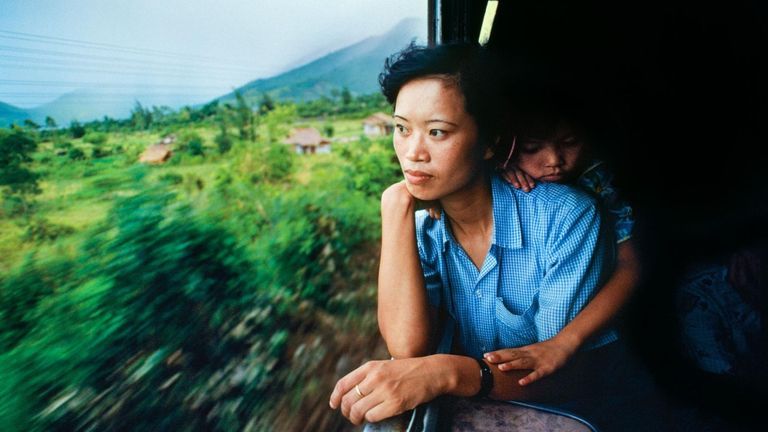
Karnow’s photograph of a teacher named Tran Thi Diep on the Thong Nhat train in 1990.
Documenting a Changing Country 1990–2015 presents Catherine Karnow’s intimate, decades-long portrait of Vietnam. Known for her global reportage for National Geographic, Karnow turns her lens toward a country she has photographed for more than thirty years. Timed to the 50th anniversary of the end of the American War and the 30th anniversary of US–Vietnam diplomatic relations, the exhibition traces Vietnam’s extraordinary transformation from 1990 to 2015.
Born in Hong Kong and now based in San Francisco, Karnow is an internationally recognised photographer whose work has appeared in National Geographic, Smithsonian, GEO. Her lifelong relationship with Vietnam began in 1990, shaped partly by her father, Stanley Karnow—author of Vietnam: A History—yet ultimately forged through her own encounters with the country’s layered histories and shifting futures.
Her photographs chart Vietnam’s early Doi Moi (Reformation) years, the legacies of war seen through the lives of Amerasians and families affected by Agent Orange, and the arrival of a confident “New Vietnam.” Along the way are portraits of significant figures: the legendary double agent Pham Xuan An; Ho Chi Minh’s sculptor Diep Minh Chau; the last relatives of Emperor Bao Dai; and General Vo Nguyen Giap, whom she photographed privately in Dien Bien Phu in 1994 and again throughout his 2013 funeral.
What emerges is both a national chronicle and a personal one.As Karnow notes, “Vietnam reveals itself to me in small moments — gestures of grace and resilience that shape how I see the world.”
NGUYEN THI LY, AGENT ORANGE GIRL, 2010
During the Vietnam War, the US military released nearly 12 million gallons of Agent Orange across swathes of the country, stripping the land of foliage so enemy troops would have nowhere to hide. Decades later, long after the spraying stopped, its toxic residue continues to mark Vietnamese lives.
Passed down genetically, the effects of Agent Orange have manifested as diseases and physical deformities that now span three generations of Vietnamese families.
AMERASIAN BOY AND MOTHER, 1990
An enduring and often overlooked legacy of the Vietnam War is the story of the Amerasians – the children born to American soldiers or civilians and Vietnamese women. No one truly knows how many there were; estimates range from 70,000 to 100,000.
GENERAL GIAP, “SNOW-COVERED VOLCANO,” 1990
The French called him the “snow-covered volcano,” because of his icy exterior and explosive temperament.
Do you notice how the two halves of his face look almost like they belong to different people?
“On the left side, you see the iron-willed general — the strategist who told my father, quite literally, we will fight at all costs. It’s the face of a man willing to push a war to its final consequence.
But on the right side, another figure emerges: someone unexpectedly gentle, remembered for his kindness toward his female troops, someone who would later become deeply spiritual. A face that softens, almost contradicting the other,” Karnow remarks.
BAO NINH, 1990
The acclaimed author, Bao Ninh, wrote The Sorrow of War, published in 1990. It was the first book to depict the horror and brutality of war, countering the government’s propaganda. The people worshipped him for it, and he became an instant celebrity. He never published another work, retreating instead into a quiet life on the outskirts of Hanoi.
THE LAST ROYALTY, 1990
In Hue, Karnow’s intention was to find the last surviving relatives of Bao Dai.
The questions guiding her were simple: How do you illustrate the Nguyen Dynasty? How do you convey that, before there were presidents or prime ministers, there were dynasties?
In retracing Karnow’s path to Hue, she wanted to move beyond the surface of the citadel façade. Her interest was in people. She spent the day with two of Bao Dai’s relatives, later photographing them in the cemetery in France where their family rests.
HANOI OPERA HOUSE, 1994
Legacy of the French and a pride of Vietnam, the Hanoi Opera House was completed in 1911. It is also where, in 1945, Viet Minh forces staged a grand meeting to assess the armed forces, which directly led to the general uprisings against French rule throughout the country.
For Karnow, this photograph encapsulates Vietnam’s layered histories. French architecture sits alongside the trace of wartime trauma, embodied in the man with an amputated leg. The 1990s appear in the cyclo driver waiting for a passenger; the future, in the woman on the motorbike.
WOMAN ON TRAIN, 1990
In Central Vietnam,Tran Thi Diep, a schoolteacher from Hanoi, rides the Saigon-Hanoi train, also known as the Reunification Express.
One image reveals the duality of Vietnam that Karnow often returns to: the stillness of a woman set against the blur of a passing train. The photograph becomes a meditation on temporal ambiguity: is she moving toward the future, or turning back toward the past? Vietnam, as Karnow suggests, lives in that tension: nostalgia for what has been, and a persistent hope for what might come.
About Vietnam - Documenting a Changing Country 1990-2015
- Venue: 45 Trang Tien exhibition house, Hanoi
- Duration: 21.11 - 05.12.2025