Dong Nai Rerouted A Riverfront Road To Preserve A 100-Year-Old Villa
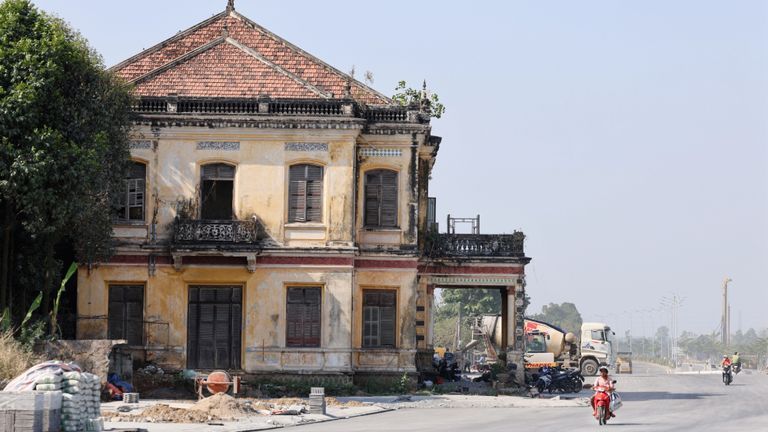
100th-year old villa located along the Riverfront Road, Dong Nai. | Source: Phước Tuấn for VnExpress
The Dong Nai Riverfront Road project has been completed by 90%, with traffic expected to open before the Lunar New Year 2026. On the route lies 100th-year-old Vo Ha Thanh villa, the project has been forced to reroute the road, encroaching into the Dong Nai River.
The road is part of a major urban restructuring strategy centered on the Cai River, the historical spine of Bien Hoa. Provincial authorities have classified it as a key infrastructure project for a city that aims to expand toward the river.
Stretching roughly 5.2 kilometers, the Dong Nai riverside road was initially designed to cut directly through the Vo Ha Thanh villa. Under the original plan, nearly nine meters of the structure would have been demolished for road works. Following recommendations among historians, architects, and cultural experts, the provincial People’s Committee instructed the Department of Construction to assess alternative strategies: rerouting the road along the section passing the 100th-year old villa.
A house built from Bien Hoa’s history and economy
In the early 20th century, Bien Hoa—once a frontier settlement shaped by river trade, stone quarrying, and craft villages—was gradually reorganized into a colonial administrative city. Built between 1922 and 1924, the house stood alongside the Bien Hoa Administrative Office, marking the city’s transition from frontier land to colonial urban center.
The French-style villa was built for Vo Ha Thanh, who held the title đốc phủ (former provincial governor), a high-ranking local administrative position under French rule. Unlike traditional mandarins shaped solely by Confucian education, provincial governors of this era represented a new class of Vietnamese officials—fluent in colonial bureaucracy and navigating between indigenous society and French governance.
Architecturally, the house combines French structural principles—symmetry, thick masonry walls, and tall windows—with local adaptations, including carved wooden details, traditional gable roofing, and the extensive use of Buu Long green stone quarried locally. Thanh’s wealth came from stone quarrying, an industry that helped shape Bien Hoa’s early economy.
The villa therefore functioned as more than a residence: it reflects a moment when Vietnamese elites began adopting Western lifestyles while remaining rooted in local materials and landscape.
This private residence holds a collective memory
Over the decades, the villa became woven into the cultural life of the region. It served as a filming location for cinemas or television dramas, most notably The Beauty of Tay Do (Người đẹp Tây Đô) and The Tailor (Cô Ba Sài Gòn), embedding its image in popular memory as a symbol of the past.
Tran Buu Loc - director of The Tailor shared to Tuổi Trẻ news: "When scouting locations, the film crew immediately liked the setting and space because it fitted with the script and characters. The film crew prepared for a week and filmed for two weeks. This house had a classical beauty and was suitable for the 1960s-era’s aesthetic."
Through cinema, the villa entered public consciousness not as a living space representing memory, class, and a colonial heritage.
Complex realities of heritage preservation in Vietnam
Despite its age and architectural value, the villa has never been officially classified as a historical monument. Its current status reflects the complex realities between historical value, private ownership, and urban planning.
According to the Dong Nai Department of Culture, Sports, and Tourism, the villa first drew official attention in 2016, when heritage specialists identified its architectural significance and proposed adding it to the monument ranking list. However, the approval process stalled due to a lack of consent.
As the villa is privately owned, authorities required the cooperation of the property’s legal representatives to proceed with monument classification. The house’s representative refused the designation, citing concerns over restrictions on renovation, usage, and inheritance. This impasse highlights a recurring limitation in Vietnam’s heritage system, where preservation efforts often clash with private ownership rights.
In 2023, following a survey of areas slated for demolition under the Dong Nai Riverside Road project , “the Department of Culture, Sports and Tourism proposed to the Provincial Party Committee the direct solutions to preserve and conserve the villa architectural structures for its historical values,” said Nguyen Hoang An, Deputy Director of the Dong Nai Department of Culture, Sports and Tourism, to VTC News.
The debate surrounding Lầu ông Phủ reveals a larger truth: in Vietnam, heritage is not always lost due to neglect. Instead, it often survives in a gray zone - valued, yet unprotected and legally fragile.
For now, when the city continues to expand, the villa still remains standing by the Dong Nai River. It is a reminder that preservation is often less about labels, and more about whether a society chooses to negotiate with its past, or pass over it.