Echoes Of 1934: Why Gen Z Is Reimagining Vietnam’s Early Tân Nhạc?
Source: Vietnamnet
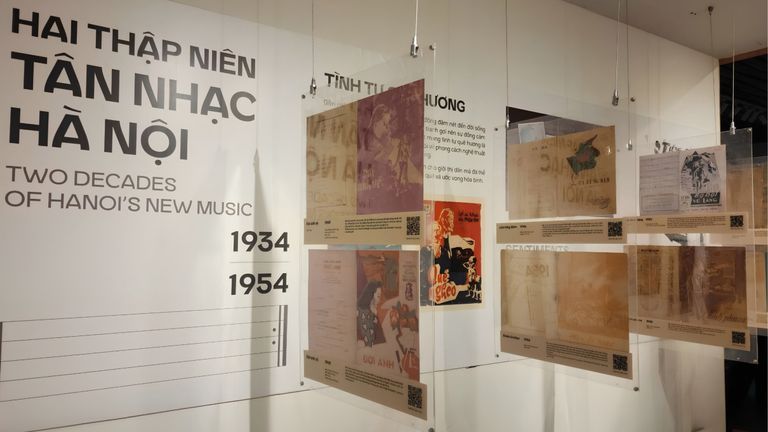
Inside the sprawling corridors of the Hanoi Museum, a quiet revolution is taking place. Amidst the artifacts of the Thăng Long - Hanoi Festival, a particular exhibition titled “Hướng về thành phố xa xưa: Hai thập niên tân nhạc Hà Nội (1934–1954)” (literally “Looking Towards the City of Old: Two Decades of Hanoi’s Modern Music (1934–1954)”) has become an unlikely magnet for the city’s youth. They aren't just there for the Instagram aesthetics of sepia-toned posters; they are there to find the roots of a melody they’ve heard sampled in lo-fi beats or reinterpreted on prime-time television.
Under the curation of researcher Nguyễn Trương Quý, the exhibition chronicles the pivotal twenty years when Vietnam’s sonic identity pivoted forever. It was a time when the clatter of horse-drawn carriages began to compete with the hum of the gramophone, and when the traditional scales of the past met the romantic harmonies of the West. Today, nearly a century after the first notes of Tân Nhạc (literally “New Music”) were penned, Gen Z is rediscovering these “echoes of 1934” not as museum pieces, but as a living, breathing part of their cultural DNA.
The Birth Of Tân Nhạc: A Revolution On Five Lines
To understand the current obsession, one must look back to 1934, often cited as the dawn of the modern Vietnamese song. Before this period, Vietnamese music was primarily rooted in the pentatonic scale and traditional theatrical forms like Chèo or Tuồng. The transition to Tân Nhạc was more than just a musical shift; it was a psychological break from the old world.
Influenced by French romanticism and the soaring popularity of Thơ Mới (literally “New Poetry”), young composers began to experiment with Western five-line staff notation. They traded the rigid structures of the past for the fluid, emotional possibilities of the piano and the violin. Composers like Văn Cao and Phan Huỳnh Điểu were polymaths of their era, blending the melancholic beauty of Vietnamese lyricism with the sweeping arrangements of European classical music.
This era marked a profound cultural shift. The youth of the 1930s and 40s sought a new language for an emerging individualistic sensibility—one distinct from the communal and classical functions of Ca Trù or Hát Xẩm. In blending Western scales and chromaticism with local vocal traditions, they forged a hybrid sound that felt both strikingly novel and deeply Vietnamese.
The Sheet Music Culture And The Business Of Art
Walking through the “Hướng về thành phố xa xưa” exhibition, one is struck by the visual beauty of “tờ nhạc” (literally “sheet music”). In an age of digital streaming, it is easy to forget that music was once a physical, tactile commodity. These sheets, often featuring hand-drawn lithographic covers, were the primary way music was consumed and shared.
Publishing houses like Tinh Hoa (literally “The Essence”) and Thế Giới (literally “The World”) were the epicenters of this burgeoning industry. For the first time, music was a professionalized trade. Composers received royalties, and the success of a song was measured by how many printed scores were sold in the stalls along the streets of Hanoi.
However, Tân Nhạc wasn’t just about romantic pining. It was also a tool for civic engagement and nation-building. During the mid-1940s, as the movement for independence gained momentum, music became a vehicle for mass education. A fascinating example is the song “Cô Tú” (literally “The Young Lady Scholar”), which was written to support Bình Dân Học Vụ (literally “Mass Education Movement”). These songs were designed to be catchy and easy to remember, helping to teach the national alphabet to a largely illiterate population. The music of this era served a dual purpose: it comforted the soul in the evening and educated the mind in the morning.
The Aesthetic Of Resilience
There is a specific phrase often used by Vietnamese music critics to describe the pre-war era: “Buồn Nhưng Không Bi Lụy” (literally “Sad But Not Despairing”). This emotional nuance is perhaps the most significant reason why Gen Z finds this music so compelling today.
The songs of the 1934–1954 period—works like “Dư âm” (literally “The Echoes”) by Nguyễn Văn Tý or “Áo mùa đông” (literally “The Winter Coat”) by Phan Huỳnh Điểu—are undeniably melancholic. They speak of missed connections, the mists of the West Lake, and the departure of soldiers. Yet, there is an underlying dignity in this sadness. It is a “clean” sorrow, one that acknowledges pain without surrendering to hopelessness.
In an era of high-speed living and “hustle culture,” modern listeners are finding solace in this refined melancholy. The lyrics of Đoàn Chuẩn – Từ Linh, for instance, are masterpieces of atmospheric storytelling. For a generation grappling with their own anxieties and the search for identity in a globalized world, this “sadness without despair” offers a template for emotional maturity. It is music that allows you to feel the weight of the world while still standing tall.
The Gen Z Renaissance: From “Anh Trai” To Jazz/Trap
The revival of Tân Nhạc isn’t happening in a vacuum. It is being fueled by a sophisticated wave of reinterpretations across various media. One of the most visible catalysts has been the television phenomenon “Anh Trai Vượt Ngàn Chông Gai” (official English title “Call Me by Fire Vietnam”). On this show, veteran artists and young idols collaborate to “remix” heritage songs, often infusing them with rap verses, heavy synth-pop, or jazz arrangements.
When a young artist takes a classic like “Tiến Quân Ca” (official English title “The March to the Front”) or a romantic ballad from the 1940s and layers it over a trap beat, they are doing more than just refreshing a melody. They are engaging in a dialogue with their ancestors.
Gen Z producers are particularly fond of “Jazzification.” By leaning into the cabaret roots of early Hanoi music, they are creating a V-Jazz scene that feels both cosmopolitan and deeply rooted in local history. Artists like Mỹ Anh or the band Chillies have shown that the melodies of the past have a structural integrity that can withstand even the most radical genre-bending. These modern versions serve as a gateway; a teenager might discover a song on TikTok, only to find themselves months later at the Hanoi Museum, staring at the original 1930s sheet music.
A Timeless Cultural Bridge
The enduring power of Vietnam’s early Tân Nhạc lies in its ability to act as a bridge between the East and the West, as well as the “ancient city” and the “smart city.” The 1934–1954 era was a time of profound transformation, much like the present day. Then, as now, the Vietnamese people were looking for a way to define themselves in a changing world.
By reclaiming these songs, Gen Z is asserting that their identity is not a blank slate. They are the heirs to a sophisticated tradition of fusion and resilience. As the exhibition concludes its run, the music it celebrates continues to echo through the headphones of students on the Metro and the speakers of chic rooftop bars.
The “echoes of 1934” remind us that while the technology of music changes from gramophones to tờ nhạc to streaming, the human heart’s need for beauty, romance, and a sense of belonging remains constant. In the reimagining of Tân Nhạc, Vietnam’s youth have found a way to move forward by looking back, ensuring that the melodies of the past are never truly lost, but merely waiting for a new voice to sing them.
Why International Listeners Should Pay Attention?
For an international audience trying to grasp modern Vietnam, Tân Nhạc provides an indispensable key.
Too often, foreign narratives reduce 20th-century Vietnamese history purely to military conflicts, viewing the nation strictly through the prism of war. But the story of Tân Nhạc reveals a deeply sophisticated urban culture that was actively negotiating its identity, art, and romance in the face of monumental global upheaval.
It demonstrates how Vietnamese artists took European instruments. The violins and pianos brought by colonizers, and turned them into tools of self-expression, cultural sovereignty, and artistic innovation. They did not become Westernized; they made the Western language of music speak with a Vietnamese soul.
When you listen to a modern V-Pop track or an indie lo-fi beat sampled from a 1940s ballad, you are hearing the sound of a culture that refuses to abandon its past. You are listening to an unbroken dialogue across almost a century, from the quiet, oil-lit alleyways of 1934 Hanoi to the neon-lit, smartphone-illuminated avenues of today.
As the exhibition at the Hanoi Museum draws to a close, the mechanical music box plays its final notes of “Tiến Quân Ca”. A group of teenagers records the moment on their smartphones, instantly uploading the video to their feeds with a lo-fi filter. The brass cylinder stops turning, but the echo lingers, gentle reminder that in Hanoi, no true melody ever truly dies. It simply waits for the next generation to play it again.
Exhibition Information
- Title: Hướng về thành phố xa xưa: Hai thập niên tân nhạc Hà Nội (1934–1954) (literally “Looking Towards the City of Old: Two Decades of Hanoi’s Modern Music (1934–1954)”)
- Venue: Bảo tàng Hà Nội, Phạm Hùng Street, Nam Từ Liêm District, Hanoi
- Duration: Open through late September
- Featured Artifacts: 102 original sheet music prints, shellac records, archival photography, and interactive soundscapes curated from the private collection of Nguyễn Trương Quý