Hanoi Takes First Steps Towards Flying Taxis
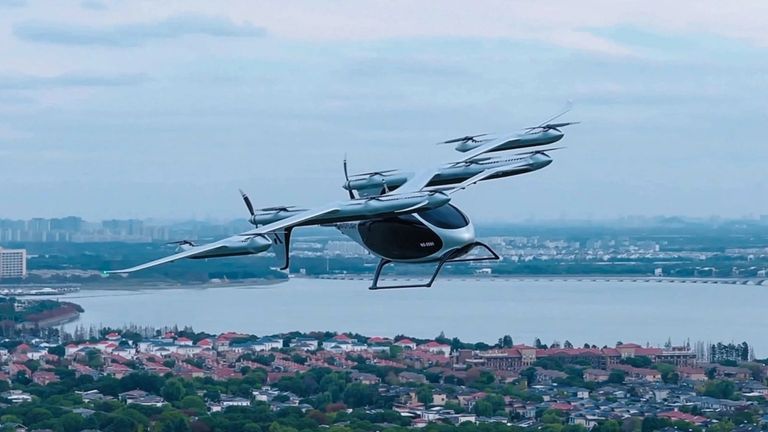
Flying taxis in China. | Source: SCMP
Flying taxis have been included in Hanoi’s 100-year master plan as a potential mode of future transportation. Now, that future may be closer than expected.
On September 28, the Hanoi Department of Science and Technology and Hung Viet Company signed an agreement to research and propose controlled trials of flying taxis in Hanoi
The partnership will focus on developing a pilot proposal, studying traffic management models for unmanned aerial vehicles (UAVs), and establishing an operations control centre. A commercial low-altitude economy model will be explored once the trials are completed and their effectiveness has been evaluated.
What’s In Hanoi’s Plan?
Flying taxis are no longer a futuristic concept. The technology is being tested in several countries, including the US, China and the UAE. China has made some of the most significant regulatory progress, bringing flying taxis closer to commercial passenger operations.
Under Hanoi’s proposal, unmanned flying taxis would operate at four locations across Hanoi, completing approximately 500 flights over four months to assess their capacity to transport passengers and cargo.
The four proposed testing sites include Hoa Lac Hi-Tech Park, West Lake, My Dinh National Stadium and the Hateco Long Bien area. Each location would be assessed under different flight routes, altitudes, and takeoff and landing arrangements.
The proposed aircraft is the EH216-S, an autonomous flying taxi developed by Chinese manufacturer EHang, which has already obtained an operating certificate in China. Since receiving certification, EHang’s operators have completed more than 3,000 EH216-S flights.
However, commercial passenger operations still await further approval from the Civil Aviation Administration of China (CAAC). The approval process in Hefei has reportedly been delayed following an aircraft accident in June that was unrelated to EHang.
Back in Hanoi, the city’s Department of Science and Technology has circulated the controlled trial application to relevant authorities and agencies for feedback. This, however, does not constitute official approval to proceed with the proposed trials.
“No decision has been issued by the Hanoi People’s Committee approving the implementation of flying taxi trials,” Le Thu Hien, representative of Hanoi’s Department of Science and Technology, affirmed.
How Soon Could Flying Taxis Take Off In Hanoi?
While Hanoi is only taking its first steps towards introducing flying taxis, several countries are already approaching commercialisation. However, as of early October 2026, no country has established a regular, paid flying taxi passenger service.
Alongside China, the US and the UAE are also moving closer to commercial operations. Unlike China's autonomous flying taxis, US-developed models are designed to operate with pilots on board.
In the US, two leading flying taxi developers, Joby Aviation and Archer Aviation, are in the final stages of the Federal Aviation Administration's (FAA) type certification process. Both companies missed their initial targets for commercial launches in 2025 due to certification delays.
The UAE has also opted for piloted aircraft developed by US manufacturers. Bonny Simi, President of Operations at Joby, said the company hopes to launch commercial services in Dubai before the end of 2026, with the first vertiport at Dubai International Airport already completed.
On February 25, 2026, Joby and Uber unveiled Uber Air, a service designed to allow passengers to book flying taxi rides directly through the Uber app. However, Joby must still complete its vertiport infrastructure and secure the necessary approvals from the UAE’s aviation authorities before launching commercial operations.
These developments suggest that technological readiness alone is not enough to bring flying taxis into everyday use. Regulatory approval, supporting infrastructure and public trust remain critical hurdles, even for countries at the forefront of the industry.
For Hanoi, turning the proposal into reality will require more than successful test flights. The city will need to develop the necessary infrastructure, establish a clear regulatory framework and build consensus among authorities, industry stakeholders and the public to ensure the technology can be tested and eventually adopted safely.