Hanoi’s 100-Year Transformation Plan Explained
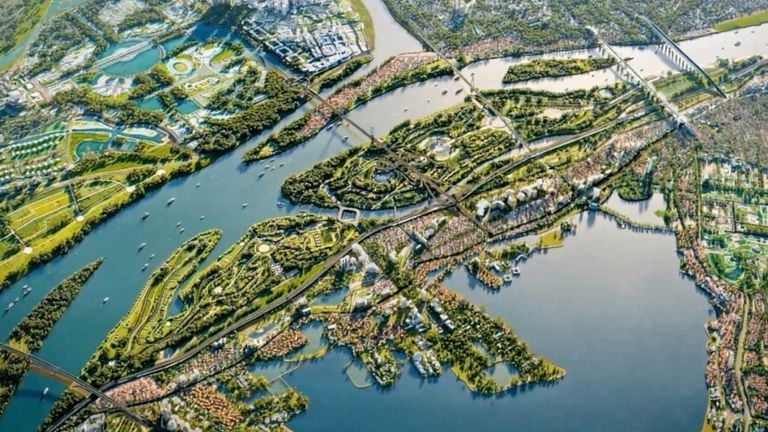
Hanoi plans to completely change in the next 100 years. | Source: Hanoi’s People Committee.
On May 14, the Hanoi People’s Committee approved a master plan for the capital with a 100-year vision.
The plan is the city’s longest-term development blueprint to date, setting out Hanoi’s strategy through 2085 and beyond while reshaping the capital’s urban structure, growth model, transport network, population distribution, environment, and economy for generations to come.
From limiting its population to 20 million people to flying taxis, Hanoi aims to transform itself into a greener, smarter and more decentralised megacity.
What Hanoi will look like in the next 100 years
The plan envisions a “Cultured, Civilised, Modern and Happy” Hanoi, which is built through the following strategies:
Population of no more than 20 million people
The plan emphasises “placing people at the core” of development. Under the vision, Hanoi aims to pursue not only economic growth but also improvements in the quality of life.
The master plan projects Hanoi’s population to reach around 14–15 million by 2035, 15–16 million by 2045, and 17–19 million by 2065. After 2065, the city plans to cap its population at 20 million.
At the same time, Hanoi targets annual GRDP growth of around 11%, both overall and per capita. By 2065, per capita GRDP is expected to reach 95,000 USD per year, before rising to at least 200,000 USD after 2085.
Beyond economic targets, the blueprint also sets out specific social goals. These include an average life expectancy of 79–80 years, 70–72 healthy years of life, and a happiness index of 9.2–9.5 out of 10, with Hanoi aiming to rank among the world’s happiest capitals by 2065.
Rapid, sustainable and inclusive development
The master plan sets an ambitious economic target for Hanoi to maintain double-digit growth, with GRDP expected to expand by more than 11% annually and reach roughly 1.92 trillion USD by 2065. In the longer term, the city aims to sustain growth at around 5% per year.
Rather than relying on extensive, land-driven expansion, Hanoi plans to shift toward a development model powered by productivity, science, technology and innovation. The capital aims to complete industrialisation before 2030 while prioritising high-value sectors such as semiconductor manufacturing, artificial intelligence and environmentally friendly industries.
The plan also proposes the development of smart ecological industrial parks, high-tech zones, free trade zones and free economic zones designed to attract advanced industries and international investment.
Besides economics, Hanoi also seeks to strengthen its cultural and creative identity. Authorities aim to develop markets for cultural products and position the capital as a regional and global Creative City, while expanding tourism and service industries.
Rebuilding the urban structure
Over the next century, Hanoi plans to move away from traditional outward expansion and instead develop as a “multi-polar, multi-centred” megacity.
Under the strategy, the capital will expand not only on the ground, but also underground and in low-altitude airspace. Hanoi plans to build extensive underground infrastructure — including reservoirs, drainage systems and parking facilities beneath roads and public spaces — to address chronic flooding and improve urban capacity.
The city also aims to gradually integrate advanced aviation technologies, such as drones and flying taxis for logistics, into its future transport network. While these technologies are still in the trial or early commercialisation stage in countries such as the United States, the United Arab Emirates and China, Hanoi has incorporated them into its long-term planning vision, identifying them as potential components of the capital’s future development over the next century.
At the same time, Hanoi will decentralise development away from the historic core. The Red River is expected to become the capital’s main ecological and cultural corridor, linking Hanoi with surrounding provinces and regional economic networks.
Different urban zones will take on specialised roles: the historic centre will remain the political, cultural and financial hub; northern Hanoi will focus on logistics and free trade around Nội Bài Airport; the east and south will develop industry, transport and logistics infrastructure; while Hòa Lạc and Sơn Tây–Ba Vì are planned as centres for technology, innovation and eco-tourism.
Transport infrastructure is positioned as the backbone of the strategy. Hanoi plans to expand metro and regional rail systems, develop Ring Roads 4, 4.5 and 5 as new economic corridors, and build a second international airport in southern Hanoi to strengthen regional connectivity and reduce pressure on the city centre.
Reshaping the historic core
The blueprint also proposes large-scale urban renewal across both historic and ageing districts. Hanoi plans to selectively redevelop and restore key areas, including the Old Quarter, the French Quarter, old apartment blocks, Tây Hồ, and heritage sites such as the Imperial Citadel of Thăng Long, Cổ Loa and the Temple of Literature.
Authorities also plan to restructure urban areas along Ring Roads 1, 2 and 3, synchronise infrastructure block by block, expand green spaces and promote transit-oriented development in suburban zones.
A vision stretching beyond this century
Unlike previous urban plans focused on short-term expansion, Hanoi’s new strategy offers more comprehensive solutions to long-standing urban challenges such as traffic congestion, flooding and environmental pollution. More importantly, it is a century-spanning vision that attempts to imagine what the capital could look like for generations to come.
What emerges from the blueprint is Hanoi’s attempt to pursue several difficult goals simultaneously, such as balancing rapid economic growth with sustainable development, and accelerating urbanisation while still preserving the city’s cultural and historical identity. It is an ambitious challenge not only for Vietnam but for many major cities in the world.
Whether Hanoi can fully realise that vision remains uncertain. But the scale of the plan signals a major shift in how the capital sees its future: not simply as a growing city, but as a city attempting to redesign itself for the next 100 years.