How El Niño and Upstream Dams Are Forcing the Mekong Delta to Reinvent Farming
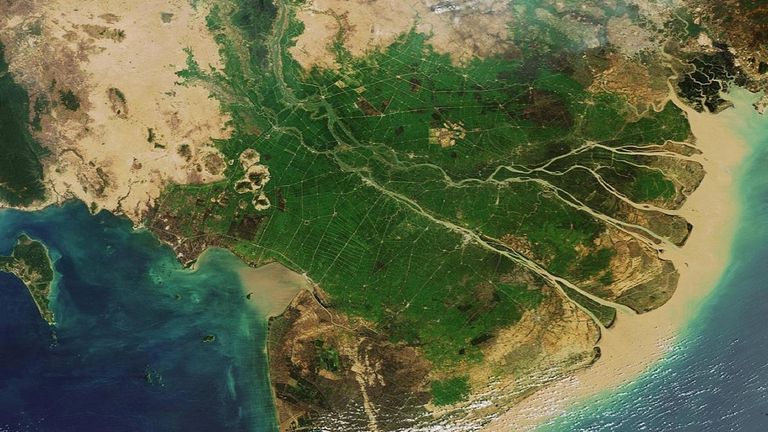
An intricate network of rivers, irrigation canals and rice fields forms the Mekong Delta, Vietnam's agricultural heartland. | Source: European Space Agency (ESA), Copernicus Sentinel-2
In the low-lying waterways of southern Vietnam, the dry season no longer arrives merely as a pause in the monsoon rains. As the Mekong Delta enters the 2026–2027 dry season, the ocean is once again advancing up its rivers, turning vital irrigation canals brackish and threatening the fields that feed tens of millions of people.
For decades, the region’s answer to the encroaching sea was concrete: higher dykes, heavier embankments and vast networks of sluice gates designed to keep freshwater in and saltwater out. Today, caught between a warming climate and a rapidly sinking landscape, the delta is being forced into a far more profound transformation, learning not how to defeat the salt, but how to live with it.
When The Sea Moves Inland
The immediate trigger is brewing thousands of kilometres away in the Pacific Ocean. According to an October 2026 assessment by UNICEF Viet Nam, the delta is entering the dry season under the grip of an unusually intense El Niño, with a 96% probability that very strong conditions will persist through January 2027. For the Mekong basin, that atmospheric shift translates into suppressed rainfall and dwindling river flows just as tidal forces from the East Sea push upstream with greater vigour.
With less freshwater flowing down from the upper Mekong to hold the ocean at bay, seawater is forecast to surge deep into the delta’s intricate web of estuaries and canals. Projections released in November 2026 by the Southern Institute for Water Resources Research (SIWRR) warn that the 4 grams-per-litre salinity boundary, a concentration toxic to most rice varieties and fruit trees, could penetrate 50 to 70 kilometres inland along several river mouths. Across coastal provinces, rice paddies, fruit orchards and municipal freshwater supplies face months of acute stress.
For farmers here, the forecast carries an unsettling sense of déjà vu. Extreme salinity events are no longer rare anomalies; they are becoming a recurring feature of delta life. During the severe El Niño crisis of 2015–2016, seawater intrusion damaged roughly 244,805 hectares of rice cultivation across the region, according to research published in the journal Water in 2023, wiping out harvests and leaving hundreds of thousands of households short of drinking water. Each major drought leaves deeper economic scars and exposes just how fragile the delta’s freshwater defences have become.
Why The Salt Is Winning
Climate variability is only half the story. Beneath the seasonal advance of the tide lies a slower, human-made crisis that is structurally tilting the delta in favour of the sea.
For millennia, the Mekong Delta was built and sustained by vast quantities of sand and silt carried down from the Tibetan plateau. That geological conveyor belt has been dramatically throttled by cascade after cascade of upstream hydropower dams. Research led by the geomorphologist Đoàn Văn Bình and colleagues, published in Geomorphology in 2020, found that dam construction has slashed the volume of sediment reaching the delta from roughly 167 million tonnes a year to just 43 million tonnes—a drop of around 74%.
Starved of sediment, the delta is literally losing ground. As studies in Communications Earth & Environment in 2025 and investigative reporting by Mekong Eye in July 2026 have underscored, sediment depletion causes riverbeds to scour and deepen, creating wider, deeper channels that act like superhighways for incoming tidal saltwater. At the same time, coastal mangroves and shorelines are eroding rapidly, while heavy groundwater extraction, often pumped to compensate for salinised surface water, is causing the land itself to subside faster than global sea levels are rising.
Nowhere is this slow-motion reckoning clearer than in Bến Tre, a province woven together by river branches and renowned for its lush fruit gardens. An agricultural land-use assessment tracking Bến Tre between 2014 and 2023, alongside recent Mekong Eye reporting, charts how repeated waves of prolonged salinity have withered freshwater-dependent orchards, particularly the province’s prized green-skinned pomelos. Faced with dying trees and mounting debt, many orchard owners have been forced to cut their losses, uprooting pomelos and replanting their land with coconuts—a crop far better equipped to tolerate brackish soil.
Learning To Farm With Saltwater
Across other parts of the coastal delta, farmers are re-engineering their calendars so that saltwater becomes an asset rather than an enemy. At the centre of this shift is the rotational rice–shrimp system, an ingenious seasonal model that mirrors the delta’s natural hydrological pulse.
During the rainy season, when monsoon downpours and high river flows flush salt from the fields, farmers plant rice in their paddies. When the rains stop and brackish water creeps back into the canals during the dry months, they flood those same fields with estuarine water to raise black tiger prawns or whiteleg shrimp. The cycle is symbiotic: shrimp waste enriches the soil with organic nutrients for the following rice crop, while decaying rice stubble provides a natural food source and habitat for juvenile prawns.
Research by the Australian Centre for International Agricultural Research (ACIAR) and scientists at Can Tho University has shown that well-managed rice–shrimp systems can significantly boost and diversify household incomes while curbing the heavy use of chemical fertilisers and pesticides. Because shrimp are highly sensitive to agrochemicals, farmers are incentivised to keep their fields clean, a dynamic that has helped local cooperatives tap into lucrative markets for certified organic rice and sustainable seafood. Reporting by Việt Nam News in November 2025 noted that the model has expanded to cover approximately 107,000 hectares in the reported An Giang area alone, becoming a pillar of regional adaptation.
Yet researchers caution against treating rice–shrimp farming as a universal panacea. The system walks a delicate ecological tightrope. Shrimp survival and yields remain highly sensitive to sudden spikes in salinity, high temperatures and water pollution, while the wet-season rice harvest still depends on reliable monsoon rains to wash accumulated salt out of the topsoil. When dry seasons stretch too long or rains arrive late, both halves of the cycle can falter.
The Limits Of Keeping The Sea Out
The growing interest in adaptive farming also reflects a quiet reassessment of Vietnam’s long-standing engineering orthodoxy. For decades, state water planners relied heavily on hard infrastructure—massive tidal sluice gates, sea dykes and closed irrigation perimeters—to seal off entire sub-regions and preserve year-round freshwater rice production.
In practice, trying to hold back the sea across a dynamic, interconnected delta has often produced friction and unintended consequences. As water governance researchers Tran and Tortajada documented in Environmental Policy and Governance in 2022, rigid sluice-gate regimes frequently pit upstream freshwater rice growers against downstream brackish-water shrimp farmers, who actually need saline water to reach their ponds. Closing gates to protect one commune can starve another of the water quality its livelihoods depend on.
Even from a purely hydrological standpoint, blocking the tide in one channel can backfire elsewhere. A 2026 modelling study in the Journal of Water Management Modeling examining tributary sluice-gate operations found that indiscriminate gate closures alter tidal dynamics and water exchange, inadvertently concentrating salts and worsening salinity intrusion in adjacent waterways.
Vietnam’s leadership has already recognised the need for a course correction on paper. Passed in 2017, the government’s landmark Resolution 120/NQ-CP called for a "no-regrets" development strategy rooted in the philosophy of thuận thiên, working with nature rather than against it. The policy explicitly urged the delta to move away from chasing triple-cropped freshwater rice at all costs, advocating instead for agricultural systems tailored to each zone’s natural freshwater, brackish or saline conditions. Turning that vision into everyday water management on the ground, however, remains a complex political and technical challenge.
What A More Resilient Mekong Delta Looks Like
As the 2026–2027 dry season tests the delta’s limits once again, the contours of a more resilient agricultural future are beginning to take shape around diversity and flexibility. In coastal buffers, that means pairing mangrove restoration with low-impact aquaculture to rebuild natural storm and erosion defences. Further inland, it involves breeding salt- and drought-tolerant rice varieties, shifting planting calendars ahead of peak salinity forecasts, and strengthening farmer cooperatives so smallholders can share water-monitoring data and access higher-value markets.
How well farmers, local cooperatives, scientists at institutions like SIWRR and ACIAR, and policymakers at the Ministry of Agriculture and Environment navigate this transition carries stakes far beyond the delta’s embankments. Accounting for more than half of Vietnam’s rice output and the bulk of its fruit and aquaculture exports, the Mekong Delta is the engine of the nation’s food security. Severe disruptions in its fields and orchards ripple quickly through domestic food prices, regional processing factories and global supply chains.
Crucially, adapting to a saltier future does not mean abandoning freshwater agriculture or converting every paddy in southern Vietnam into a shrimp pond. Freshwater ecosystems remain irreplaceable across the upper and central delta, just as brackish systems belong along the coast. The real test for Vietnam’s agricultural heartland is resisting the urge to impose one uniform solution on a fluid landscape, recognising that in an era of rising seas and diminished rivers, resilience lies in knowing where to build a wall, and where to open the gate.