Melanie Chambraud: How Studying Abroad Reclaimed My Neither-White-Nor-Vietnamese Roots
Source: Provided
There is a quiet weight to living between two worlds. When you grow up in a city that claims half of your heritage while the world sees only the other half, the concept of "home" can feel like a moving target.
For Melanie Chambraud, growing up in Saigon meant looking different from everyone around her, despite being raised by a fully Vietnamese family and speaking fluent Vietnamese. When she packed her bags at fourteen to study abroad in California, she expected America to finally offer a place where she could blend into the background. Instead, leaving Vietnam launched a years-long journey of code-switching, social friction, and an eventual, deeply personal reclamation of her identity.
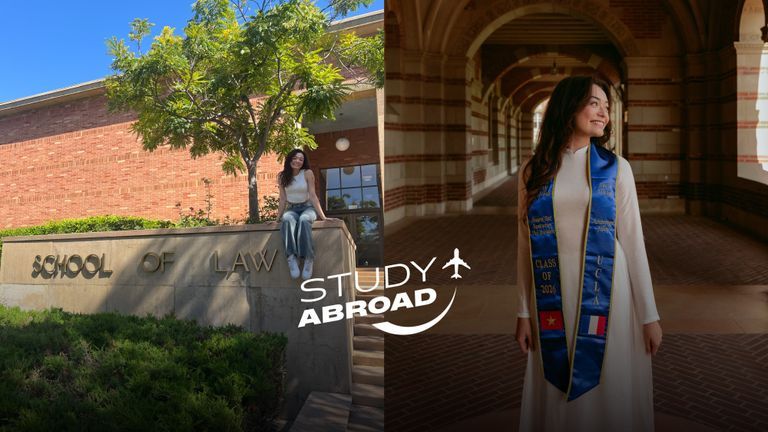
Today, as a UCLA Law graduate working in cross-border legal practice, Melanie reflects on what it really means to navigate an international education when you feel neither "white enough" nor "Vietnamese enough", and how stepping onto foreign soil ultimately taught her to embrace the roots she once tried to hide
Growing up in Saigon with a French father and a Vietnamese mother, how did you perceive your sense of belonging before you ever moved abroad?
I don't think I ever felt a true sense of belonging growing up. In Vietnam, I stood out because I was half-white. I was taller than the other kids, I had curly hair, freckles, and arm hair. I attended an international school in Saigon, but I still stuck out like a sore thumb, and kids would make fun of me.
At the same time, I was raised entirely by my mom and my grandmother, a Vietnamese family. So all my values, my upbringing, and my first language were Vietnamese. But because of how I looked on the outside, people in Vietnam always viewed me as a white foreigner.
At fourteen, you made the decision to leave Saigon and go to high school in California. What were your expectations about life and identity before landing in the US?
When I moved to the States, I thought, "Oh my god, there are so many white people here, I'm finally going to blend in!" I expected American high school to be a place where I wouldn't stand out so much.
My mom specifically chose a high school in Orange County with a high Asian population because she wanted to make sure I stayed connected to Asian culture. I really believed that moving abroad would be the moment I finally fit neatly into a community.
What was the initial experience like when you actually arrived and started school in California?
I hated it at first. The very first week, I literally cried to my mom and told her I wanted to go back home to Vietnam. For the first two solid weeks of high school, I ate lunch completely alone in a hallway and didn't speak to a single person.
American high schools were also so different from what I knew in Vietnam. In Vietnam, you stay in one classroom with your peers and a homeroom teacher, whereas in America, the bell rings and everyone scatters independently. I felt completely lost and isolated.
Did you encounter any unexpected barriers or misassumptions when integrating into the school system?
Yes, immediately. Because the administration looked at me and came from Vietnam, they automatically assumed I couldn't speak English. They didn't even bother testing my language skills—they just placed me directly into English Language Learner (ELL) classes.
I already spoke fluent English, so being placed in those lower-level classes delayed my academic trajectory and affected my course tracking all the way through college enrollment. It was incredibly frustrating because nobody took the time to assess who I actually was; they just made assumptions based on where I came from.
How did your peers receive you, both white students and Vietnamese-American students?
That was the biggest shock. In Vietnam, I was seen as white, but in America, white peers viewed me as "super Asian". Meanwhile, when I tried talking to Vietnamese-American kids at school, they questioned my background. They would speak broken Vietnamese to me and ask, "You're Vietnamese? Can you even speak it?" even though I spoke pure, fluent Vietnamese and they grew up speaking broken Viet.
I felt like I was caught in this bizarre middle ground where I was less than both sides. I even experienced ignorance from classmates, getting called names like "commie" during school activities simply because I was from Vietnam.
How did you adapt socially to survive those high school years under that kind of pressure?
I code-switched heavily. I tried my absolute best to act as white as possible to fit in. At school, I avoided bringing Vietnamese food because I was self-conscious that my rice dishes smelled different compared to the other kids' ham and cheese or PB&J sandwiches.
I had listened to K-pop my whole life in Saigon, but when I got to the US, kids made fun of it back then, so I completely stopped listening to it for four years. I spoke less Vietnamese, changed the way I dressed, and only hung out with white friend groups. Later on, when applying for early jobs, I even left my Vietnamese middle name, "Dang Lee," off my resume because my mom warned me that people might look down on Vietnamese applicants. I was constantly shrinking my heritage just to blend in.
During those lonely moments early on, where did you find comfort or a safe space?
I joined the high school marching band and played the French horn. It sounds crazy, but marching band became my ultimate escape. My band mates were a bit nerdy, super kind, and incredibly accepting. They didn't care about social cliques or identity categories; they just welcomed me. That community really carried me through high school when I felt socially invisible everywhere else.
As you transitioned from high school to college and eventually to UCLA Law School, when did your relationship with your identity begin to change?
College was the first major shift. For the first time, I was surrounded by Asian-American and Vietnamese friends who gave me a total 'crash course' in modern Vietnamese youth culture. Through them, I discovered current Vietnamese music like tlinh, cinema, street coffee culture, and podcasts like Vietcetera. They showed me a vibrant, modern side of Vietnam filled with youth pride that completely opened my eyes.
Attending UCLA Law School was the final catalyst. Being in an environment where people were vocal about their rights taught me how to use my voice. I stopped apologizing for who I was and started actively sharing my culture, hosting Tết celebrations for my law school classmates, making them Vietnamese food, and giving them red envelopes.
Was there a specific moment where you realized you no longer needed to force yourself into a specific identity box?
It hit me during my interview for a UCLA scholarship. Afterward, the interviewer told me that he appreciated how outspoken and sure of myself I was.
It was a profound wake-up call. I thought to myself: "I spent my entire life trying to shrink myself and blend in, but the moment I stand firmly in who I am, people respect it. Why am I trying so hard to fit into a box when I'm not box-shaped?" I realized that having a multi-layered, bi-cultural background isn't a flaw but my greatest strength.
How has this entire journey redefined your career choices and your personal definition of success compared to traditional expectations?
Like many parents of her generation, my mom had a classic vision of success—building a secure, comfortable life in the US and enjoying the fruits of hard work. Coming from her perspective, after all the effort put into my US education, moving to Asia felt counterintuitive, and she naturally worried about me leaving California.
But my definition of success shifted. It became about being present for family and elevating my community. After my father passed away so suddenly, I realized I wanted to be in Asia where I could actually be close to the people I love. To me, success isn't just about achieving a high standard of living in the West; it's using what I've learned to do good and stay connected to my roots.
How did you actually turn that vision into reality and make the move to Singapore happen, especially coming out of a US law school?
Ever since my first year of law school, I knew I wanted to do cross-border transactions specifically to work with Vietnamese people and elevate Vietnamese enterprises. But when I brought this up to my law school career counselor, she flatly told me, "That's not a thing."
And I refused to accept that. I knew the world was bigger than just California, so I started digging through my law firm's global network on my own. I discovered they actually had a dedicated Vietnamese practice group based out of Singapore.
I immediately cold-emailed everyone in that practice group: "Hi, my name is Melanie. I speak fluent Vietnamese, and I'm super interested in developing Vietnamese business practices." At first, they were a bit taken aback by how persistent I was, but my passion for Vietnam and fluent language skills won them over. They offered me a three-month summer internship in Singapore, which turned into the full-time role I have today.
Looking back at the fourteen-year-old girl who landed in California feeling completely out of place, what message would you pass on to young students preparing to study abroad?
I would tell them: Do not change who you are just to blend in. When you're young and studying abroad, it feels natural to look for ways to assimilate so you don't stand out. But as you grow older, you realize that what makes you valuable and special is precisely what sets you apart. If you erase your roots to fit into a group, those people aren't really your people anyway.
Embrace your heritage, hold onto where you come from, and trust that your unique background will take you exactly where you need to be.
Finally, is there something about Vietnam that would be your greatest motivation in life?
On a personal level, it’s my grandmother and my family living in Vietnam. They are my emotional anchor. Every time I step off the plane in Saigon, I feel like a fish that has just been dropped back into water—it’s where I feel most at ease. So, ultimately, my biggest dream is to make the path easier for those coming after me.
Today, whether it's through mentoring young Vietnamese students, hosting workshops for prospective study-abroad applicants, or hopefully creating a legal scholarship in the future, I want young Vietnamese people to know that their roots are their strength, and that they belong on every stage they step onto.