Richard Vine: Presence, Absence, And The Void In Art
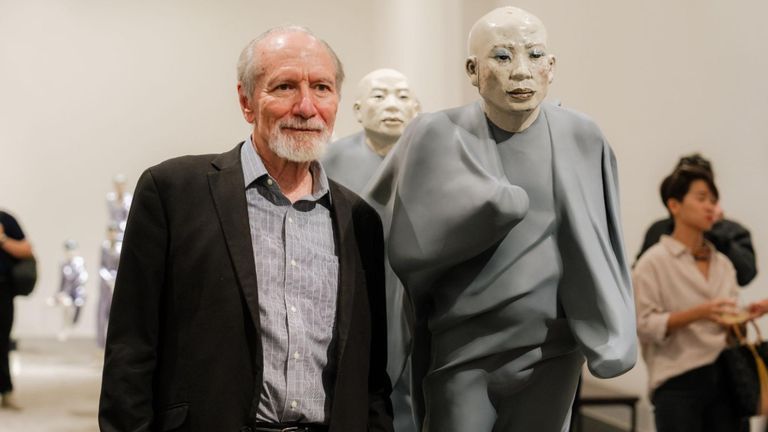
Source: The Figure and the Void organizers
I often compare falling in love with art to romance: no matter how many experiences you’ve had, you can always feel those same sparks all over again.
In the international world of art criticism and research, Richard Vine is a familiar name. A former Managing Editor of Art in America, he has published some 300 articles, reviews, and interviews, alongside several books on art and the art-world crime novel SoHo Sins. Yet, having the opportunity to chat with him in Saigon on the occasion of the exhibition “The Figure and the Void,” Richard Vine revealed an open, warm, and deeply approachable persona.
From a boy growing up in the remote countryside with no museums nearby, Richard Vine went on a long journey: studying literature, teaching, and then gradually getting pulled into the art world through conversations in artists’ studios. Today, alongside his writing and criticism, he has curated and co-curated exhibitions across Beijing, New Delhi, New York, Hangzhou, and Ho Chi Minh City.
Still, Vine is quick to point out that he considers himself a critic first. Curating came later, in 2013, and, as he puts it, largely because people began asking him to do it.
We sat down for a conversation with Richard Vine to hear a “professional outsider’s” perspective on contemporary art, curating, and the lifelong journey of experiencing beauty.
When was the first time you realized art could become a serious part of your life?
I didn’t study art or art history initially; I studied literature. I grew up in a working-class family in the remote countryside. We had no art in our house, no museums anywhere, and no galleries.
My very first exposure to real art was on a school field trip in the ninth grade. I was completely bowled over. I didn’t know objects like that could exist in the world.
One thing that stayed with me was seeing Greek vases in the museum. When I went home, I saw a basket of fruit on our dining room table, sitting in a bowl my mother had made out of popsicle sticks. I remember thinking, “I have a long way to go. I have to learn about this other world.”
Later, when I was teaching literature at the School of the Art Institute of Chicago, all my students were aspiring artists. Through them, I started meeting curators, collectors, and critics. My art education didn’t come from textbooks or slide lectures; it came from going to artists’ studios, hanging out in cafes, and hearing them talk.
In a way, I think that unconventional education served me well as a critic. I came into the art world without the standard art history preparation, so I was drawing from other sources, making different comparisons, and basing many of my responses on what I knew about artists in the flesh - in the real world and how they think and feel.
After decades of observing and writing about art, what can still make you stop in front of a work?
It’s rarely a case of saying, “I’ve never seen this before”. These days, it’s more a matter of an interesting twist on an established theme, form, or medium.
A lot of work today is “drive-by art”, you see it once for 30 seconds and you’ve seen it; there’s nothing more to assimilate. But the artists in “The Figure and the Void,” Dinh Cong Dat, Rodney Dickson, and Nguyen Trinh Thi, each made me pause, puzzle, and try to understand how the three of them could be put together conceptually.
How did you connect these three distinct artists under the theme “The Figure and the Void”?
All three artists, in their own very different ways, deal with the human figure and the empty space around it - the void. Anytime you depict the human figure, you are dealing with two elements: the body itself and the empty space around it. There is a parallel between that and individual consciousness: we look out at the world, certain of our own existence, but out there in the void, there are all these other forms and relationships.
- Dinh Cong Dat chooses to place emphasis on communality. His figures remind us of communal groups where people find security and group identity.
- Rodney Dickson takes a deeply personal approach by painting his friends. Their faces are clear and recognizable, but the rest of the body trails away like a ghost, a poignant reminder of how people drift in and out of our lives.
- Nguyen Trinh Thi connects her video art installation directly to the site, a building at 159 Dong Khoi that used to be a cinema. She uses moving images and sounds to bring the past back into the present space.
Some viewers might feel that Rodney Dickson’s portraits are a bit haunting or unsettling. How do you view this reaction?
Much of experimental or avant-garde art is about disturbing the audience a little bit. The idea is to question established values and authority rather than unthinkingly accepting everything. When a work of art unsettles you, it provokes you to think, and that is precisely when the art begins its work.
After so many years as both a critic and curator, how do you balance your professional judgment with your personal response to art?
I think you’re always operating with two lenses. One is the professional lens: based on your experience, you ask whether a work will be of interest to people in the field, whether it lends itself to being written about, or whether it might make a good addition to a magazine or an exhibition.
But then there’s the other half, which is your personal reaction. And a lot of the time, those two don’t overlap. The things you respond to most personally aren’t always the things being discussed in the field at that moment.
What you live for is that moment when the two overlap. That’s the sweet spot. Ideally, that’s the work you write about and the work you curate
In your opinion, what makes a good curator?
Oddly enough, I sometimes think of being a curator as like being a lawyer: your job is to make the best case possible for your client (the artist). You pick the most persuasive works and come up with a clear rationale for why they are important.
Crucially, a good curator must avoid jargon. Your job is to reach the general public with clear thinking, accessible language, and a sincere regard for the work you are presenting.
How do you maintain a fresh eye after all these years in the art world?
Some people assume that seeing a lot of art makes you jaded. But I compare it to falling in love. You might have a relationship that goes wrong, but then time passes, you meet someone new, and you feel all those same wonderful things all over again. The same thing happens with art.
Additionally, I make a point of pushing myself out there to look at things outside the mainstream. When abstraction was all the rage, I looked at figurative art. In the early 2000s, when Chinese contemporary art was virtually unknown in the United States, I went to Asia to explore it firsthand. Pushing into new territories keeps you fresh and keeps you delightfully unbalanced.
Spending most of your time observing and connecting, what is next on your agenda after this exhibition?
Right after leaving Vietnam, I return to New York to prepare for a solo show in Chelsea featuring a senior Chinese artist born in 1953. At the same time, I’m working on a book about a mid-20th-century woman artist, someone overlooked by history largely because she lived in Florida and had a very happy family life.
Then in May, I’m going to Iceland for a retrospective of an artist who takes industrial steel beams into lava fields and... blows them up with dynamite to create sculptures. Each trip, each artist opens up a new space for me to keep learning and feeling inspired.
Thank you, Richard, for taking the time to speak with Vietcetera and for sharing your perspective with us. We look forward to seeing where your curiosity takes you next.
For those in Saigon, The Figure and the Void, curated by Richard Vine, is on view at An Fine Art Gallery, 159 Dong Khoi, Sai Gon Ward, Ho Chi Minh City, through September 30, 2026. Admission is free.
- Location: An Fine Art Gallery – 159 Dong Khoi, Sai Gon Ward, Ho Chi Minh City
- Dates: September 18, 2026 – September 30, 2026 (Opening: September 18, 2026)
- Opening Hours: 09:00 AM – 08:00 PM daily (Free Admission)