The Most Expensive Vietnamese Painting Is On Silk: Here’s Why It Matters
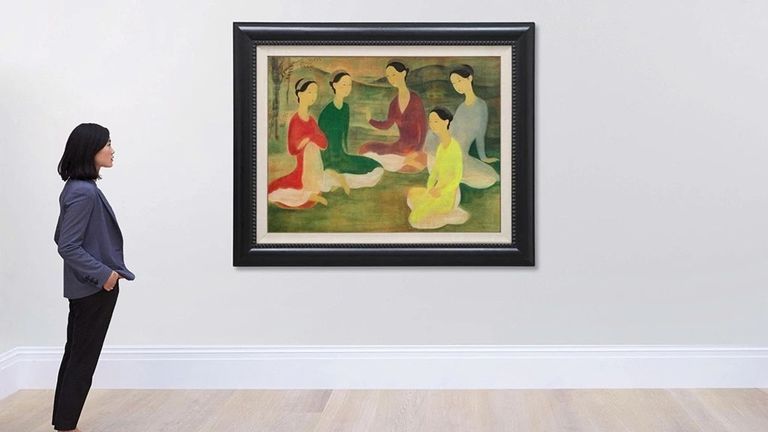
Source: Sotheby's Hong Kong
Behind the record is a nuanced art medium, from the process of silk washing to the meticulous strokes of gouache, and to the artists of the Indochine Golden Age who has transformed Vietnamese silk painting, introducing it to the Western world. Today, the medium is also finding new hands through beginner-friendly workshops, keeping a century-old tradition alive outside the professional practice. Here is all you need to know about the art form that just made history.
About The Record-Breaking “Đàm Đạo”
“Conversation d'élégantes au jardin”, translated to “Conversation of Elegant Ladies in the Garden”, features five women wearing Áo Dài and sitting in a garden, each with their own graceful pose and gestures. This masterpiece of Vũ Cao Đàm was sold for $28.96 million HKD (approximately $3.69 million USD and 95.85 billion VND) on September 28 at Sotheby’s Hong Kong Modern & Contemporary Evening auction.
The piece was painted in 1939 through a medium of watercolor and gouache on silk, measuring 85.6cm by 114.5cm - Sotheby’s deemed this unusually large for silk painting and described it as the artist’s largest multi-figure work in the medium. Vũ Cao Đàm created this piece in France, far from his homeland, combining a material from his cultural heritage and his European artistic experience to embody a sense of elegance in his painting.
Through Sotheby’s perspective, the painting is the perfect intertwinement of Vietnamese and European artistic expression. Vũ Cao Đàm uses a traditional Vietnamese medium to depict a European concept of a garden gathering. Simultaneously, he depicts the modern vision of Vietnamese women through the image of five women gathering without their respective husbands, socializing and exchanging ideas, capturing the way urban women were becoming more educated and independent, shifting away from the Confucian restraints at the time.
The sale of “Conversation d'élégantes au jardin” marks a new milestone for Vietnamese art, strengthening its place in the international art market and drawing attention to silk painting, a traditional medium that demands precision at every layer.
The History And Revolution Of Vietnamese Silk Painting
The art of painting on silk has existed for hundreds of years, originating in Ancient China and came to Vietnam around the 11th to 14th centuries, appearing in the form of portraits of national heroes and historical figures. But it became distinctly Vietnamese in 1925 when the silk washing technique was discovered, revolutionizing silk painting and making it a traditional Vietnamese art form.
Nguyễn Phan Chánh was a student at École des Beaux-Arts de l'Indochine (Indochina School of Fine Arts, Hanoi) when he pioneered the technique of silk washing that revolutionized traditional silk painting in Vietnam. The silk canvases are washed in water between layers of colors, allowing the pigment to soak organically into the silk, creating a luminous and transparent effect that made up the characteristics of Vietnamese silk painting today.
Other pioneers like Mai Trung Thứ and Lê Văn Đệ played a major role in the revolution as well, turning the lenses of silk painting towards poetic realism - portraying everyday Vietnamese life with grace and a quiet warmth that resonates both locally and internationally.
The pioneers’ works were showcased on a global stage in the 1930s, gaining international recognition, most notable at the 1931 Paris Colonial Exhibition. Art critics and buyers praise the way the artists were able to beautifully intertwine European art themes with the delicacy and elegance of the Vietnamese silk painting techniques, establishing the medium’s permanent place in international art history.
Silk And Oil: The Delicacy and Durability Of Vietnamese Modern Art
Vũ Cao Đàm’s recent record-breaking silk painting overtook an oil painting “Portrait de Mademoiselle Phuong” (Portrait of Mademoiselle Phuong) by Vietnamese artist Mai Trung Thứ, sold at Sotheby’s Hong Kong in 2021 for $3.1 million USD, ending oil's hold on the top spot for Vietnamese art.
Oil paintings historically commanded higher volume on the secondary market due to its durability and familiarity to international collectors. In 2014, Lê Phổ's oil-on-canvas painting “View from the Hilltop” was sold at Christie's for approximately $840,000 USD. In 2019, his oil painting “Nue” (Nude) raised the record to $1.4 million USD, also at Christie's, and in 2021 Mai Trung Thứ's “Portrait de Mademoiselle Phuong” pushed it to $3.1 million USD.
However, silk began closing the gap in 2023, when Lê Phổ's silk painting “La famille dans le jardin” (Family in the Garden) was sold for $2.37 million USD, the second-highest price for Vietnamese art at the time. And now, Vũ Cao Đàm’s “Conversation d'élégantes au jardin” holds the record.
The shift from oil to silk painting is evident in how its characteristics shape its market value. Oil paintings are durable, which allow many pieces to circulate in the market, the silk material is more fragile and fewer good-condition works survive, therefore making silk a much rarer sale on the secondary market, driving up its relative value. Oil allows artists to rework and build up layers, giving them more room for complexity and detail, while on silk, color soaks in immediately and is difficult to correct, so the perceived mastery of silk paintings is slightly higher to collectors. Furthermore, silk paintings have a stronger tie to Vietnamese culture relative to oil paintings, which hold an international modernism edge, collectors who seek work that represents Vietnam specifically would opt for silk painting.
In short, due to the scarcity of Vietnamese silk paintings, an appearance of a qualitative silk painting can drive exponential price surges overnight on the secondary art market.
The New Generation Of Silk Painting
As the art market is slowly shifting towards silk paintings, these notable contemporary artists are reinventing the delicate medium while still keeping the core identity, shaping the current and future of Vietnamese silk painting.
Vũ Đình Tuấn
Born in 1973 and based in Hanoi, artist Tuấn is known for his innovative layering of watercolors on silk and contemplative builds in his art work. His highly acclaimed “Surreal Face” series where he portrays traditional depictions of human faces in a softer form but multi-layered with psychological themes. Another highly praised series is “Metamorphosis”, Tuấn merges the human face with natural landscapes and elements using heavy watercolor layering that redefines silk not as fragile but a deeply textured space to portray introspection
Bùi Tiến Tuấn
Born in 1971 and based in Ho Chi Minh City, he is known for his portrayal of urban women through a minimalist and sensual lens, with his famous nude silk painting which experts claim are rare for Vietnamese fine arts. Tuấn represents the beauty and elegance of women through a bolder approach, distinct from the classical rural themes of quiet grace and virtue.
Lê Thuý
Born in 1988 and based in Hoi An, she uses silk painting as a medium to portray larger themes around ecological loss, human and nature relationship, memories and the transition of cultural heritage. Thuý pairs the raw and unprimed silk techniques with darker philosophical takes on these themes, blending delicate natural visual motifs with imagery symbolizing human struggles.
Beyond these names, a growing community of artists, from established masters to students still learning to stretch their first frame, continues to shape where Vietnamese silk painting goes next.
Silk Painting In Modern Daily Life and Where To Experience It
Silk painting is best to experience in person, whether you want to stand in front of a master’s work or to pick up the paint brush yourself.
To get an immersive experience of observing the silk paintings carefully curated dating back to ancient times, take a visit at Vietnam National Museum of Fine Arts - Hanoi. This is Vietnam’s main art museum, showcasing fine arts from ancient times to the modern era. Its silk painting collection includes several pieces on display from famous artists Nguyễn Phan Chánh and Lê Văn Đệ. With audio guides available in many languages, adult tickets are around 40k VND ($1.54 USD).
And if you are ready to pick up a paint brush and laying your hands on silk, here’s where to begin:
Art Tutor Hanoi
Located near the West Lake (Tây Hồ) in a calm and cozy art studio, you are introduced to the traditional tools and materials, step-by-step guidance to sketch and apply colors on silk to achieve the luminous look, and finishing with a silk painting of your own to take home as a souvenir. A single-session of around 2.5 hours is priced from $40 per guest, with all materials provided and instructors who can speak both Vietnamese and English.
Address: Ngách 264/15 Ngõ 374 Âu Cơ, Thôn Đông, Hồng Hà, Hà Nội
Quang San Art Museum
At Quang San Art Museum in Ho Chi Minh City, you can try painting watercolor directly onto silk before turning your artwork into a handcrafted paper fan. The hands-on workshop introduces participants to the delicate way watercolor spreads across silk and the traditional mounting process. Past sessions have lasted around four hours, with all materials provided and instruction available in Vietnamese and English. The museum’s silk-painting workshops are held occasionally rather than as a regular program, so check its schedule or social media for upcoming sessions.
Address: 189B/3 Nguyễn Văn Hưởng, An Khánh Ward, Ho Chi Minh City
Vũ Cao Đàm painted “Conversation d'élégantes au jardin” on a material that was still finding its place in modern art, and nearly ninety years later, that same delicate silk has outpriced every Vietnamese painting before it. The record belongs to one artist, but it reflects a century of painters who proved that Vietnamese silk could stand among the world's great art forms, and a new generation still striving towards innovating the future of Vietnamese silk painting.