The World Is A Blank Canvas, And Studying Abroad Was Ginger Nguyễn’s First Sketch
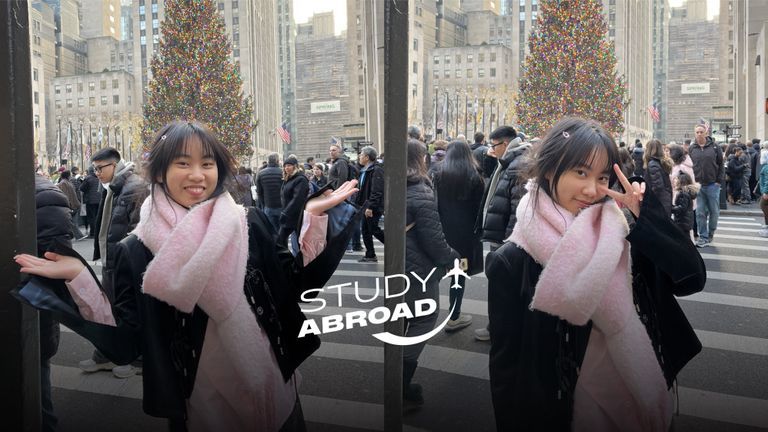
Source: Provided
For the Study Abroad series, we usually meet our guests through a screen, and Ginger Nguyễn is no exception. But talking to Ginger feels less like an interview and more like catching up with an old friend, one who proudly calls herself a professional “yapper.” Currently back home in Hanoi, she is also navigating an all-too-familiar international student headache: waiting for her U.S. visa interview after August appointment slots disappeared almost as soon as they opened.
"It was supposed to be the 11th of August, but my visa interview slot ran out. So I was like, 'Oh.' Now I have to pay the delay fee for a different time," she laughs, seemingly unfazed by the chaos.
Ginger, who is studying 3D Animation at the School of Visual Arts (SVA) in New York City, carries a distinctly Gen Z spirit that shifts effortlessly between energetic Vietnamese and rapid-fire English and the occasional “lowkey,” “highkey,” in between. But beneath her easygoing, chatty personality is a surprisingly grounded perspective on what it means to study abroad, make art, and figure out what she wants to do with the opportunities in front of her.
Between Ginger’s “highkey” and “lowkey” is the story of a young artist navigating different cultures, finding her voice, and figuring out what she wants to make of the world she has been given.
You made the bold choice to leave Hanoi for New Zealand at just 15 years old. What made you decide to leave at that age?
Honestly, I was just so over it! At the time, I was studying at the British International School (BIS) in Hanoi. It had a STEAM curriculum, so there was definitely an arts component, but the overall environment still felt very academically and STEM-oriented. I tried so hard, and I liked being challenged, but my brain simply didn't work that way (laughs). My grades were okay, but I knew I wasn’t really thriving in that system. I felt this intense, unspoken pressure to fit into a mold that just wasn’t mine.
So, when my parents came back from a trip to New Zealand completely mesmerized by the quiet green fields and the cows, and my mom asked if I wanted to study abroad there, I didn't hesitate. I was like, "Yes, please let me go!"
Though I was scared of starting over from scratch, I was far more excited to escape STEM and discover what else was out there.
When you first boarded that flight, what were you hoping to discover about yourself and your relationship with art?
I had known for a long time that I loved art, but I had absolutely no idea where I fit within the massive world of creativity. I didn't know which artistic field I wanted to pursue as a career. Leaving Vietnam was my way of giving myself a blank canvas. I wanted the freedom to explore, to travel, to try different things, and to see which medium would finally click with who I was.
Due to the pandemic, you ended up being stuck in New Zealand for three long years without being able to return home. How did that pivot your “adventure”?
It was really hard. At the time, I went through this fiercely independent, almost "edgy" phase where I told myself, "I can do this completely on my own, I don't need anyone's help". I didn't even cry that much when I left my friends in Hanoi because I assumed I'd see them in the summer. But when COVID hit and the borders slammed shut, the reality that I was stuck there for three years slowly started to sink in. It hit me like a ton of bricks, and I fell into a really dark, lonely place.
My saving grace was my homestay family. I stayed with a wonderful, elderly Indonesian-Kiwi couple whose daughters had already moved out. I made an active effort to connect with them. We had these deep "soul talks" after dinner, watched movies together, and shared our cultures through food. My host mom would cook Indonesian dishes, and I would cook spicy Vietnamese noodles for her. They showed me how to navigate the local buses, set up my bank card, and truly made me feel like I had a second family.
But to fully cope, I relied heavily on media, animation, and online communities to stay connected to the human world. That was actually when I watched Arcane, which completely blew my mind. I started researching how they made it and read that the creators hand-painted and hand-textured the 3D models. So, right there in my homestay room, I started teaching myself Blender.
Is that what led you to SVA in New York? What made you decide to commit to 3D animation as a career?
I loved painting, but I knew I didn't necessarily want to pursue fine arts as a career. And I'm kind of greedy, too. I have so many hobbies: fashion design, interior design, world-building, and illustration. That is what drew me to 3D animation. It felt like the ultimate "greedy basket" because it's a replication of the real world. I could bring all those interests into one place: design the costumes (fashion), build the environments (interior design), paint the textures, and turn them into one creative skill set.
Strategically, I also wanted a skill set that would be difficult to master on my own. I love illustration, but that’s something I can practice independently or through YouTube. 3D programs are incredibly complex; I knew I needed university courses with someone actually leading and guiding me through. I wanted to make sure that paying for a university degree was actually worth the investment. SVA was one of the absolute best schools for animation, and it felt like the perfect place to give me a professional skill set that I need.
When you later moved to New York City to attend SVA, what was your first impression of such a different environment?
It was a massive, overwhelming shock! I went from a country where you could drive two hours and be surrounded by the greenest hills and paragliding over ocean bays, to a place of pure concrete. On my very first day, my primary impression was the smell—I literally told my parents it smelled like "an uncle's bad breath"! We were staying in Battery Park at the very end of Manhattan, and SVA's campus was up on 23rd Street. I was so absolutely terrified of the subway system that I opted to walk the entire hour to school, jet-lagged and completely dazed, staring up at skyscrapers so tall they blocked out the sky. I remember calling my parents and saying, "I don't know if I can ever like this place."
Of course, now I absolutely adore New York, but that first transition was incredibly gritty.
Did that experience of moving between such different places change the way you see where you come from?
Oh, definitely. I think the further you move away from home, the more closely you start holding onto it. For me, that made me much more aware of the beauty and history of Hanoi.
I have this deep, almost funny obsession with the “decay” of Hanoi. Sometimes its beauty lies in the traces of time: the peeling paint on old French Quarter walls, layers of faded phone numbers stamped over one another, posters being covered and replaced. Those walls almost feel alive to me. They record all these different moments of the city.
That actually became the subject of my IGCSE art portfolio, and I continued exploring those cultural and architectural elements throughout high school. I think being away from Hanoi made me notice these things in a way I probably wouldn’t have if I had stayed.
At the same time, living in such different environments, from the quiet green landscapes of New Zealand to the overwhelming concrete of Manhattan, changed the way I looked at places in general. In middle school, I also volunteered to help physically build classrooms, mixing concrete and laying bricks. Experiences like that made me more aware of how differently people live and what certain spaces can mean to them.
So I think my environments have made me see art as more than just creating something visually beautiful. It can be a way of documenting where we come from, understanding different cultures, and drawing attention to the realities that shape people's lives. That’s probably why I’ve come to see art as something that is inherently cultural and political.
You mentioned that art is inherently cultural and political. Could you elaborate on that?
Like Anthony Bourdain said, when you travel, your mind gets open to the struggles of others, and you start to care more about the people around you. It made me realize how incredibly lucky and privileged I am to have financial stability and a family that supports my dreams. I don't have the immediate, paralyzing fear of survival. But to me, that family support shouldn't make me comfortable or complacent. Rather, it's the exact reason why I have a responsibility to be spontaneous, take risks, and give back.
A safety net means that if I try something incredibly difficult and "fail" in the conventional sense, I have somewhere to retreat to, dust myself off, and try again. It's that stability that actually allows me to ask, "Why not?" and leap. And if I am lucky enough to have that launchpad, my ultimate goal is to use my voice and resources to build that same security for others who don't have it. I honestly don’t need a huge house or a fancy car. If I have money and resources, I’d much rather use them to support social causes, contribute to charity, and do things that have a tangible impact on other people’s lives.
Because I am so grateful to have this stability to pursue my dreams, my personal goals have shifted from just creating art for myself to giving back to the community. When you find yourself in a happy, secure position where you actually have the power to help someone and make their day a little better, I always think: Why not just do it? It’s not going to kill you, and it makes the world a little warmer.
What about an art project that’s just for you, based on your own feelings?
To be completely honest, I actually do art for other people much more than I do art for myself. I love collaborating or creating something specifically for someone because there’s something really rewarding about knowing they’ll appreciate it.
But when it comes to making something that is purely about me, or just reflects what I’m thinking and feeling, I hit a massive wall. I’m such an overthinker, and I have this bad habit of being way too strict with myself. I feel like if I’m going to make something for myself, it has to become this perfect masterpiece, so I end up putting so much pressure on the process that I sometimes don’t make anything at all.
People always tell you to just put something out there, let it be “fine and ugly” first, and improve it later. I’m really trying to learn that mindset, but my default is still very much “go big or go home.” If I’m doing something for myself, I feel like I have to put 100% of my soul into it.
So, ironically, even though I’ve done a lot of personal and cultural work, especially during high school in New Zealand, most of it was still connected to a school assignment or a specific purpose. Since leaving home, I’ve actually done less art purely for myself.
I think that’s something I’m still learning – how to make art without needing it to serve anyone else or prove anything. Hopefully, as I gain more experience and get past that perfectionist block, I’ll be able to make something that is completely, uniquely mine.
Looking ahead, graduation is on the horizon. What are your immediate goals after you finish school, especially given how rapidly the creative and tech industries are shifting right now?
After graduation, my immediate goal is to work at major film or game studios to gain a few years of real-world industry experience. I’m really leaning towards big blockbuster productions because I absolutely love the feeling of working on a massive, collaborative project.
But I also think a lot about the future, and sometimes I feel like I overthink it too much! Right now, the creative industry is changing so fast because it is highly linked with the tech industry, which makes the job market a bit tough and unpredictable. My mom actually nailed this advice into my head: "You need to have a passive income and multiple sources of revenue so that when a door gets shut, you aren't left stranded."
So, if the entertainment industry gets too hard, my plan is to do commercial work. Even if my heart is in film, commercial design is a great way to make a stable living and build capital. Once you have money, you can actually use it to fund the independent films you believe in, hire your friends, and make things happen on your own terms instead of waiting for a studio's green light. It’s all about creating that financial stability so you never have to compromise your artistic vision. And that’s my big dream actually.
Tell us more about your ultimate dream.
So, after I get those years of blockbuster experience abroad under my belt, my big dream is to return home to Vietnam and open my own large-scale 3D animation studio.
I don’t want it to just be a commercial factory. I want to build a space that acts as a collaborative, supportive harbor for Vietnamese artists. If we have a stable, successful commercial side that brings in solid revenue, we can use those resources to self-fund independent, passion-driven animated films, hire local talent, and uplift the creative community here.
It brings everything full circle for me. I was so incredibly lucky to have a family that gave me a safety net to pursue my dreams and ask "Why not?" without fear.
So my ultimate goal is to take my voice, my skills, and my resources and build that exact same safety net and launchpad right here in Hanoi for other young artists who deserve it. I want to show them that you don't have to leave your home country or struggle in isolation to create world-class art—we can build a thriving, sustainable creative home together.