The Year Of The Fire Horse Explained Through Vietnamese Culture
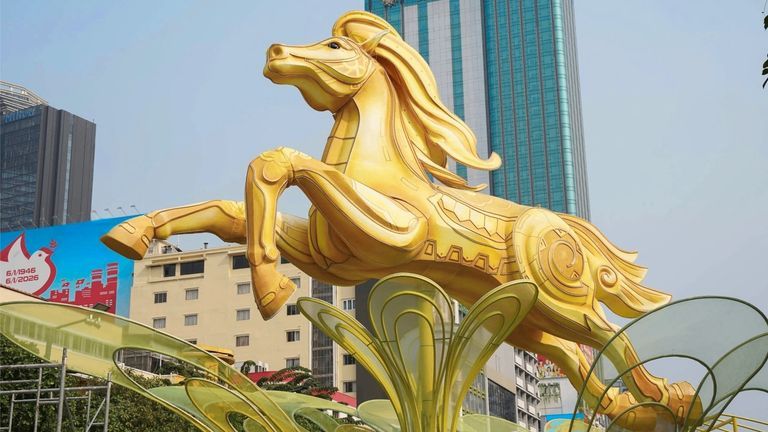
The horse mascot at Nguyen Hue Flower Street is inspired by the image of "Saint" Giong riding a horse flying to heaven. | Source: Thuận Văn for PLO
The year 2026 is Bính Ngọ, the Year of the Fire Horse. It marks the transition from the Earthly Branch of the Snake (Tỵ) to the Horse (Ngọ), and from the Heavenly Stem Ất (Wood) to Bính (Fire). The Horse is associated with freedom, endurance, and loyalty, while the Fire element represents warmth, illumination, and transformative energy.
Across East Asia, horses were vital for transportation and warfare, symbolizing mobility and progress in agrarian societies. In Vietnam, however, the horse also holds a symbolic presence. Beyond its practical role, it appears in mythology, folk belief, religious practice, and poetry—often as a bridge between the human and the divine.
Below is a closer look at how the horse is understood in Vietnamese mythology, spiritual life, art, and feng shui.
In myth: the Horse as national strength
In Vietnamese epic legend, Thánh Gióng was a miraculous child born during the reign of the sixth Hung King (around the 14th century BCE). Silent and immobile for years, he suddenly spoke when the country was threatened by invaders, asking the king to forge an iron horse, an iron whip, and iron armor.
When the weapons arrived, the child instantly transformed into a towering warrior. Riding a fire-breathing iron horse, he charged into battle, defeated the foreign army, and restored peace to the land. After his victory, Gióng rode to the peak of Sóc Mountain and ascended to heaven.
The image of a young boy on a blazing iron steed has since become one of the most enduring symbols of Vietnamese resilience and collective strength — a belief that extraordinary force emerges when the nation calls.
Today, Giong and his majestic horse are commemorated in a statue at Phu Dong Roundabout in Ho Chi Minh City. Erected in 1966, the monument has stood for more than half a century. A detail often overlooked is that Thánh Gióng, holding a bamboo staff and seated atop the iron horse, is still depicted as a young boy — a reminder of innocence transformed into heroic power.
In belief: the Horse as spiritual mediator
Beyond legend, horses appear frequently in temples and ritual spaces. In traditional belief, deities are often depicted riding horses when descending to fulfill their missions. Offering horse statues has therefore long been a gesture of reverence, acknowledging the animal’s role as a spiritual escort. In this sense, the horse acts as a mediator between worlds, carrying respect, intentions, and prayers.
In the former imperial capital of Hue, horses were often represented as dragon horses (long mã) on ritual architecture. These figures appear on walls separating entrance paths from temple courtyards, including communal houses, pagodas, shrines, and family temples. The dragon horse motif also endures in wooden altar carvings and ceremonial objects, continuing a visual tradition in Huế that stretches back over a thousand years.
In folk culture: the Horse as aspiration
In Vietnamese proverbs, the horse often serves as a metaphor for character and maturity. “Đường dài mới biết ngựa hay” (Only a long journey reveals a good horse) suggests that true worth is proven over time. “Ngựa non háu đá” describes youthful impulsiveness, likening inexperience to a young horse eager to kick. Meanwhile, “Một con ngựa đau, cả tàu bỏ cỏ” (When one horse is sick, the whole stable refuses to eat) reflects solidarity and collective care.
Through these sayings, the horse becomes a mirror of human nature — ambition, impatience, endurance, and loyalty.
In folk art, especially Đông Hồ paintings, the symbolism becomes even more explicit. “Mã đáo thành công” (Success arrives with the horse) depicts galloping horses as a blessing of achievement and prosperity. “Vinh quy bái tổ” (Returning home in glory) often portrays a scholar accompanied by horses upon his triumphant return. Across these images, the horse is closely associated with journeys toward honor, success, and recognition.
In Feng Shui: the Fire Horse’s intensified energy
When the dynamic energy of the Horse combines with the intensity of Yang Fire, its traits are amplified. A Fire Horse year tends to be fast-moving, emotionally charged, volatile yet transformative. It rewards courage and decisive action, but punishes impulsiveness and recklessness.
What To Do
- Step into leadership roles and take bold yet conscious action.
- Build toward long-term goals with clarity and direction.
- Embrace new opportunities instead of hesitating.
- Channel ambition wisely rather than acting on impulse.
- Address areas of life that feel misaligned — this is a year for necessary change and growth.
What To Avoid
- Acting too quickly under emotional pressure.
- Making major decisions in moments of anger or urgency.
- Overcommitting and stretching your energy too thin.
- Letting restlessness lead to burnout.
- Confusing intensity with productivity.
This browser does not support the video element.
Image of the Horse features in WCA2025 Album 'Viết Tiếp Câu Chuyện Việt Nam'. | Source: @onearteveryday, 01A Collective