Vietnam Launched 234 Major Projects In One Day: New Olympic Complex, Airport And Railway
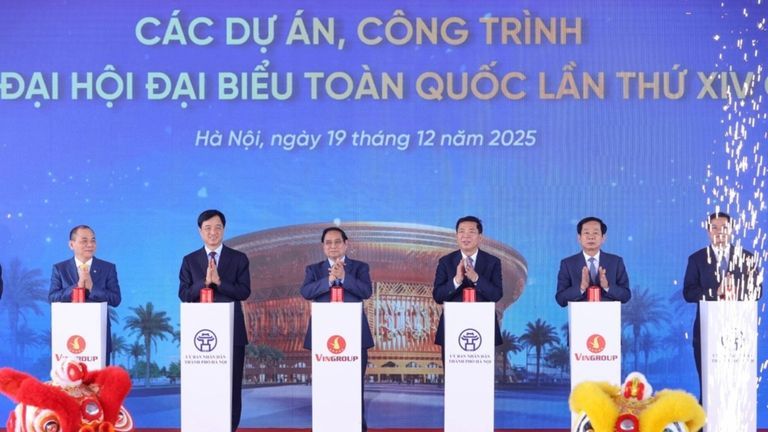
Prime Minister Pham Minh Chinh and senior officials at the groundbreaking events of 234 major projects on December 19. | Source: Bao Lao Dong
On December 19, Vietnam simultaneously launched 234 new major projects across 34 cities and provinces nationwide, including 148 newly launched projects and 86 projects undergoing inauguration or technical opening.
According to Prime Minister Pham Minh Chinh, this event has three record-setting aspects: the largest total investment ever, exceeding VND 3.4 quadrillion (USD 129 million); the highest level of private sector participation, at nearly VND 2.8 quadrillion (USD 100 million) , accounting for more than 82% of the total; and the single largest project by capital scale — the Olympic Sports Urban Area, with an estimated investment of around VND 925 trillion (USD 35 million).
Projects span multiple areas of socio-economic development. Some of the most notable developments include: an Olympic complex in Hanoi, an urban railway project in Phu Quoc, and a new airport in the outskirts of Hanoi.
Infrastructure completion
One of the key focuses of the projects is the completion of transport infrastructure, including accelerated work on expressways, bridges and roads, including upgrading key sections on the North-South expressway, building a new railway on Lao Cai - Hanoi - Hai Phong routes, and 3 new metro lines - reflecting Vietnam’s push to strengthen national connectivity and logistics networks.
Beyond transportation, the initiatives span key sectors including seaports, energy infrastructure, hospitals and social housing, with notable projects such as an upgrade in Quy Nhon and Cai Mep-Thi Vai seaports, a solar power plant in Khanh Hoa, expansion of hospitals in Hanoi and Ho Chi Minh City and social housing units constructed by Vingroup.
The programme also includes the construction of new airports, notably Gia Binh Airport in Gia Lam (outskirts of Hanoi), designed to ease pressure on Noi Bai International Airport. It also continued to complete Long Thanh International Airport in Dong Nai Province, one of the country’s largest aviation projects and a cornerstone of Vietnam’s long-term transport strategy.
A major milestone in Vietnam’s modern infrastructure development
Of 234 projects, the Olympic Sport Urban Area (in Thuong Phuc commune, Hanoi) stands out as the single largest project by capital scale. The project is being developed by Vingroup, with a footprint of over 9,000 hectares and an estimated investment of VND 925 trillion. It’s ambitious to function as a modern integrated sports and urban complex, capable of hosting major continental and global events such as the Asian Games, the Olympics and the World Cup.
Beyond the Olympic complex, Hanoi is also developing seven other major projects, including a VND 4.665 billion (USD 17.7 million) To Lich River Riverside Park project and urban renewal and public space development along both banks of the Red River.
The event also highlighted the Urban Light Rail Transit project in Phu Quoc, marking a milestone for modern public transportation outside traditional urban centers. The approximately 17.6 km line will connect Phu Quoc International Airport with the APEC Convention Centre, featuring a mix of elevated and underground sections and an expected operational capacity that could reshape mobility on the island.
This system supports broader plans to position Phu Quoc as a tourism and events hub ahead of APEC 2027, forecasting faster connectivity and economic spillovers.
An infrastructure push powered by private capital
With the simultaneous launch of 234 large-scale projects on December 19, 2025, Vietnam has sent a clear signal of its ambition to accelerate infrastructure development and push the country’s physical foundations into a new phase of modernisation.
Notably, private capital accounts for around 82% of the total investment across the 234 projects, while state funding makes up just 18%. This structure helps ease concerns about an aggressive expansion of public spending. It also points to a broader shift in the government’s role: from a direct investor to a facilitator, setting the framework for private capital to take the lead in major infrastructure development.
The participation of large private developers in flagship projects - such as Vingroup’s Olympic Sports Urban Area in Hanoi and Sun Group’s urban light rail transit (LRT) system in Phu Quoc - suggests that investors see potential for capital recovery or long-term economic value in national-scale projects.
At the same time, the dominance of private investment extends the debate beyond financing. For projects of this scale, including the Olympic complex and the Phu Quoc LRT, this also raises a key question: will these projects generate greater returns for investors, or deliver greater benefits for the public?
The projects’ necessity, efficiency of use and social impact - while not yet clearly reflected in public assessments - remain issues that will need close attention as they move forward. In that sense, the long-term success of Vietnam’s infrastructure push may hinge less on how quickly projects break ground and more on whether they ultimately justify their scale.