Vietnam's National Gold Exchange Launch: What You Need To Know
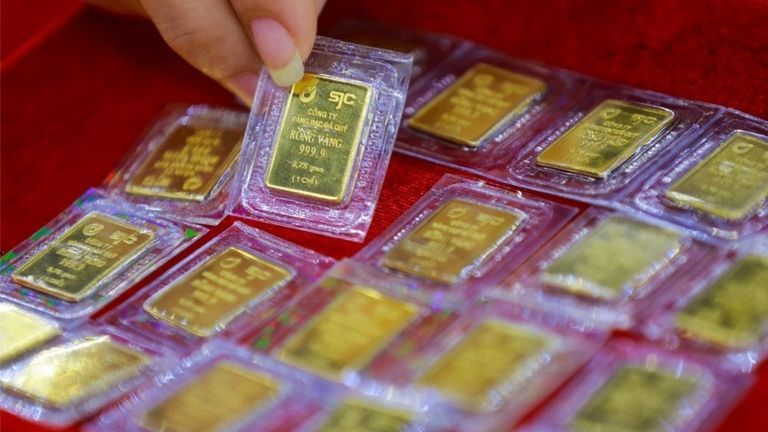
Global gold markets are undergoing one of the most violent swings on record. | Source: Vietnam Plus
Global gold markets are undergoing one of the most violent swings on record. After climbing steadily to an all-time high of US$5,608 per ounce, gold plunged to around US$4,724.8 per ounce - the sharpest decline in modern trading history.
Vietnam has not been spared. Domestic gold prices peaked at VND 196 million per tael (~US$5,850 per ounce) on January 29, 2026, before falling almost vertically to around VND 170 million per tael (~US$5,100 per ounce) by February 2. Yet, gold in the Vietnam market remains around US$580 higher than the global price, underscoring a disconnect between local and international markets.
That fluctuation has only reinforced existing concerns about the gold market. In late January, Prime Minister Pham Minh Chinh ordered authorities to fast-track the establishment of a national gold exchange by February 2026, aiming to improve transparency, rein in speculation and bring domestic prices closer to global benchmarks.
Sustained high demand collides with limited supply
Vietnam’s demand for gold is driven not only by investment motives but also by deep-rooted cultural and financial behaviours. Vietnamese people often view gold as a safe haven and a form of long-term savings, which makes gold more preferred than other financial assets like stocks or bank deposits. This explained the sustained demand for physical gold, especially gold bars and jewellery, even when prices are high.
At the same time, Vietnam’s gold market has been constrained by a tightly controlled supply structure. For more than a decade, the State Bank of Vietnam has restricted gold imports and production, leaving gold bar supply largely dominated by Saigon Jewellery Company (SJC) and a handful of authorized providers. This demand-supply imbalance has kept domestic prices above global levels, fuelling speculation, hoarding and FOMO (Fear of missing out) - driven buying.
In June 2024, four state-owned commercial banks (Agribank, Vietcombank, VietinBank and BIDV) were authorised to sell physical gold bars from SJC directly to the public. They were allowed to sell, but not buy back gold, to help narrow the gap between domestic and international prices, as well as to provide more gold distribution channels. While the price gap narrowed at times, it quickly widened again amid strong demand and limited supply.
By establishing a national gold exchange, the government aims to address these structural issues: enabling a more transparent and competitive market where prices reflect real supply and demand, broadening participation beyond a small set of producers and importers, and providing consumers and investors with clearer price signals and access to more products.
The three-phase fast-track plan to start in February 2026
The gold exchanges have been rolled out in several countries. Notable examples include the London Bullion Market Association (LBMA), which serves as the global benchmark for gold pricing; the COMEX division of the New York Mercantile Exchange (NYMEX), one of the world’s largest futures markets for gold; and the Shanghai Gold Exchange (SGE), which plays a central role in China’s tightly regulated domestic gold market.
In Vietnam, the government has begun studying to establish the national gold exchange since May 2025. By December 2025, the National Assembly urged the government to urgently develop appropriate solutions and a roadmap for setting up a gold exchange.
On January 26, 2026, Prime Minister Pham Minh Chinh ordered the State Bank of Vietnam to fast-track the process and put the National Gold Exchange into operation as early as February 2026. This response was at a time when gold prices once again surged to new peaks, rising by VND 2.7–3.7 million per tael in just one day.
According to the State Bank of Vietnam, the national gold exchange is piloted to roll out in three phases.
- Phase 1: Exchange will be limited to imported gold
- Phase 2: Exchange will include both imported gold and gold bars.
- Phase 3: Exchange will be widened to a broader range of products, including imported gold, gold bars, domestically circulating gold, gold certificates, and gold derivatives.
During the pilot phases, exchange will not be linked to international gold trading platforms. Participants will include exchange providers, settlement banks, and trading members in Phase 1, and will be further expanded in Phases 2 and 3.
Can Vietnam’s regulatory framework keep up with the gold exchange?
In January 2026, JWR, a major gold trading platform in Shenzhen, China, collapsed when tens of thousands of investors rushed to cash out amid rising gold prices, leaving more than 10 billion yuan (about US$1.4 billion) of client funds frozen.
Analysts attributed the failure to regulatory oversight, including insufficient licensing, ambiguous product classification and insufficient safeguards for client assets outside formal exchanges. For Vietnam, where demand for gold is similarly strong and speculative behaviour is prevalent, the episode raises a critical question: can Vietnam’s regulatory framework keep pace with rapid market expansion and mitigate comparable systemic risks?
According to Can Van Luc, chief economist at BIDV and a member of Vietnam’s National Financial and Monetary Policy Advisory Council, the core issue is not whether a gold exchange exists, but how different types of gold are regulated.
“Gold bars and bullion are often seen as investment and savings assets; therefore, they have direct implications for financial stability and require stricter oversight. While gold jewellery, primarily a consumer good, should be governed under a separate and more flexible framework.” He noted with Vietnam Plus.
To reduce systemic risks, Luc also called for greater transparency around gold holdings in the economy and an end to gold-based lending practices, which he says pose significant financial vulnerabilities. With the domestic–global price gap remaining wide, he added that an immediate priority is to expand legitimate supply by standardising gold bar specifications, lowering production costs and easing conditions for gold imports and manufacturing.