



According to IQAir’s 2024 rankings, Tra Vinh (now part of Vinh Long Province after Vietnam’s administrative restructuring) was ranked No. 1 among Southeast Asian cities for clean air, recording an exceptionally low PM2.5 level of 5.2 µg/m³.
Tra Vinh is a coastal city in Vietnam’s Mekong Delta, home to three major ethnic groups - Khmer, Kinh, and Hoa. The city stretches between the Tien and Hau rivers, making it an important center for agriculture, particularly rice cultivation and aquaculture.
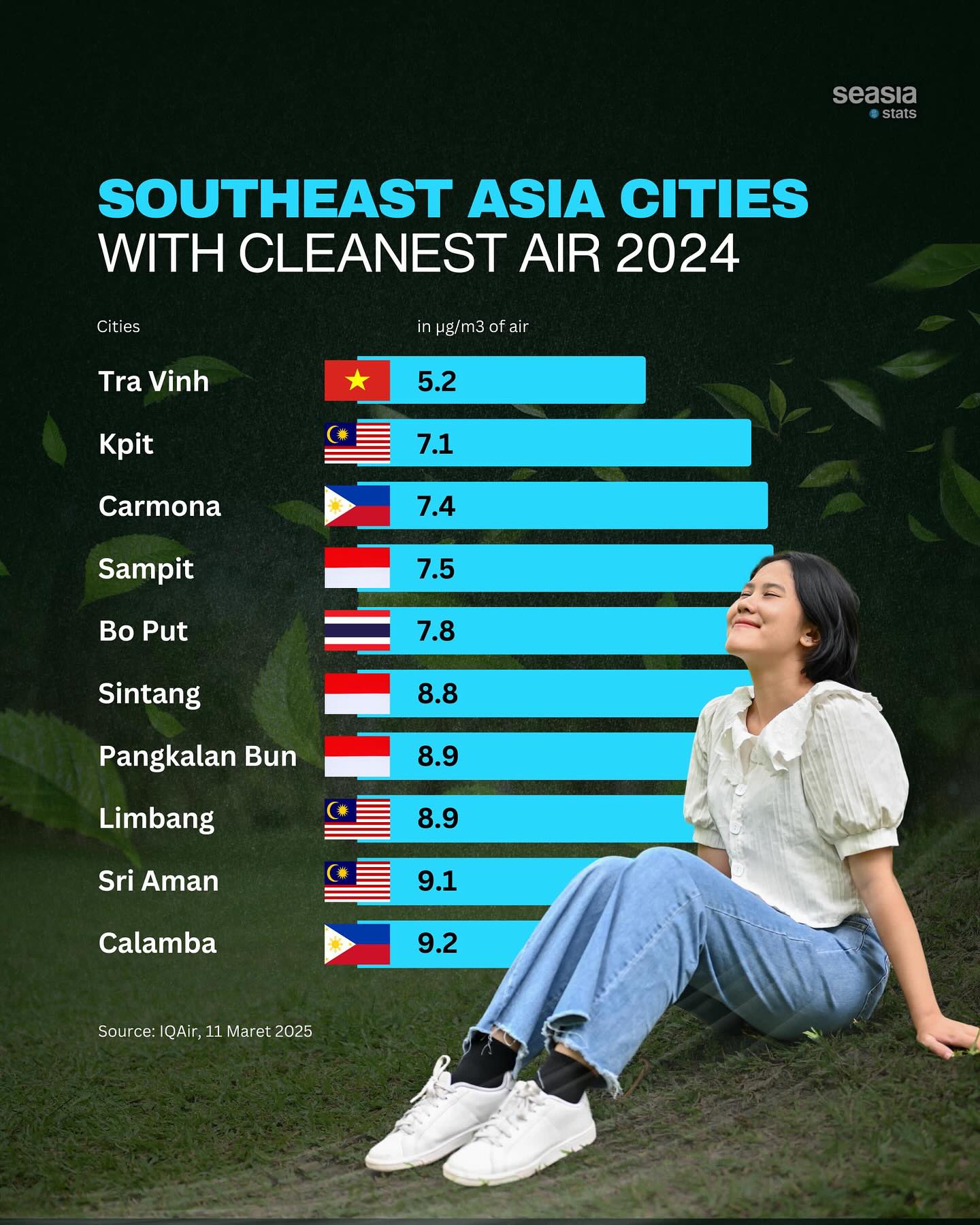
In a time when many Southeast Asian cities struggle with smog, dense traffic, industrial growth, and climate pressure, Tra Vinh stands out as a green urban zone that many larger cities can only dream of. Trailing behind are Kapit (Malaysia) at 7.1 µg/m³ and Carmona (Philippines) at 7.4 µg/m³, followed by Indonesia, Thailand, and Malaysia in the top 10. They tell the story of Southeast Asian cities chasing the new luxury of the 21st century: clean air.
Green lungs in the heart of the Mekong Delta
Tra Vinh is located between the Tien and Hau rivers, forming a triple ecological system of salt–brackish–freshwater. With a green coverage of 29 m² per resident, nearly 10 times higher than the average Vietnamese city, Tra Vinh possesses one of Vietnam’s most extraordinary natural assets: an urban forest woven directly into the city’s fabric. The city is shaded by more than 14,463 mature trees across 87 streets, of which over 800 are century-old giants: white thingan, oil palm, tamarine trees (sao, dầu, me) planted since the early 20th century, during the French urban grid planning era.

The city has 12 Khmer pagodas which contribute their own green density such as Khmer temples like Chùa Âng (built in the 10th century) sit within dense pockets of old-growth trees; or the Ao Bà Om heritage zone holds hundreds of sao and dầu trees with exposed roots, forming a rare coastal woodland ecosystem. The system helps absorb pollutants, lower heat, and maintain stable atmospheric conditions in the city.

An urban forest ecosystem
Tra Vinh also stands out for its unwavering policy: the city expands, but the trees stay. Instead of cutting down century-old trunks to widen the streets, planners here redesign roads to curve around them, turning trees into small roundabouts and civic landmarks. The famous dầu tree at the Hung Vuong–Le Loi intersection is a classic example: when construction crews encountered its massive root system, the city refused to cut it down and built a protective island around it instead.

Each year, the city allocates 20 billion VND (over 750 million USD) for tree maintenance and invites experts from the Netherlands and Australia to treat aging trees - injecting nutrients, improving soil structure, or removing paving that once restricted their roots.
“No other urban area in the country has preserved such a dense system of century-old trees. They are the green lungs of the city, and protecting them is our shared responsibility.” - said Mr. Nguyễn Văn Nhủ, Chairman of the Trà Vinh City People’s Committee
Industry development with strong environmental safeguards
Tra Vinh manages its industrial growth with relatively strict environmental controls and strategic zoning. Most factories are placed along the coastline or major river corridors, where stronger natural ventilation and lower population density help disperse emissions. This pattern is visible in the Duyen Hai Economic Zone, which concentrates power generation, logistics, aquaculture processing, and port-related industries rather than dispersing them throughout residential areas. By doing so, Tra Vinh can avoid the formation of dense industrial zones and supports dispersed, low-emission livelihoods (rice farming, coconut orchards, aquaculture).

According to the Tra Vinh Provincial Planning Report 2021–2030 and VCCI’s Provincial Green Index (PGI) 2023:
- The province prioritizes the sea-based economy, including fisheries, seaport logistics, and coastal infrastructure.
- Aquaculture and seafood processing are among its leading industries, leveraging saline–brackish ecosystems.
- Tra Vinh is emerging as a renewable-energy hub, especially offshore wind power in Duyen Hai.
Trà Vinh was also ranked #1 in Vietnam’s Provincial Green Index (PGI) 2023, reflecting high scores in environmental governance and pollution control.
Tra Vinh plans to expand the city horizontally
What comes next for Tra Vinh is a promise: to grow without losing the quiet breath that made it special. Instead of widening streets or clearing trees, the city plans to expand outward, creating new urban zones while keeping its century-old canopy untouched. Renewable energy, coastal economy, and sustainable aquaculture will anchor future development.
For Vietnam, Tra Vinh’s ranking is more than an environmental achievement, it’s a symbol. A quiet victory reminding us that amid rapid urbanization, pockets of unpolluted air still exist, created not by accident but by intentional planning and natural endowments.
