A Farewell To Hanoi’s 70 Year-Old Pho Thin Bo Ho
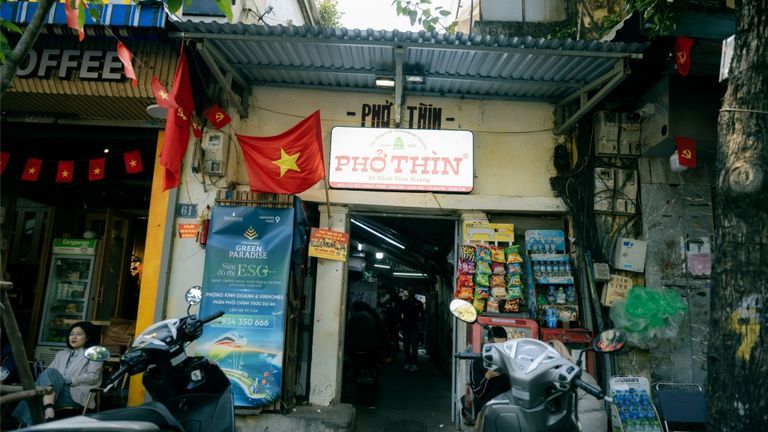
Front space of Pho Thin Bo Ho at 61 Dinh Tien Hoang. | Source: Nhu Hoan
Hanoi announced the "Van Hien (Civilization) Avenue" project to renovate the Dong Kinh Nghia Thuc Square and redesign Dinh Tien Hoang Street into a boulevard. Many familiar shopfronts and homes are being removed to make way for a new cityscape.
Among them is Pho Thin Bo Ho, a 70-year-old pho eatery inside Alley 61 on Dinh Tien Hoang Street, now facing relocation. The demolition of Pho Thin is more than a change of address; it marks the fading of a culinary icon among many Hanoian’s memories.
A place held in generations of Hanoians’ memories
The history of Pho Thin Bo Ho began around 70 years ago when Mr Bui Chi Thin, a man from Ha Tay, started selling "phở gánh" (a portable pho stall on poles) in 1955. Later that same year, a regular customer introduced Mr. Thin to a small nook in Alley 61 on Dinh Tien Hoang Street - the first store of Pho Thin Bo Ho. Over time, its reputation spread by word of mouth, drawing generations of Hanoians and visitors alike.
Although Mr. Thin's family pho restaurant is only a few square meters, just enough for a row of tables and chairs nestled against the old wall, this modest space has witnessed many ups and downs, attached to many generations of Hanoians. The old weathered sign, the worn wooden chairs inside evoke a sense of nostalgia that no modern renovation could replicate. With the city’s development and fast pace, Pho Thin acts as a pause in the city’s relentless rhythm.
"Hanoi residents have been attached to Pho Thin Bo Ho restaurant for many years, which has become a part of the capital's culinary culture. If the restaurant moves elsewhere, we will definitely lose a familiar memory," a regular customer shared that they felt regretful when the restaurant was about to relocate.
Pho Thin Bo Ho’s cooking method gives a well-balanced and light broth, made from the essence of beef bones and spices. The noodles are cooked to perfection, with the tender beef slices and other meat cuts. The herbs and condiments, such as lime, chili, and basil, enhance the overall flavor, adding a refreshing and aromatic touch. The combination creates a satisfied taste for every customer.
The new journey of Pho Thin Bo Ho
Mr. Bui Chi Thanh, third generation of Pho Thin, who is currently running the business, said that the shop is expected to officially relocate in April 2026 or at the latest by early 2027.
“I felt sad and worried since the shop is a memory-keeper of many generations. I have to think of how to maintain the economic income for the family, as well as keep the traditions that have been passed down for 70 years.” he once shared with VnExpress.
Mr. Thanh has prepared for the “disappearance” of Pho Thin Bo Ho old shop. He has just opened another location at 19 Hang Voi Street, 400 meters from the old shop. The new location has been operating for over two months, it is more spacious with two floors, more equipped and cleaner.
Modern boulevard dreams or Hanoi’s Old Quarter heritage
In Chuyện cũ Hà Nội (Old Stories of Hanoi), writer To Hoai once recalled Pho Thin Bo Ho with a detail that has since become legend. During the American bombing period, when much of the city shut down early, Mr. Thin’s shop was said to be the only place in Hanoi still serving phở late into the night. “Those who craved phở had to brave the air-raid sirens to get there,” To Hoai wrote. “Meanwhile, Mr. Thin remained unflustered, calmly lifting noodles by hand, joking in witty, metaphor-laced verses.” This small shop quietly witnessed the country’s transformations, serving a sense of continuity in uncertain times.
That intimate, human-scaled memory stands in contrast to the “Van Hien Avenue” project. While it aims to build a cultural-historical axis, Hoan Kiem Lake’s visual identity will be changed.
According to architecture Tran Tuan, the concept of a "boulevard" evokes the image of a symmetrical, grand urban spatial axis with important, symbolic landmark buildings. Yet the identity of the "Hà Nội băm sáu phố phường" (36 streets of the Old Quarter) is shaped by narrow, vibrant streets. It creates an intertwine of daily life, commerce, and community memories.
As Hanoi pushes forward with its vision of a modern cultural boulevard, the question remains: urban renewal may bring cleaner spaces, but at what cost to the city’s collective memory? The answer will show whether Hanoi can balance development with cultural continuity.