A Taste Of Vietnam, A Spirit Of Its Own: The Story Of Lady Triệu Gin
Source: Behalf Studio
On the far outskirts of Ho Chi Minh City and just a few minutes away from the infamous Cu Chi Tunnels, there is a place of magic that distills spirits for the world. The distillery specializes in several types of gin, two vodka expressions, and a white rum. One sip at a time, these spirits are showing the world how Vietnam is adding value to the country’s immense agricultural bounty.
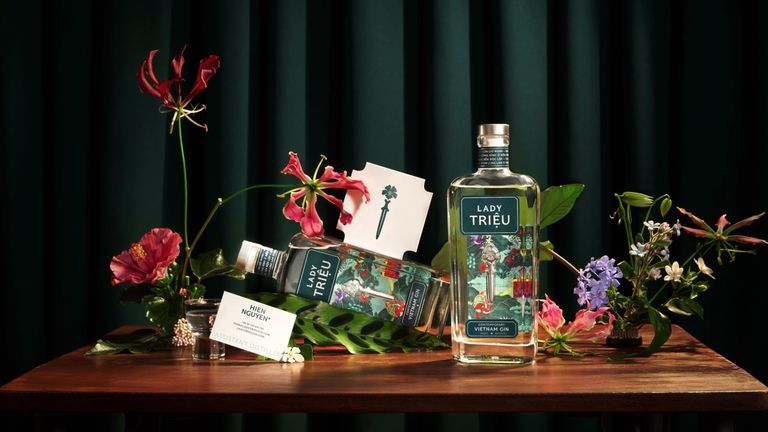
Lady Triệu Gin is named after Triệu Thị Trinh, a heroine who led a Vietnamese rebellion against the Chinese during its Three Kingdoms Era in 248. At the time, she was just 23 years old. Like her female predecessors the Trung sisters more than 200 years earlier, Bà Triệu (Lady Triệu) was a symbol of resistance against foreign rule and a model of female courage in the face of overwhelming odds. This spirit of courage and discovery continues to this day.
“We wanted to create spirits that are rooted in the country and give people a reason to discover more about it. The story of Lady Triệu, the Vietnamese warrior, is an important part of that identity,” says Eve Manne, the general manager of Trieu Brand Collective, noting that the collective’s entire product line is made from Vietnamese agricultural products.
I learned about this award-winning distillery on a recent trip to the distillery. I had the good fortune to ride with Javin Chia, the distillery master of the spirits. Javin is a Singaporean who has been creating magic at the Cu Chi distillery for the past three years. He’s a true F&B guy. After a stint at culinary school in Singapore, he studied distilling in Scotland. Upon his return to Singapore, he produced the country’s first ever single malt whiskey before being recruited to distill spirits in Vietnam.
When visitors enter the distillery, they are welcomed with a refreshing gin and tonic on ice. There is a large copper still for the distillation process and numerous large tanks which contain the spirits that eventually make their way to the bottling and labeling line. Javin seems most at home in one of two rooms at the distillery.
The first is the botanical room where numerous large bags and jars of Vietnam’s agriculture bounty are in dry storage and awaiting inclusion in the distillation process.
The second room is the research and development lab where there is a constant process of testing, refining, and testing again the concoctions that may end up in a Lady Triệu bottle in the future.
So far, the distillery produces seven Lady Triệu gins plus two more limited edition gins created for Ănăn Saigon restaurant and the Sofitel Legend Metropole in Hanoi, two expressions of Nhậu Vodka of which one is pandan flavored, and Firetail Rum, which is 100 percent sugarcane-based, made from a mix of fresh sugarcane juice and molasses.
“There is no guarantee of success for any product which enters the market, but the best thing we can do as distillers is to listen, meet bartenders, bar owners, and especially drinkers. We ask them what they want. After that, it’s a matter of crafting a high-quality product which meets and exceeds their expectations,” said Javin, adding that ultimately it comes down to taste.
“Without a doubt, the best part of my job is the opportunity to explore and experiment with new botanicals and flavors, followed closely by watching someone enjoy a drink we crafted,” he told me while explaining what was in the several small glasses that he offered me to taste test in the R&D lab.
A large portion of Javin’s time in the Cu Chi facility is thinking up new creations and new mixes that might turn into something tasty. Ginger? Sure, but how much. Oranges? Yes, but the peel only or the peel and the fruit? Cinnamon? Definitely, but again in what portions and how should the cinnamon sticks be cured and processed before being included in the copper pot still.
Across the spirits range, there is just one ingredient that is imported. This is juniper berries needed for Gin, which does not grow in sufficient quantities in Vietnam. The distillery imports the juniper berries from Tuscany Italy.
The other botanicals come from all corners of Vietnam and are stored in big burlap bags and medium to small-sized jars in the botanical room. The room is a cacophony of smells. Some ingredients used across the spirits range, such as sugarcane and pandan, grow within a couple hundred meters of the distillery.
The gin itself, as well as the vodka, is rice-based. The rum is made from a mix of fresh sugarcane juice and molasses, which undergoes fermentation before distillation. For the gin, botanicals give each expression its character through distillation. The pandan vodka involves distillation and infusion with fresh pandan leaves and young rice. The end products are distributed throughout Vietnam and in several foreign markets. Considering Vietnam’s immense agricultural wealth, there are a lot of botanical options for Javin to choose from.
“We always do our utmost to ensure Vietnam’s produce is at the core of Lady Triệu gin, with Vietnamese rice being at the core of our spirit, and Vietnamese botanicals, except for juniper, being used exclusively in our gins,” says Javin.
“We work closely with our botanical suppliers, who work tirelessly to procure new and exciting botanicals for us to use. My team will even bring in herbs and spices from their own family gardens, allowing us a unique insight into the cornucopia that Vietnam provides.”
Trieu Brand Collective, the owner of Lady Triệu Gin, Nhậu Vodka, and Firetail Rum, distributes its products across the Asia-Pacific, the United States, and is currently developing the Canadian market, with online shopping also available in Europe and the UK.
It also works with local restaurateurs to host pairings of high-quality Vietnamese food with its own high-quality spirits. The food and spirit tastings offer a choice of multiple gins, a new rum product, and an appropriately named vodka product called Nhậu, the Vietnamese word for friends celebrating by having drinks and sharing food together.
This writer was fortunate, and grateful, to be invited to a special cocktail pairing experience between the Michelin-starred chef Peter Cuong Franklin and Lady Triệu. Peter is the owner and head chef of Pot Au Pho 2.0. and Ănăn Saigon, the latter is the first restaurant in Ho Chi Minh City to earn a Michelin star.
For the cocktail pairing event, Peter and his Pot Au Pho 2.0. team prepared a three-course tasting menu that featured seven exceptional dishes. Each course was paired with different cocktails made with Lady Triệu Gin, Nhậu Vodka, and Firetail Rum. In a word, the pairings were fantastic. My personal favorite was the Lobster Bun Rieu paired with a Pink Snapper cocktail that was made from Lady Triệu Ănăn Phở Gin, tomato, and tương ớt chili sauce.
“Our collaboration with Michelin-starred chef Peter Cuong Franklin is a good example of what can happen when we bring different areas of expertise together,” says Eve and adds. “For me, it is about exchanging ideas, creating something original, and helping people discover another side of Vietnam.”
My Nhậu drinking partners, meaning the people I was sitting next to at the pairing event, helped me discover some new sides of Vietnam even though I have been living and working in Vietnam for 20 years, the past six years as a full-time writer. The guy on my left was a fashion designer. The people sitting across from me were travel writers. The couple on my right were editors and publishers for a European magazine. There was a hipster DJ and it seemed that everyone in the room easily conversed in a combination of English and Vietnamese. This is part of the New Generation of a New Vietnam.
It was a refreshing change of pace and venue for this writer who is more used to telling Vietnam’s business development story which tends to focus on the country’s growing market and manufacturing prowess. It doesn’t focus too much on its creativity and ingenuity which definitely exists and is growing. The “good at making cheap products” label is a perception that Vietnam has duly earned, but one that it can also hopefully begin to shed as more creative types enter the market. More cocktails pairings will help.
“I think Vietnam’s image is evolving across the board, not just in manufacturing. Vietnamese artists are attracting attention at international auctions, actors and filmmakers are gaining recognition abroad, and brands like Công Trí and Marou Chocolate are showing that we can create products with their own identity and compete internationally,” claims Eve noting that changing perceptions takes time.
“We need to move beyond being known for making products for others and become better known for creating our own,” says Eve about Vietnam. Lady Triệu is doing its part.
As a business writer, I could not agree more. The likes of Marou Chocolate, numerous coffee brands, and the spirits from Trieu Brand Collective are a good start to the building of the Vietnam brand.
Cheers to all for a tasty and creative future.
Enjoy responsibly. 18+.
Please do not share this content with anyone under the age of 18.