Bright Paint, Mixed Reactions: The Debate Over Ho Chi Minh City’s Tet Makeover
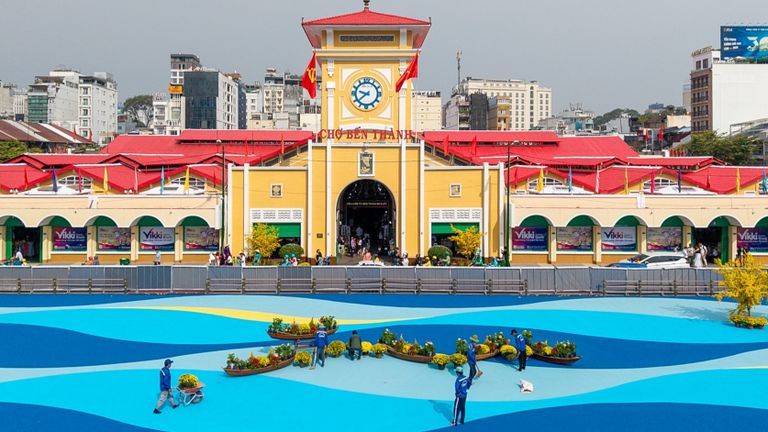
A look at Ben Thanh Market and the surrounding square after renovation. | Source: VietNamNet
In January 2026, several iconic landmarks in Ho Chi Minh City took on a new look. Ben Thanh Market, one of the city's symbols, was repainted with a bright red roof, while Turtle Lake - a popular gathering place in the city- appeared in fresh turquoise instead of its former grey.
These are two of the seven projects under the city’s renovation for Tet 2026. They are fully implemented by a private company and supervised by the Ho Chi Minh City Department of Construction. Although the official handover date is February 10, images of the sites have already sparked mixed public reactions.
The visible shift which emphasises preservation
The renovation plan was approved by the Chairman of the Ho Chi Minh City People’s Committee. Seven locations to upgrade include Ben Thanh Market and its surrounding square, the Phu Dong six-way intersection, Turtle Lake, as well as building on major streets such as Nguyen Hue, Dong Khoi, Ham Nghi and Hai Ba Trung.
According to the approved plan, historical sites such as Ben Thanh Market and the Railway Head Office (on Ham Nghi Street) were to be renovated with an emphasis on preservation. While exterior surfaces would be repainted, the original architectural structures and colour schemes were intended to be retained, alongside cleaning damaged details.
Ben Thanh Market
At Ben Thanh Market, the contrast between before and after was immediately apparent. While the renovation retained the market’s overall structure, the previously roof has been repainted a bright red, and the surrounding square redesigned with ocean-themed colours, prompting many residents to pause and look.
Turtle Lake
Turtle Lake was originally finished in washed stone, giving a consistent tone with the modernist design when it was first built in the 1960s. The renovation focused on repainting the structure in brighter tones, combined with sidewalk cleaning and additional tree planting.
The contrast between the new turquoise finish and the site’s previous appearance became a focal point of online discussion.
Along central thoroughfares such as Nguyen Hue, Dong Khoi, Hai Ba Trung and Ham Nghi, selected building facades were scheduled to be repainted, road markings refreshed, and curbs and concrete sidewalks restored, which was intended to create a more uniform and refreshed streetscape ahead of Tet.
The line between urban renovation and urban memories
The renovation of symbolic landmarks has triggered strong public attention. By February 2, Ho Chi Minh City announced it would pause the projects amid growing backlash.
Later in the same day, the city’s Department of Planning and Architecture and the Department of Construction stated that upgrades at iconic landmarks such as Ben Thanh Market and Turtle Lake were carried out in the right direction. The departments also said the renovation helped make the city centre cleaner and more visually appealing, attracting residents to visit and take photos.
However, this statement leaves open questions about how preservation is defined in practice.
Even though most of these sites have not been officially recognised as heritage, experts say such abrupt changes can easily clash with “urban memory” that has long been embedded in the memories of generations born and raised in Ho Chi Minh City.
According to Professor Nguyen Xuan Tien, Chairman of the Ho Chi Minh City Fine Arts Association, renovations of iconic sites should clearly distinguish between basic maintenance and full restoration, and avoid “updating” landmarks based on current aesthetic tastes.
He added with VnExpress that the colours of heritage sites should be carefully chosen, not arbitrary. Historical records show that Ben Thanh Market’s roof originally carried a muted reddish-brown tone, rather than bright red. Even a slight shift in colour, he said, can make a landmark feel out of place, disrupting the visual memory long associated with the city
Professor Nguyen Xuan Tien also noted that roles and responsibilities must be clearly defined when renovating symbolic sites. Any intervention in such spaces, regardless of whether it is labelled as “renovation”, must be carried out by authorities with proper functions and specifications. The absence of a clear “gatekeeper” increases the risk of heritage being altered for the sake of speed or novelty, at the cost of losing the original character.