Can Bicycles Become Vietnam’s Next Urban Transport Solution?
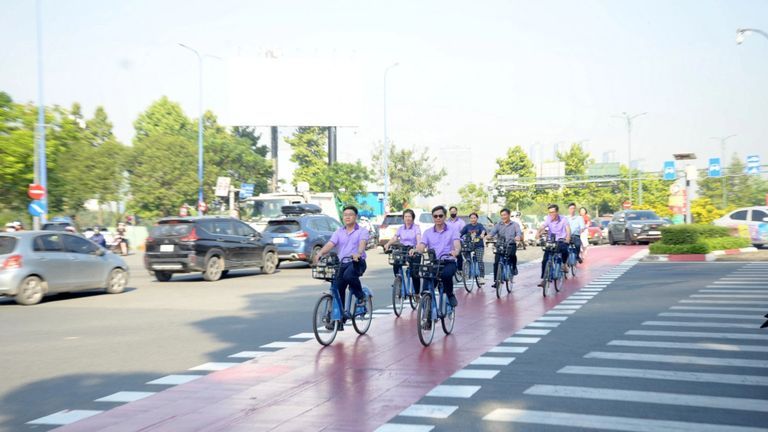
The new bicycle lane in Ho Chi Minh City. | Source: Thanh Nien
Ho Chi Minh City has established a new dedicated bicycle lane, with a total investment of VND 13 billion (approximately $495,000). The lanes are 5.8 kilometres long and 2 meters wide, located along Mai Chi Tho Street (formerly District 2). They are marked with red paint and positioned at the pedestrian walkway and the motorbike lane on this road.
In 2021, Ho Chi Minh City had already introduced a public bike-sharing system across central streets of Le Loi, Dong Khoi, Nguyen Hue… in Saigon Ward (formerly District 1). Hanoi shared a similar path: the capital of Vietnam introduced public bike facilities in 2023, followed by a 4 kilometers-lane for bicycles along To Lich River in 2024.
The move reflects a growing interest in cycling as an urban transport option. However, the key question is not whether bicycles can replace motorbikes in Vietnam’s largest cities, but what role cycling can realistically play in a traffic landscape long dominated by motorized vehicles.
Bicycle as part of the urban transformation
Being a low-cost, environmentally friendly mode of transport, bicycles have undergone a shift in meaning. Once dominated Vietnam’s streets in the 1970s and 1980s, bicycles served as the primary means of transport for students and working-class families. Today, cycling is reframed as a conscious choice for urban residents, as research pointed out, it is linked to personal well-being, fitness, and environmental awareness.
Many countries around the world have integrated bicycles into their transport systems to take advantage of their environmental benefits. In the Netherlands, there are more bicycles than people, with around 23 million bicycles compared to a population of 17 million. About 36% of the Dutch use bicycles as their primary means of transportation, whereas only around 1% of Vietnamese cycle or walk as part of their daily routine.
As part of efforts to reduce air pollution and align with Vietnam’s net-zero target by 2050, both Hanoi and Ho Chi Minh City set plans to increase the use of bicycles, besides increasing electric vehicles, and restricting gas-powered transportation.
Under the proposed vehicle emissions control plan for the 2026–2030 period, Ho Chi Minh City aims to deploy at least 8,000 public bicycles citywide, alongside measures to restrict the circulation of gas vehicles. In the initial phase, around 5,000 bicycles will be deployed in key areas such as Vietnam National University–Ho Chi Minh City, the Thu Thiem Urban Area, and along metro corridors.
On December 31, 2025, the first bicycle lane in Ho Chi Minh City was launched. Located on Mai Chi Tho Street, this lane links several modern residential neighbourhoods such as Sala, New City, and The Sun Avenue. The city has outlined plans to extend its bicycle lane network to link commercial hubs, office complexes, parks, and sites of historical significance, alongside improved integration with public transport and parking infrastructure.
Meanwhile, under the 2024 Capital Law, Hanoi has prioritized resources and land allocation for transit-oriented development (TOD), in which bicycles are identified as a key component of the urban mobility framework.
Since August 2023, the capital city has operated a public bicycle system with more than 1,000 bicycles at 79 stations, attracting over 833,000 registered users and an average of nearly 700 new users each day.
From infrastructure to everyday use
While new infrastructure often sparks initial curiosity, isolated lanes that are disconnected from daily travel networks struggle to attract sustained use.
Rebecca Morgan, a regular cyclist living in the Thao Dien area, told Vietcetera that the new bike lane on Mai Chi Tho Street is not attractive enough for those who cycle regularly.
“I think they need to at least make it 20 kilometres, connect from An Phu to (old) District 1, so it will attract cyclists like me, who usually travel far more per ride. We will also be able to travel to work. Just merely 6 kilometers is not enough,” she said.
These concerns point to a broader challenge facing cycling initiatives in Vietnam’s major cities. Launched in 2024, the 4-kilometre bicycle lanes along To Lich rivers are expected to serve as a model for integrating cycling into Hanoi’s transport system. Yet, after 2 years, the lanes are now only seen with trash and relatively low traffic.
A similar pattern can be seen in Ho Chi Minh City’s public bicycle system. In the first six months of 2025, the system only recorded around 37,000 active users—a tenfold decline compared to its first year of operation in 2021.
The future of urban cycling
To make cycling more accessible and possible in the city, there are a range of barriers. Rebecca Morgan said that the weather and the existing transportation system often prevent her from cycling more frequently in the city.
“The hot and humid climate makes long rides uncomfortable; people can sweat heavily or get sunburned while cycling. To encourage more people to ride, I think shower facilities should be installed widely and made easily accessible,” - she added.
While bike-friendly countries like the Netherlands have built extensive cycling infrastructure, with a network of more than 35,000 kilometers of bike lanes integrated into public transport systems and urban amenities, Vietnam remains at a much earlier stage, as its urban landscape was not designed for widespread cycling.
“In Hanoi, many streets are narrow, averaging only 7 to 11 meters, leaving little room for dedicated bicycle lanes. Even on wider roads, the heavy flow of motorized vehicles can make cycling feel intimidating, discouraging people from taking to bicycle” said transportation expert Nguyen Xuan Thuy to Thanh Nien.
Making this vision a reality requires a complete bicycle network that connects lanes with key hubs - public transport stations, residential areas, and parks - and includes cyclist-friendly facilities, allowing cycling to become a seamless part of the urban transport system rather than just a collection of standalone lane.