Chef Nguyễn Kim Quý: “Technique Can Make A Dish Better, But Identity Is What Makes People Remember It”
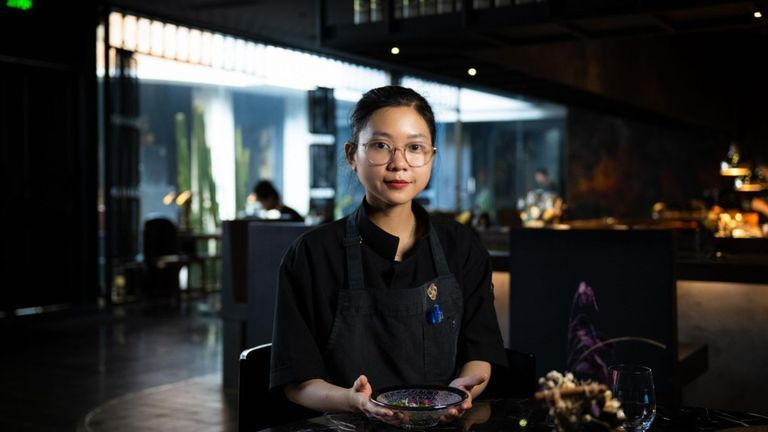
Chef Nguyễn Kim Quý - Runner-up of Rising Chef Challenge 2023. | Source: Khooa Nguyễn for Vietcetera
This wasn't meant to be another conversation about recipes or cooking techniques. Sitting across from Nguyễn Kim Quý, I found myself asking a different question instead: why would someone in their early twenties choose to spend their youth in a professional kitchen?
Quý was just 22 when she became the runner-up of Rising Chef Challenge 2023. Three years later, as the competition returns, we meet again - this time in the same kitchen where she has continued to sharpen her craft since the contest ended.
1. Hi, Kim Quý. You've achieved some remarkable milestones at a young age - becoming Demi Chef de Partie at CoCo Dining by 25 and finishing as the runner-up of Rising Chef Challenge at just 22. When did your passion for cooking begin?
People often assume that careers requiring patience and precision begin with a lifelong calling or a childhood passion. My story is much simpler than that.
When I was 18, while my friends were busy deciding which university to apply to, I just thought: “Why not give cooking a try?”
So that's how it started - with nothing more than curiosity.
It wasn't until I graduated three years later as the salutatorian of my faculty that I realized: curiosity had quietly grown into something much deeper. Every day in the kitchen made me want to learn more, to pay closer attention to the smallest details, to refine my craft, and ultimately, to create dishes that leave a meaningful impression on the people who enjoy them.
I'm 25 now. People can say, “You're still so young.” They're right - I am. That's exactly why I don't want to get comfortable with what I've achieved so far.
What I can say with confidence, though, is that cooking has become part of who I am. I've experienced pressure, setbacks and countless small moments of joy in the kitchen. Looking back, they all feel like ingredients in the same dish - each one shaping me and pushing me to keep moving forward.
2. Your story sounds like a journey filled with excitement, achievement and plenty of challenges along the way. What were some of the biggest obstacles you faced when you first started?
People often say that a good start makes everything easier. Mine was anything but.
When I first enrolled in culinary class, I knew almost nothing about cooking. I didn't even know the proper way to hold a knife or prepare ingredients. On top of that, my parents weren't supportive of my decision. As a woman, they worried that working long hours in a hot, demanding kitchen would be too physically exhausting.
There was another misconception I had to confront. Like many people, my parents believed that being a chef simply meant cooking in the kitchen, with little room to grow beyond that. After a few years of studying and working, I realized the profession demands much more. To build a long-term career, I've had to keep learning - not just about food, but also about culture, critical thinking and leadership.
3. Has there ever been a comfort zone in your career? And how have you challenged yourself to move beyond it?
Absolutely.
Early on, I tended to rely on established rules. I'd assume that a dish had to be prepared in a certain way or that what I learned in school was the only right approach.
The more I learned and the more kitchens I experienced, the more I realized there is rarely just one correct answer. Every chef brings a different perspective and a different way of solving the same problem. Embracing that has helped me move beyond those early limitations and stay open to constant learning.
What makes this profession so fascinating, though, is that there's no universal definition of what tastes “good.”
If cooking is an art, then every chef is an artist with a distinct perspective and style. Diners are no different. Some appreciate the authenticity of tradition, while others are drawn to bold, contemporary interpretations. A dish that resonates deeply with one person may leave another completely unmoved.
That's why every new kitchen, every new cuisine and every new style feels like starting from zero. It means learning to listen, adapt and continually reinvent yourself.
4. What led you to join Rising Chef Challenge 2023? Looking back, how did the experience change the way you see yourself and your profession?
I had only recently graduated and had just started working at CoCo Dining when I decided to enter the competition. At the time, I felt there was still so much I didn't know and so much I wanted to learn.
People sometimes ask if I joined because of the prize money. The answer is no - although I have to admit, the prizes were pretty attractive. (Laughs.) What I was really looking for was the chance to meet other chefs, observe how they worked, how they thought and how they carried themselves in a professional competition. Because I was not fixated on the outcome, I was able to enjoy the experience without putting too much pressure on myself.
The biggest change after the competition was visibility. More people came to know my work, and I found myself becoming more confident. I stopped worrying so much about making mistakes and moved beyond the mindset of simply completing the tasks assigned to me.
One lesson from the Rising Chef Challenge continues to shape the way I work today: preparation is everything. In my experience, it accounts for almost 90% of a dish's success. Diners may spend only a few minutes enjoying a plate, but those few minutes are made possible by dozens of hours of preparation behind the scenes.
5. How has your perspective on regional identity and Vietnamese cuisine evolved since Rising Chef Challenge?
When I first joined Rising Chef Challenge, I mainly viewed regional identity through the lens of local ingredients and signature dishes from different parts of Vietnam. At the time, I believed that incorporating these elements into contemporary cuisine was a way to tell Vietnam's story.
After several years working at CoCo under the guidance of Chef Vương and Chef Chí, my perspective has changed. I’ve come to realize that identity is not only found in ingredients or recipes, it also lies in the mindset, culture and ways of thinking that shape how Vietnamese people create flavors.
For example, the role of rice in our culture, the importance of fish sauce, the way we balance different tastes, or how we make use of ingredients in everyday cooking - these are the deeper values that define Vietnamese cuisine.
I also believe that for Vietnamese food to reach a global audience, we don't need to simply replicate what others are doing. What matters is understanding our own heritage deeply and finding a contemporary language to share those stories, so people around the world can connect with and appreciate them.
6. Since we're talking about creativity, modern cuisine today has been constantly reinterpreted to reflect contemporary tastes. However, some argue that these transformations can sometimes take away from the original meaning of a dish. Where do you think creativity in cooking should draw the line?
To me, creativity isn't about changing something just for the sake of being different. It's about making a dish more meaningful. And before you can break a rule, you first need to understand why that rule exists.
For example, when my team and I researched Vietnam’s wet-rice civilization and the techniques behind fermented shrimp paste for our “Lưu Tích” menu, we realized that some dishes are the ones that shaped our childhood, while others are the ones we create today to shape the future.
That is also how my team and I approach our work. When developing a menu, we spend a great deal of time researching Vietnam’s wet-rice civilization, traditional fermentation techniques, and the ways Vietnamese people make fish sauce, fermented shrimp paste and other staples.
Only after understanding those foundations do we begin asking: how can we retell these stories in a new way? The presentation may change, and the techniques may evolve, but the roots and spirit of the dish should always remain.
7. Rising Chef Challenge returns this year with the themes “The Dish That Made You” and “The Dish That Makes You.” What do these themes mean to you?
“The Dish That Made You” represents the dishes that have shaped who I am. It could be the meals my mother cooked every day, the rice I grew up eating, the bowl of fish sauce on a family table, or the familiar flavors that define Vietnamese cuisine. These seemingly simple things became the foundation that helped me develop a deeper love and understanding of food as I grew older.
“The Dish That Makes You” reflects the person I am today. After years of working in the industry and competing, I no longer want to create dishes that are simply delicious. I want my food to tell a story - to showcase the identity of Vietnamese ingredients and the cultural values I believe in.
To me, these two ideas cannot be separated. The dishes that were part of my childhood are what shaped me into the chef I am today. And it is from those memories and flavors that I continue to create dishes with my own perspective and identity.
8. Finally, what message would you like to share with young chefs who are considering joining Rising Chef Challenge 2026?
To anyone who is thinking about joining the Rising Chef Challenge, I would say: don’t wait until you feel good enough or perfect before applying. Because when I joined, honestly, I didn’t have much either. (Laughs.)
Looking back, the most valuable thing I gained wasn’t the runner-up title. It was the growth that came from having the courage to step outside my comfort zone. The competition gave me the chance to meet many people, learn from different perspectives and better understand the kind of chef I want to become.
I also still carry with me something my mentor once told me: technique can make a dish better, but identity is what makes people remember it. That idea continues to guide the way I approach my craft today.
I believe the future of Vietnamese cuisine does not lie in trying to replicate what the world is already doing. Instead, it comes from learning advanced techniques while telling Vietnam’s story through the ingredients, culture and values that make us unique.
I hope Rising Chef Challenge 2026 will be a place where you can bring your own stories and identities to the table. Don’t be afraid to try, because sometimes taking that first step can lead you somewhere far beyond what you ever expected.
Rising Chefs Challenge is part of Flavors Vietnam 2026. This year's competition is co-organized by , bringing new culinary experiences while continuing to celebrate Vietnam's vibrant F&B culture.
Applications are open from 12 July to 2 August 2026.
Learn more about the competition and apply here.
Grand Finale
Date: 18 September 2026
Venue: Saigontourist Hospitality College, Ho Chi Minh City