Chef Sakal Phoeung: True Fusion Cuisine Means 1 Plus 1 Equals 1
Source: Khooa Nguyen
The modern culinary world is witnessing an explosion of the "Fusion" concept. It is easy to find menus claiming to offer cross-cultural experiences simply by placing Eastern and Western ingredients on the same plate. Yet, beneath this glamorous facade, the line between a culinary masterpiece and a chaotic mix (Con-fusion) is incredibly thin.
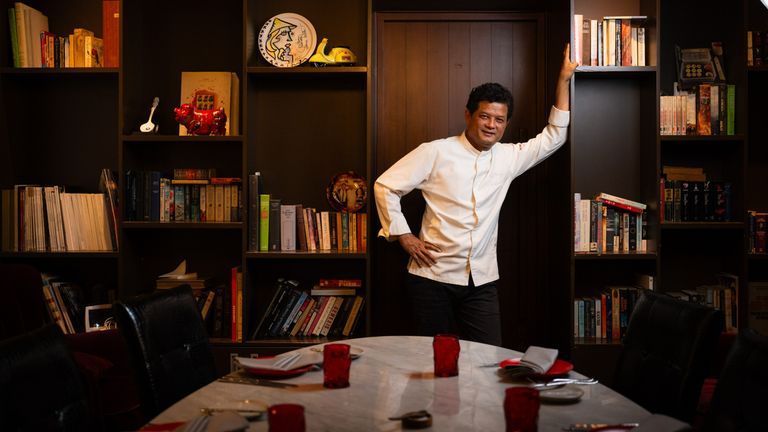
To decode this puzzle, no one is more suited than Chef Sakal Phoeung – who was recently crowned Chef of the Year at the Flavors Awards 2026. Carrying Asian roots from his early childhood in Cambodia, forged by nearly two decades of academic culinary training and the refined French palate of his youth, and ultimately spending over twenty years intertwined with the vibrant rhythm of Vietnam, he can be likened to a perfect "Fusion masterpiece" of a well-traveled life.
According to the President of the Escoffier Vietnam Association, reaching the zenith of Fusion cuisine requires hands guided by profound empathy, where culinary techniques, personal memories, and an intimate understanding of ingredients must harmonize to the point where
1 plus 1 equals 1.
If you had to use three words to describe yourself, which would you choose?
I think they would be: Passion, Tenacity, and Creativity.
Do these three words correspond to the three pieces that make up who you are: one part in Cambodia, one part in France, and one part in Vietnam?
Exactly. What exists within me today is the result of a mixed culture. I was born in Cambodia but left at the age of 7 to grow up in France with an adopted French family. That is why I carry French culture and taste; my family regularly cooked French dishes.
But deep down in my roots, I still retain the lingering flavors of Asia. Up to now, in my 50s, I spent my first 7 to 15 years in France, but I have lived in Vietnam the longest – nearly 20 years. This blend creates a harmonious whole, and today, I can truly consider Ho Chi Minh City my real hometown.
Traveling helped me rediscover the flavors of my memories.
How have these flavors helped you rediscover your memories?
My initial foundation stems from culinary school and working alongside French chefs. That is the technical core. But it was my travels to Vietnam, Thailand, China, and returning to Cambodia that helped me "rediscover" myself. I found the flavors that belong to my memory.
Even now, when I visit the countryside or walk through local markets, I sometimes come across fruits or herbs whose names or shapes I can't quite recall. But the moment I taste them, memories instantly rush back. I remember eating this when I was a boy in Cambodia. The same goes for street food; I remember dipping bread in condensed milk as a child. When I came to Vietnam and saw that familiar sight again, I was like, "Wow, I remember this flavor from when I was 5 or 7 years old." These memories, though simple, are absolutely wonderful.
It seems your entire career is a journey to trace back your roots. In your opinion, what is the biggest difference in taste between Cambodia, France, and Vietnam?
This is very interesting. Before coming to Vietnam, because I grew up in a mountainous region deeply rooted in traditional French culture with cheese, wine, and sausages, I rarely paid attention to the cuisines of other countries, especially in Asia. I knew Asian food was delicious, but I had never really studied it deeply.
It was only upon arriving here that I realized Vietnamese and Cambodian cuisines share a profound intersection with the French colonial legacy. In Saigon or Phnom Penh, you can easily find baguettes, various cold cuts, pâté, or Laughing Cow cheese. The culture of eating sandwiches (bánh mì) is a distinct characteristic with French undertones, yet it has been molded to suit local tastes.
Even though I have Asian blood but grew up with French culture, when enjoying these dishes here, I realized we are not far apart at all. Our culinary cultures are truly intertwined.
For me, Fusion is the most complex realm of gastronomy.
You just mentioned "cross-culture." Do you think Bánh mì is a prime example of Fusion cuisine in Vietnam?
Personally, I don't think Bánh mì is Fusion. It is a "combination" of multicultural ingredients.
We need to clearly define the boundaries. Many people still confuse the concept of Fusion. When you combine ingredients together, the equation is 1 + 1 = 2. You take a French baguette, add pâté, cold cuts, cilantro... they form a new recipe, but the ingredients still retain their original essence. That is a cultural intersection, a cumulative addition.
Fusion, to me, is a more complex realm: 1 + 1 = 1. It means you must harmonize disparate elements together to create a completely new result, a singular entity with a distinct flavor and story.
The boundary between Fusion and Con-fusion is incredibly thin.
So, if we merely place separate ingredients next to each other on a plate, it’s hard to call it Fusion. I wonder, what is the true boundary between Fusion (intersection) and Con-fusion (chaotic mix)?
That boundary is incredibly thin. To create Fusion cuisine, it is paramount that you truly understand both cultures and the roots of the flavors.
If you pick up an ingredient just because it looks exotic without understanding its culture, origin, and flavor profile, you will create a highly chaotic "Con-fusion" dish. The ultimate goal of a dish is not just to fill the stomach, but to leave a lingering sensation in the diner's mind after 1, 2, or 3 months.
If you can bring that level of ecstasy to the diner, you win. If the dish falls flat or tastes bizarre simply because you forced clashing flavors together, you have failed.
Palate is shaped by childhood culture – Asians are used to rich fish sauce, while the French are accustomed to creamy richness. However, the palate evolves. As a child, I hated tomatoes and salads, but now I love them. The mission of Fusion is to facilitate that taste evolution for the customer.
I used to ask myself, can I do Fusion?
Do you remember the first time you experienced and decided to cook a Fusion dish?
That used to be a big question for me. When I left France for Vietnam (my first time living abroad), I asked myself: "Can I do Fusion?" Around 2001-2002, I dined at a restaurant run by an American chef at the Caravelle Hotel. His food was strange but highly creative. That experience pushed me: "Why not? This is an opportunity to create new flavors."
I started step by step. First, by applying French techniques to cook local ingredients. Then, I set out to find harmony between local spices and European ingredients. I realized that Asian diners don't prefer overly rich or heavy dishes. Thanks to the abundant and refreshing ingredients in Vietnam, I was able to create Fusion dishes that retained a robust flavor profile while remaining incredibly light and delicate.
I believe anyone can cook, but does that hold true for Fusion cuisine?
Anyone can cook, but creating an outstanding Fusion dish requires passion and talent. Cooking is about taking risks and forcing the brain to continuously research and experiment. Everyone can do it, but whether you succeed or not depends on the individual's acumen and creative mindset.
A Fusion dish requires knowledge, ingredients, and a story.
So how does your creative process for a Fusion dish unfold?
There must be a clear "storyline" right from the start. Based on that concept, I need to understand the ingredients deeply. I rarely incorporate an ingredient into a dish if I haven't tasted it or don't fully grasp its characteristics.
When combining Asian and European elements, I always choose components whose compatibility I am confident in. I am willing to take risks, but they must be calculated risks in terms of flavor.
A chef's line between winning and losing lies in the moment the diner begins to eat.
As an editor, I also face many risks when creating. How do the risks in the culinary profession differ from other fields?
Our risk lies in immediate and highly personal judgment. When I invite you to try the restaurant's signature dish, I am placing a bet on it. To me, it's perfect, but to your palate, it might not be.
If you enter a competition and lose, you might be sad for an hour or a day, and then move on. But dining is the joy of living. If a customer waits a long time with high hopes for a romantic dinner, only for the food to bring disappointment, that terrible memory will haunt them for a long time. Our line between winning and losing lies in the very moment the diner begins to eat. It is a massive amount of pressure, but also the motivation that keeps us constantly moving forward.
Many young chefs, wanting to make a strong impression, cram many special ingredients into a single dish. Have you ever fallen into that "Con-fusion" trap?
I never serve customers dishes that I myself am not satisfied with. The more experience I gain, the more I understand that creativity does not mean throwing everything into one pot.
Sometimes we fail during the experimentation phase, but the important thing is to recognize our limits, learn from the experience, and try again. Limits aren't there to make us give up; they are lessons challenging us to do better tomorrow.
Whether it's 5, 7, or 10 ingredients, nothing is more important than balance.
When there are too many ingredient choices, what is the "anchor" that keeps a Fusion dish on the right track?
It is like a law of physics or mathematics. You can mix 5, 7, or 10 ingredients, but everything must adhere to balance. You cannot throw salt into fish sauce because that is pointless. It's just like mixing a cocktail; it requires the perfect ratio.
At the same time, the chef must know how to communicate. A Fusion dish often features various states: cold, hot, soft, crunchy... I always instruct the waitstaff, or personally step out to explain to the customers why these components are placed together and the specific order in which they should be enjoyed to fully experience the explosion of flavors.
I used to think Fusion encompassed a lot of inspiration and emotion, but hearing you speak, it seems it also requires a lot of detailed calculation?
I believe it's a 50-50 ratio. If you cook solely based on emotion, your dish will face many risks and lack consistency. You need 50% emotion to breathe life into it and create a distinct personal touch, and 50% calculation and ingredient mastery to build a solid foundation.
Do not limit yourself, and allow yourself to fully immerse in the experience.
What advice would you give to young chefs wanting to pursue the path of Fusion cuisine?
Just be yourself. Cook what you understand and have mastered the basics of; from there, you can cross the boundary to experiment with the new. Do not venture into things you don't fully grasp, no matter how glamorous they appear on the surface.
For myself, despite having experience and traveling extensively, if someone asked me to cook a purely traditional Asian dish, I would decline because I know it is not my core strength.
Culinary fusion is like painting an artwork. That painting must lie at the intersection of minimalism and maximalism. Diners eat with their eyes first – they must look at it and go "Wow," and upon tasting, that "Wow" factor must remain intact.
Stepping out of the kitchen, how has continuously adapting to and intersecting with multiple cultures shaped your worldview and life philosophy?
I'm not sure if I am a "Fusion man," but I am someone who can adapt anywhere. I maintain my personality, but I am always open to understanding and integrating with the local culture.
The decision to stay in Vietnam, especially Ho Chi Minh City, was a major turning point. I love the people here. Here, no one judges your background. When they see you are talented and successful, they simply admire it and use it as motivation, rarely harboring the petty jealousy found in some highly competitive communities in Europe.
Food is a healing therapy.
If you were to compare yourself to a Fusion dish, what flavor profile do you think it would have?
It would definitely have the flavor of botanicals – refreshing green herbs with an element of surprise, rather than the fiery, aggressive heat of chili or ginger.
I like mystery. I want diners tasting my food to curiously ask themselves: "What is this aroma? What makes this spice so wonderful?" I am a dreamer, and I want to infuse that dreamy, gentle essence into my culinary creations, so that food truly becomes a healing remedy for all stress.
Thank you, Chef Sakal, for your fascinating insights. Wishing you and your team great health and continued success on your journey to color the landscape of Vietnam's F&B scene!