Education Is No Longer About Choosing A Program, But Architecting A Future Pathway
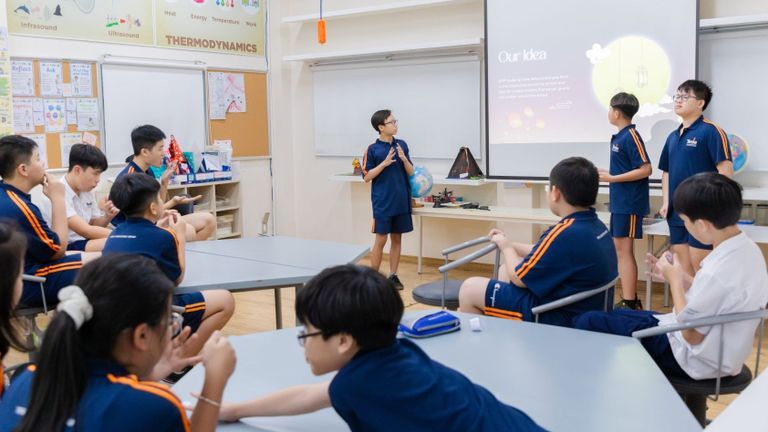
Source: Tesla
As higher education increasingly values independent thinking, research capabilities, and adaptability, the question facing many families is no longer which programme to choose, but how to design the right learning pathway. In this context, an integrated model combining the International Baccalaureate, Cambridge, and MOET is emerging as a strategic choice for Vietnamese students.
When A Single Curriculum Is No Longer Enough
For many years, the question “Which curriculum should we choose for our child?” was considered central to education planning. Yet as the world changes faster than ever, what families need is no longer just a strong programme, but a flexible learning pathway that allows students to develop a global mindset while remaining adaptable to local contexts.
From an academic perspective, the differences between international curricula are becoming increasingly clear. The International Baccalaureate (IB) is known for its educational philosophy that emphasizes critical thinking, independent research, and a global citizenship mindset. IB students are trained to ask questions, analyze issues from multiple perspectives, and connect knowledge with real-world, interdisciplinary challenges — competencies that are increasingly valued by leading universities around the world.
Cambridge, meanwhile, takes a different approach. It focuses on subject-specific depth, builds a solid foundation of academic knowledge, and prepares students for standardized academic examinations. This is an important advantage for students aiming for education systems with strong subject-based academic requirements.
Rather than placing IB and Cambridge in opposition, modern education requires a more balanced approach. IB helps students develop broad thinking and the ability to connect knowledge across disciplines, while Cambridge adds academic depth in individual subjects. The real question is not which system to choose, but how to combine the strengths of each programme into a learning pathway that offers both depth and flexibility.
At the same time, the curriculum of Vietnam’s Ministry of Education and Training (MOET) should also be viewed from a broader perspective. For many Vietnamese families, maintaining a connection with the national language, culture, and education system is not merely a legal requirement, but also a long-term strategic choice that helps students preserve flexibility across future academic options.
Two Priorities That Can No Longer Be Separated: Global Readiness And Local Flexibility
If the previous section raises the issue that a single curriculum may no longer be sufficient to prepare students for a changing world, the answer does not lie in simply “adding” more programmes. Rather, it lies in thoughtful integration, optimizing learning time, reducing unnecessary overlap, and allowing students to focus on the core competencies required by modern education: research, critical thinking, and real-world experience.
With the full IB Continuum as the backbone, supported by Cambridge and the MOET curriculum, this model enables students to develop interdisciplinary thinking, build strong subject-specific knowledge, and remain connected to their cultural identity and the national education system. In this structure, IB shapes project-based thinking, self-directed learning, and student agency; Cambridge provides academic depth across individual subjects; and MOET offers flexibility for future study options in Vietnam.
At the core of the IB framework, components such as the Extended Essay, Theory of Knowledge (TOK), and Creativity, Activity, Service (CAS) create a clear point of difference. These are not simply supplementary elements, but requirements that help students operate as independent learners from high school: asking meaningful questions, constructing arguments, conducting long-term research, and connecting learning with social experience.
The support of Cambridge IGCSE gives students a stronger foundation before entering the IB Diploma Programme — a demanding programme that requires higher levels of synthesis, analysis, and research. With solid subject knowledge in place, students are better prepared to manage the academic transition and reduce the “academic shock” that can come with more advanced stages of learning.
The third layer of support comes from MOET, which brings identity and flexibility into the model. In a context where many parents worry that international education may distance their children from the Vietnamese language or culture, MOET helps students maintain a connection with their local foundation. For international students, they may continue with the IB programme while maintaining their mother tongue or learning widely used international languages.
Through a full IB Continuum model supported by Cambridge and MOET, students no longer have to choose between “going global” and “staying connected to their roots.” Instead, they can be prepared to do both.
From “Learning to Know” To “Learning To Adapt”: The Long-Term Value Of The Right Pathway
If traditional education once focused heavily on knowledge accumulation, modern education is shifting toward a different goal: adaptability. In this context, an integrated education model is not simply the sum of three curricula, but a learning structure that helps students develop more fully in terms of thinking, academic capability, and future choices.
This difference becomes clear when looking at two development dimensions that are often treated as opposing priorities: being well-rounded and being specialized. IB helps students develop broad thinking, reasoning ability, and the capacity to view issues from multiple perspectives. Cambridge brings academic depth, helping students achieve clear mastery in individual subjects. In reality, leading universities are not looking for only one of these qualities. They increasingly value individuals who can demonstrate both independent thinking and concrete academic ability.
From the perspective of academic credentials, the value of this model becomes even clearer. Students graduate not with a single qualification, but with the potential to build a multi-layered academic profile that includes the IB Diploma, Cambridge IGCSE results, and MOET transcripts. These credentials correspond to different admission systems, from international universities to domestic higher education options. In an increasingly flexible education landscape, this is more than an advantage — it is a form of strategic insurance for students’ futures.
Another important factor lies in the quality of the school ecosystem. Schools accredited by the Council of International Schools (CIS) are not assessed solely on curriculum, but on the entire way they operate — from teaching quality and multicultural experience to standards of wellbeing, child protection, and school governance. This provides an additional layer of assurance around the environment in which students are developed.
Overall, the integrated model introduces what can be described as the “privilege of maximizing opportunity.” Students are no longer confined to a single pathway, but are prepared to actively choose the major, university, country, and education system that best fit their future. At a deeper level, the greatest value does not lie in the number of qualifications a student holds, but in the adaptability they carry with them after leaving school.
Tesla Education — A Fully Authorized IB Continuum School in Ho Chi Minh City Established in 2015, Tesla Education is among the few elite institutions in Vietnam authorized to deliver the full International Baccalaureate (IB) continuum from Kindergarten through Grade 12. The school implements a synergistic academic model integrating IB, Cambridge, and the MOET curriculum, with a strategic focus on Science, Technology, Project-Based Learning, and the holistic development of student competencies.
To expand access to this advanced integrated educational model, Tesla Education is currently offering the Academic Excellence Scholarship for Grade 10 enrollment — with financial support of up to 90% of tuition fees, valued at a maximum of VND 500 million (approx. $19,000).
Discover more at: tesla.edu.vn