In Hanoi And Ho Chi Minh City, One Square Meter Costs Nearly A Year’s Salary
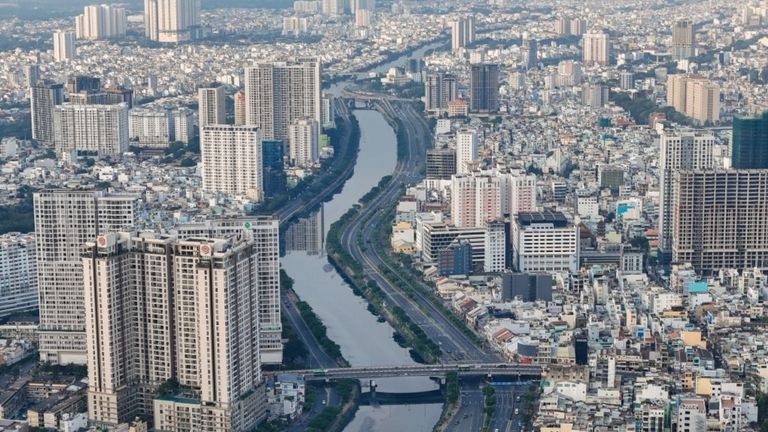
A square meter of an apartment in Vietnam is as expensive as 10 months' full salary. | Source: VnExpress
For a skilled worker in Vietnam’s two largest cities, buying just one square meter of an apartment now comes at the cost of 10 months of income. Owning a modest 50-square-meter home would require the equivalent of 41 years of earnings – assuming not a single penny is spent on food, transport, healthcare, or anything else.
In the first quarter of 2026, apartment prices in Hanoi and Ho Chi Minh City have reached around VND 100 million (USD 3800) per square meter. Meanwhile, the average monthly salary for a skilled worker stood at just VND 9.8 million (USD 377) in Hanoi and VND 9.7 million (USD 373) in Ho Chi Minh City, based on a 2025 survey by Talentnet.
As apartment prices continue to outpace wage growth and affordable housing becomes increasingly scarce, homeownership is slipping further out of reach for many urban workers.
The absence of affordable housing
In the first quarter of 2026, apartment prices in Hanoi climbed to VND 100 million (USD 3,800) per square meter, while those in Ho Chi Minh City reached VND 91 million (USD 3,500), according to data from Savills Vietnam.
The figures reflect primary-market homes – apartments offered directly by developers, before passing through any brokers, investors, or secondary buyers.
Compared with the same period in 2025, apartment prices in 2026 rose 26.5% in Hanoi and 18% in Ho Chi Minh City. According to Savills Vietnam, prices have been driven higher by a shortage of supply, with developers increasingly focused on mid- and high-end projects.
Its fourth-quarter 2025 report also found that in Ho Chi Minh City, apartments priced above VND 110 million (about USD 4,230) per square meter accounted for roughly 56% of new launches, while homes priced below VND 50 million (about USD 1,920) had shrunk to 12%.
“The pressure of affording a house is becoming harder to ignore. Affordable homes are growing increasingly scarce, while apartment prices continue to outpace income growth for ordinary residents”, said Cao Thi Thanh Huong, Associate Director of Research & S22M at Savills Ho Chi Minh City.
At the same time, Vietnam’s Ministry of Construction found that housing prices have risen by 10-15% annually, while wage growth has lagged at 6-7% a year. Over the past decade, home prices have grown at nearly twice the pace of household incomes.
Savills Vietnam also noted that mortgages are another major hurdle for homebuyers. Interest-free mortgage packages, once offered at promotional 0% rates, are gradually being replaced by fixed rates of around 9% to 10%, while floating rates can exceed 12%, placing even greater financial pressure on buyers.
Southeast Asia’s fastest-rising salary is not enough
Wages in Vietnam have increased steadily in recent years. According to Aon plc, Vietnam recorded the highest average salary growth in Southeast Asia in both 2025 and 2026, at 7.7% and 7.1% respectively, well above the regional averages of 5.4% and 5.3%. At the same time, the government has repeatedly raised the minimum wage to keep pace. From 2021 to 2026, national minimum wages climbed by about 8–10% annually.
But in a market where apartment prices can rise by more than 26% in a single year, even Southeast Asia’s fastest wage growth is proving increasingly insufficient.
According to Numbeo, the average home price in Vietnam is 30.2 times higher than the average annual household income. Among the world’s least affordable housing markets, Ho Chi Minh City ranked 10th, where property prices are 32.2 times higher than incomes, while Hanoi placed 12th at 31.1 times.
Living costs are adding another layer of strain. VTC News estimated that living alone in Hanoi requires at least VND 8 million–12 million (USD 310–460) a month, while a family may need VND 25 million–40 million (USD 960–1,540) to cover basic living expenses.
Against that backdrop, workers earning the city’s average monthly salary of just VND 9.8 million (USD 377) are often struggling simply to make ends meet, let alone save enough to own a home.
Can Vietnamese people even buy a house?
Despite surging home prices, higher interest rates, and rising living costs, homebuying demand remains strong.
According to Savills Vietnam, Ho Chi Minh City recorded around 11,500 apartment transactions in 2025, pushing the market’s absorption rate to 82%, the highest level in the past five years.
In the first quarter of 2025, apartment prices in the city also fell 10% compared to the last quarter, driven by the launch of more accessible, lower-priced units.
In Hanoi, although most new projects lie outside Ring Road 3, Savills Hanoi says they made up 70% of transactions, with absorption rates above the market average.
This suggests that housing in Hanoi and Ho Chi Minh City continues to attract affluent buyers or cash-rich investors, whose decisions are driven by the cities’ long-term growth and rapid urbanisation.
At the same time, the government has pledged to build 1 million social housing units by 2030 while gradually expanding eligibility criteria, in an effort to make homeownership more accessible to lower- and middle-income families.
Vietnam’s Ministry of Construction is also seeking government feedback on a pilot program to develop affordable commercial housing, aimed at meeting the housing needs of a broader share of the population.
Under the draft proposal, buyers or lease-to-own purchasers of affordable commercial housing must be Vietnamese individuals and may purchase only one unit directly from the developer. Buyers would also be prohibited from reselling the property for at least five years after completing full payment.
Many industry experts believe that if the policy is approved, it could bring a new wave of reasonably priced homes to the market, while prompting developers to reconsider their pricing in order to stay competitive.
However, questions remain over whether such measures will be enough to deliver meaningful change, particularly in a property market that many see as one of Vietnam’s most lucrative investment areas.
Analysts warn that any policy aimed at stabilising prices and expanding access to homeownership for ordinary buyers could just as easily be exploited for profit rather than genuine housing needs, unless backed by strict enforcement and robust oversight.
Whether those efforts can translate into homes for genuine buyers, rather than fresh opportunities for speculation, may determine whether the next generation of Vietnamese workers will still spend 40 years chasing a 50-square-meter apartment, or finally have a realistic path to owning one.