Jet Fuel Shortage Could Push Vietnam Airfares Up 70%
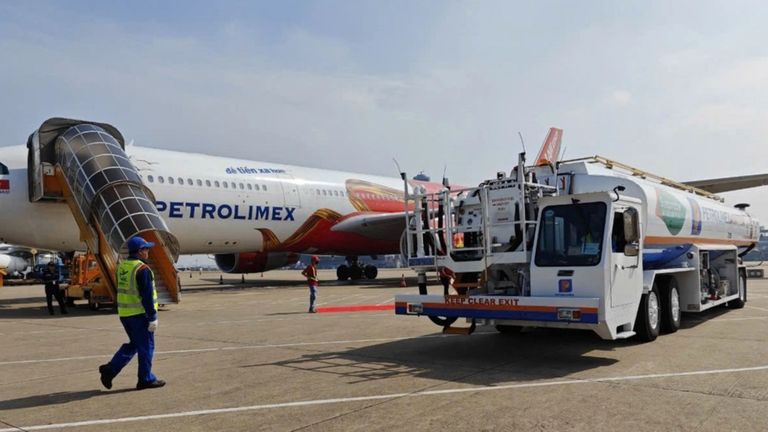
Vietnam cuts flights as fuel grows scarce amid Middle East tensions. | Source: Tuoi Tre
The global aviation industry is facing an unprecedented crisis, as fuel - accounting for roughly 35-40% of airlines’ operational costs - grows scarce amid Middle East tensions.
Vietnam is no exception. As 70-80% of its aviation fuel sourced from import, disruptions in the Middle East have constrained supply, leaving the country with limited reserves. At the same time, fuel prices have also tripled, prompting airlines to cut or reduce flight.
On March 9, the Civil Aviation Authority of Vietnam convened a meeting with relevant agencies to discuss measures to address the fuel crisis. Alongside proposals to reduce taxes and fees, other key options are adding fuel surcharges and raising the cap on airfares.
Fuel supply constrained since mid-March
Most of Vietnam’s Jet A1 aviation fuel comes from Singapore, Thailand, and China, accounting for around 70–80% of supply - according to Tran Minh Tuan, CEO of Vietnam Air Petrol Company (Skypec), one of the country’s key aviation fuel providers. The remaining 20–30% comes from domestic refineries, from the Dung Quat Oil Refinery and the Nghi Son Refinery.
However, escalating tensions in the Middle East have disrupted oil supplies, with major exporting countries either cutting back or halting shipments altogether.
More recently, China and Thailand - two of Vietnam’s largest sources of aviation fuel - have both announced a suspension of exports since mid-March, with no timeline for resumption.
Tran Minh Tuan said Skypec will ensure sufficient fuel supply through March 31, 2026, and has already ordered to meet demand for April 2026. However, he cautioned that this cannot be guaranteed, as previously signed orders may still be cancelled due to the “uncontrollable event” clauses in contract.
While major aviation fuel providers in Vietnam are still seeking alternative suppliers and are willing to accept higher prices to meet operational needs beyond April 2026, under the current situation, securing new sources remains highly challenging.
Meanwhile, domestic supply from Nghi Son Refinery and Dung Quat Oil Refinery is unlikely to ramp up Jet A1 output in the short term, as production must be balanced with other petroleum products to support broader economic activity.
Higher costs lead to flight cuts and rising airfares
The price of Jet A1 aviation fuel has tripled, compared to pre-conflict levels. This has pushed airlines’ operating costs up by 60–70%, according to Bui Minh Dang, head of the Air Transport Division at the Civil Aviation Authority of Vietnam
In response to these rising costs, both airlines and policymakers are taking action.
For carriers, the priority is to maintain operations while minimising losses. Vietnam Airlines has announced pausing operations on 7 domestic routes starting April 1, with plans to cancel 18% of the airline’s international flights and 26% of its domestic flights if fuel prices continue to rise.
Meanwhile, Vietjet Air aims to reduce its total capacity by 18% in April, while Bamboo Airways halves its flight operations, leaving only about 15–17 flights per day.
At the policy level, the Civil Aviation Authority of Vietnam has urged the government to consider a range of policy measures to support the aviation sector. This includes: tax relief on aviation fuel, VAT cuts, and a 50% reduction in aviation-related fees.
The Aviation Authority also proposed to include flexible fuel surcharges in airfares, in line with Jet A1 price fluctuations. At the same time, this authority also urged related agencies to consider adjusting the price cap on domestic routes, which is currently set at no more than VND 4,000,000 (USD $154) per one-way ticket.
Moreover, they also called for diplomatic efforts to facilitate access to fuel supplies.
On March 17, Prime Minister Pham Minh Chinh met with ambassadors from Japan, the UAE and Qatar, seeking cooperation to support Vietnam’s energy and fuel needs. In particular, he urged the Japanese government to provide Vietnam with aviation fuel, as Japan has called on the G7 to release oil reserves to boost global supply.
Flexibility is important: how travellers should book flight ticket
For travellers, the impact is likely to be immediate. Airfares may continue to rise as part of the increased costs, while reduced flight availability could limit options, particularly during peak periods.
Around the world, several airlines such as Cathay Pacific, AirAsia, and Thai Airways have announced fare increases of up to 15%.
In Vietnam, although carriers have yet to officially announce fare increases, local media have warned that ticket prices on domestic routes could rise by as much as 70%.
Market observations also show that domestic airfares have climbed rapidly. On the Ho Chi Minh City–Hanoi route, many flights no longer have an under VND 2 million (USD $76) option for a one-way ticket.
At the same time, domestic airfares for the upcoming peak holidays, such as Hung Kings' Commemoration Day and Reunification Day, are surging. Flights from Hanoi to Da Nang are now priced at around VND 3.8–5 million (USD $144-189) for a round trip, compared to the usual VND 1.4–3 million (USD $55-118).
Amid rising fares and potential flight disruptions, travellers are advised to balance early booking with flexibility.
James Noel-Beswick of Sparta Commodities and flight deal expert Scott Keyes agree that booking early is the smartest move, as fuel costs remain on an upward cycle and have yet to be fully reflected in airfares.
However, to manage the risk, passengers may want to prioritise flexible tickets that allow changes or cancellations, rather than affordable fares with restrictive conditions. As uncertainty persists, flexibility in timing, routing, and ticket conditions may prove just as important as price.