Neighbourhoods Disappear As Hanoi Pushes Ahead With 1,428 Land Clearance Projects
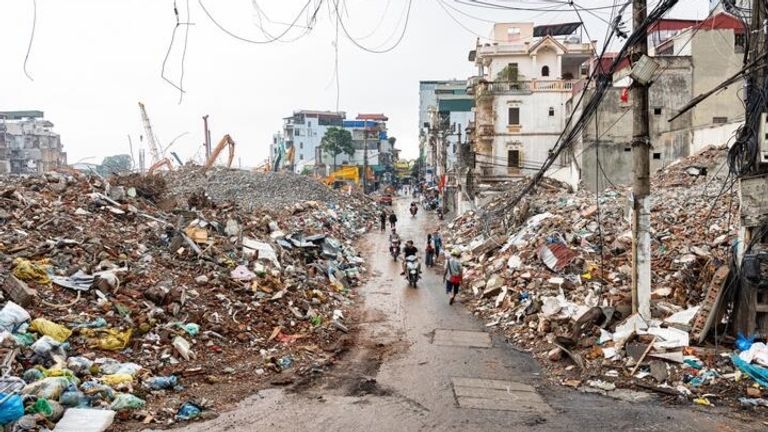
A whole neighbourhood has been demolished in Hanoi. | Source: VTC News
In May, excavators moved into Van Kiep street and Bach Dang street, the once-bustling neighbourhoods near Hoan Kiem and along the Red River, tearing down rows of houses to make way for a new bridge across the river. Within weeks, much of the area had been reduced to rubble.
This is just part of a wider wave of urban redevelopment sweeping across the capital. Across the city, neighbourhoods from Tam Trinh to Tu Lien and Thuy Khue are also disappearing.
As of May 2026, Hanoi had proceeded with land clearance on 1,428 projects. According to Vice Chairman of the Hanoi People’s Committee Truong Viet Dung, speeding up site clearance has become an “urgent and central task” as the city pushes for double-digit GRDP growth in 2026.
Why is Hanoi racing to clear land?
For years, land clearance has been one of the biggest obstacles slowing Hanoi’s infrastructure ambitions. By 2025, around 1,000 projects across the capital were reportedly stuck due to difficulties in site clearance, creating a growing backlog of delayed roads, bridges and urban developments.
Much of the slowdown has been driven by disputes over compensation, legal procedures and resettlement policies. A 2025 report by Lao Dong found that many residents believed compensation offers fell far below Hanoi’s soaring property prices, making it difficult for families to purchase equivalent housing after relocation.
Others complained that resettlement plans remained unclear or would push them to distant suburban areas, far from their jobs, schools and established communities. In many projects, unresolved complaints and prolonged negotiations have left authorities unable to secure land handovers for years.
One of the highlights is the Tam Trinh road expansion project in the former Hoang Mai District. Although the 3.6-kilometre project was approved more than a decade ago in 2012, by 2025 only around 800 metres had been completed as disputes over compensation, relocation arrangements and site clearance continued to stall construction.
Land clearance as the “central and urgent task”
In early 2026, Hanoi has accelerated land clearance as the one of the main focus, acting as the “gateway to infrastructure development, public investment, and economic growth.
In January 2026, Hanoi introduced a new set of compensation support policies aimed at accelerating land clearance, including higher compensation packages for displaced households and cash bonuses for residents who hand over sites early. The city has also offered temporary rental support of 2.5 million VND (USD 94.95) per person per month while residents await resettlement housing.
The city has also moved to tighten and standardize its land clearance framework. In April 2026, Hanoi issued Decision 40/2026/QĐ-UBND to update and unify compensation and support regulations related to site clearance. A month later, the Hanoi People’s Council approved Resolution 22/NQ-HĐND, officially publishing a list of land recovery projects across the capital.
The city has also begun setting specific clearance deadlines on major projects, with some developments required to complete land handovers on a month-by-month schedule rather than under broad annual targets.
At the same time, city leaders have repeatedly conducted on-site inspections of key transport, drainage and infrastructure projects in an effort to resolve bottlenecks directly at construction sites and accelerate stalled progress.
City officials say the push is necessary to unlock land resources and fuel economic growth. “To achieve double-digit GRDP growth in 2026, accelerating site clearance has become an urgent and central task,” Vice Chairman of the Hanoi People’s Committee Truong Viet Dung said.
As a result, many neighborhoods that had been tied up in years of land clearance disputes were demolished almost at once, in what city authorities described as a “lightning-fast” site clearance campaign.
By May 2026, Hanoi had been clearing land for 1,428 projects, including long-delayed schemes such as key ring-road sections. The Tran Hung Dao bridge project – one that was built in the bustling neighbourhoods of Van Kiep and Bach Dang – had reached 99% handover, with 324 of 326 households and organizations already agreeing to clear the site.
When a familiar parts vanishing overnight
The push reflects Hanoi’s strong determination to accelerate urban development, particularly when the capital unveiled its 100-year master plan. But for many residents, the transformation has also brought a growing sense that familiar parts of the city are vanishing overnight.
To many long-time residents, the homes being torn down are not simply pieces of real estate. They are places layered with generations of memories, family rituals and neighborhood ties. In northern Vietnamese culture, the concept of nep nha (the spirit of a household) is deeply embedded in the meaning of home. As entire neighborhoods disappear, some residents say they feel part of their personal history is vanishing with them.
Although Hanoi has raised compensation levels and introduced new support policies for displaced residents, many homeowners say the offers still fall short of the true market value of their homes, particularly given their prime inner-city location.
According to a report by Tien Phong, residents affected by the Tam Trinh road expansion project received compensation of around VND 110 million (USD 4,200) per square meter, while properties nearby listed as VND 300-400 million (USD 11,500-15,300) for a square meter. Some households with land recovery decision issued in 2019 said their compensation rates remain fixed at around VND 59 million (USD 2,260) per square meter, despite the soaring property prices in Hanoi
Disputes over compensation have long been one of the main reasons land clearance in the capital moved slowly for years. This time, however, the city appears less willing to compromise. For many long-time residents living in Hanoi’s prime inner-city neighborhoods, the speed and determination of the clearance campaign have left behind a lingering sense of loss and dislocation. What they wanted was not simply more money, but a settlement they considered fair enough to rebuild their lives.
The land clearance campaign reflects Hanoi’s determination to modernize and reshape the capital for future growth. Yet as old neighborhoods disappear and new infrastructure projects rise in their place, the transformation is also reshaping how many residents remember and experience the city they once knew, and turning parts of old Hanoi into memories.