The Sidewalks Of Hanoi: A Cultural Tapestry Beneath Our Feet
Source: Go Cheap
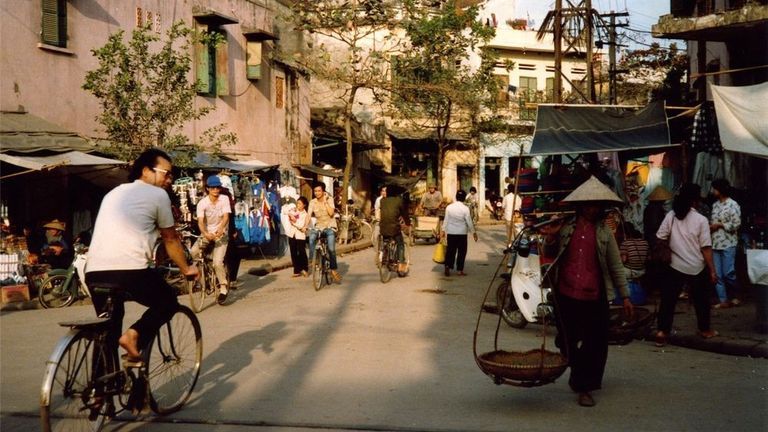
There is a peculiar kind of joy in Hanoi that isn’t found in monuments or museums, but right under your feet - on the sidewalks. These narrow strips of pavement have long been more than pedestrian paths. In Hanoi, they are playgrounds, gossip corners, makeshift kitchens, and resting places. They carry traces of colonial planning, war survival, post-war reconstruction, and everyday warmth. The sidewalk of Hanoi is where daily life unfolds, layered with memory, meaning, and the pulse of the city itself.
A product of French colonial
According to journalist Nguyen Ngoc Tien, sidewalks were not part of traditional Vietnamese urban design. Before the French colonized Hanoi in 1883, most streets were unpaved and muddy. Roads were narrow, with no formal drainage or designated pedestrian paths. According to archival writings by colonial officer Bonnal, the streets of old Hanoi were mostly tiled only in the middle, with stagnant ditches on both sides.
That changed when the French began transforming Hanoi into a colonial capital. Starting in the late 1880s, streets around Hoan Kiem Lake were expanded and paved with sidewalks, modeled after Parisian boulevards. Hang Kham street, now known as Trang Tien and Hang Khay, became the first in Hanoi to have Western-style sidewalks in 1885. Regulations soon followed: sidewalks had to be a certain width, home entrances could only rise to limited heights, and residents were required to help clean and maintain the sidewalks in front of their homes.
Early in the 20th century, these sidewalks were not merely for walking. They were leased out for commercial use. Luxury hotels around Hoan Kiem Lake opened sidewalk cafés under shaded awnings. Both French expatriates and European travelers were charmed by the idea of sipping coffee while watching the city bustle by, and later, this practice had evolved into the now-beloved sidewalk coffee culture of the locals.
From paved paths to outdoor living rooms
But Hanoi’s sidewalks didn’t just stay within the frame of French urbanism; over time, they took on a new identity. As Hanoi’s population grew, especially after major rural migration into the city in the late 20th century, the sidewalks became something of a public living room.
In the post-war era, particularly during the state subsidy period, sidewalks became survival spaces. With limited job opportunities and many state workers retiring early due to economic reforms in the late 1980s, people took to the sidewalks to make a living. Every lamppost became a workstation: bike repair shops, tea stalls, lottery vendors, and street barbers emerged overnight. As journalist Nguyen Ngoc Tien noted, a popular satirical verse from the time captured this reality: “Đầu đường thượng tá bơm xe / Giữa đường thiếu tá bán chè đậu đen” (At the street corner, a colonel pumps tires / In the middle of the street, a lieutenant sells black bean sweet soup).
For many Hanoians, the sidewalk was for the community too. Writer Do Phan recalls that in the 1960s, the sidewalks were playgrounds. Children played traditional games like o an quan (Vietnamese Mancala), nhay day (jump rope), and marbles. They bought snacks from roaming vendors: dried plums, sticky rice, sweet tofu. Older generations gathered for tea, trading neighborhood news while seated on tiny plastic stools.
Even today, food lovers will tell you that the best pho or bun dau mam tom isn't found in restaurants, but from stalls lining Hanoi’s sidewalks. The famed Pho Thin on Dinh Tien Hoang Street, for instance, often overflows onto the sidewalk with patrons, even after half a century of service. Sitting shoulder to shoulder with strangers, slurping broth while motorbikes hum past, is as essential a Hanoi experience as visiting the Temple of Literature.
Sidewalks also became emotional and symbolic spaces. During the American bombing of Hanoi in the 1960s, sidewalks became the site of air raid shelters. Circular concrete tubes were buried every few meters, ready for pedestrians to jump into when sirens blared. After the war, these sidewalks became places to gather, clean vegetables, bathe in summer heat, or cook banh chung (sticky rice cakes) for Tet.
Sidewalks of tomorrow
But as Hanoi grows, the future of sidewalk culture remains uncertain. Authorities have launched campaigns to “reclaim sidewalks for pedestrians.” There are valid reasons: chaotic traffic, sanitation, and safety. Yet this movement has sparked a debate: is the sidewalk only a utility, or is it also a cultural heritage?
Some urban experts like Associate Professor - PhD Nguyen Van Huy argue that sidewalk culture is not ancient, but a more recent phenomenon brought into the city by people from rural areas who brought their social habits into urban life. Others argue that sidewalk culture has, over time, become deeply embedded in Hanoi’s identity. As Dr. Nguyen Thi Phuong Cham notes, sidewalks are spaces of memory where people recall childhood, see life unfold, and share stories faster than newspapers.
There is no easy solution. Other cities in Thailand, Singapore, and China have implemented managed sidewalk vending zones. Hanoi might explore similar models, regulating instead of erasing. As urban planner Dinh Thi Thanh Binh suggested, perhaps part of the sidewalk can be preserved for commerce, marked with colored paint, while ensuring pedestrians still have their space.
Today’s Hanoi is a city in transformation. Sidewalk culture may shrink, shift, or reshape, but it will never truly vanish. It lives on in every Hanoian’s memory of a time when the city was close enough to touch from the curbside.